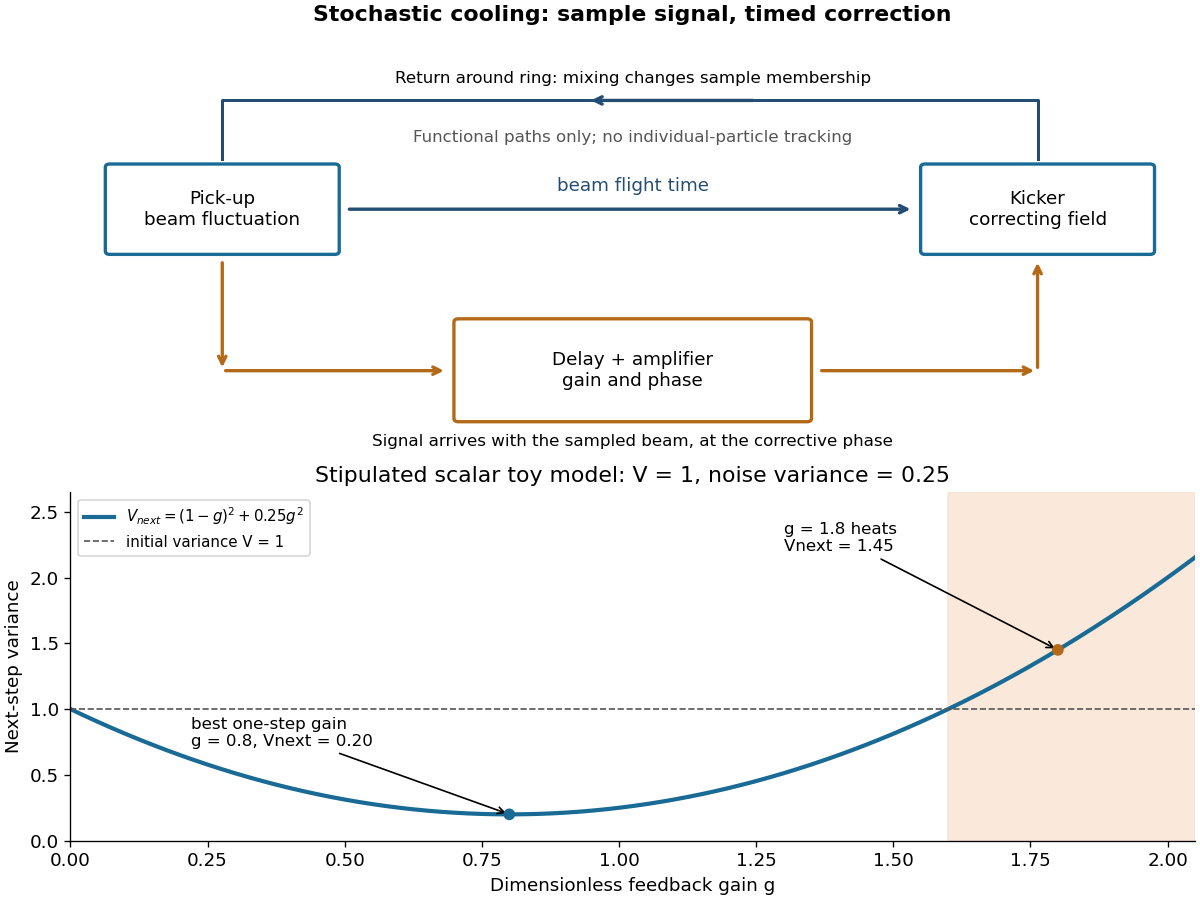
Stochastic cooling is a technique used primarily in particle physics, particularly in the context of particle accelerators and storage rings, to reduce the spread of particle beam momentum and improve beam quality. The method was developed to enhance the performance of collider experiments, such as those found at facilities like CERN or Fermilab. The basic principle of stochastic cooling involves detecting the motion of particles within a beam and applying feedback to reduce their energy spread.
Articles by others on the same topic

Simon van der Meer's stochastic cooling uses measured beam fluctuations, a pick-up, amplifier and timed kicker. Finite samples supply the signal; other particles and electronic noise contribute unwanted kicks. Delay and oscillation phase must make the correction oppose the sampled deviation.[ref]
This active system dissipates energy; it is no one-particle Maxwell's demon individually tracking antiprotons. The stochastic cooling variance model isolates the tradeoff.