The antiproton is the antiparticle of the proton: it has the same rest mass and spin , with opposite electric charge and baryon number. A negative electric charge alone cannot identify an antiproton, because a negative pion also bends in that direction in a magnetic field. Combining magnetic rigidity with velocity determines a rest mass; agreement with the proton rest mass then makes the identification much more discriminating.
The mode expansion of a Dirac field explains how independent particle and antiparticle excitations enter a relativistic field description. It supplies a theoretical language for the antiproton, while the Chamberlain-Segrè antiproton identification supplies an experimental test. The proton is a composite baryon, so a free Dirac field is not a complete account of its internal dynamics or of antiproton production in a target.
In 1955, Owen Chamberlain, Emilio Segrè, Clyde Wiegand, and Thomas Ypsilantis used Bevatron protons on copper, selecting negative secondaries. Magnetic fields selected ; scintillation counters S1 and S2 measured time of flight over . Cherenkov detector C1 flagged ; C2 accepted after material losses. S3 checked traversal. The cuts rejected negative pions.[ref]
Chamberlain's 1959 account describes C2's quartz radiator, mirrors, and photomultiplier readout. The trigger combined delayed scintillation counter signals with C2; photographed oscilloscope traces exposed fast particles and accidental coincidences through C1 pulses or extra pulses. Reversing the magnetic fields provided a positive-proton control and revealed an alignment error. Changing selected momentum at fixed velocity acceptance tested for a proton-mass peak.[ref]
The early antiproton work by Owen Chamberlain. 1959 lecture, pp. 496–501, Figs. 7–11; Columbia scan
Terminal-event studies remained unfinished; the 1955 identification did not rely on annihilation.[ref]
https://escholarship.org/content/qt46p0z8w7/qt46p0z8w7.pdf. UCRL-3172, p. 13
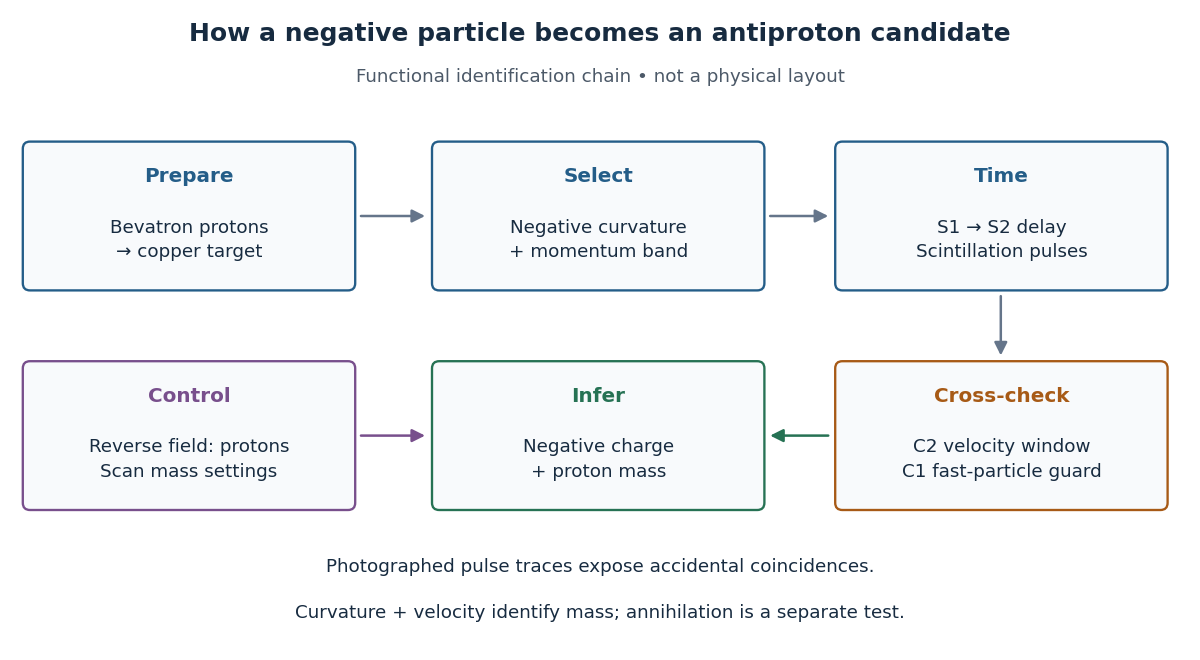
The logic is useful far beyond this experiment. A magnetic field separates electric charge signs and magnetic rigidity, but particles of different rest masses can share both. A time of flight signal adds velocity, while a Cherenkov detector independently checks whether that velocity is plausible. An accidental coincidence can imitate the delay of a slow particle without being one particle traversing the apparatus. Agreement between independent measurements is therefore part of the inference, rather than a redundant decoration.
For a singly charged track perpendicular to a uniform magnetic field, its curvature gives magnetic rigidity , and the bend direction gives the sign of electric charge. The mass shell relation and four-momentum relation between energy and velocity giveFor a known path length and constant velocity, time of flight therefore givesThis measures rest mass under an assigned electric charge magnitude. Curvature alone measures , so independent evidence for matters. In material, the measured delay is instead ; matching a local Cherenkov detector velocity to an upstream momentum requires an energy-loss correction.
As an original illustrative calculation, choose and , with rounded input rest energies and . Constant-velocity propagation givesBoth particles have the same selected momentum and negative electric charge, yet their time of flight separation is about . These are calculated values for a deliberately simplified example, not measured discovery events.
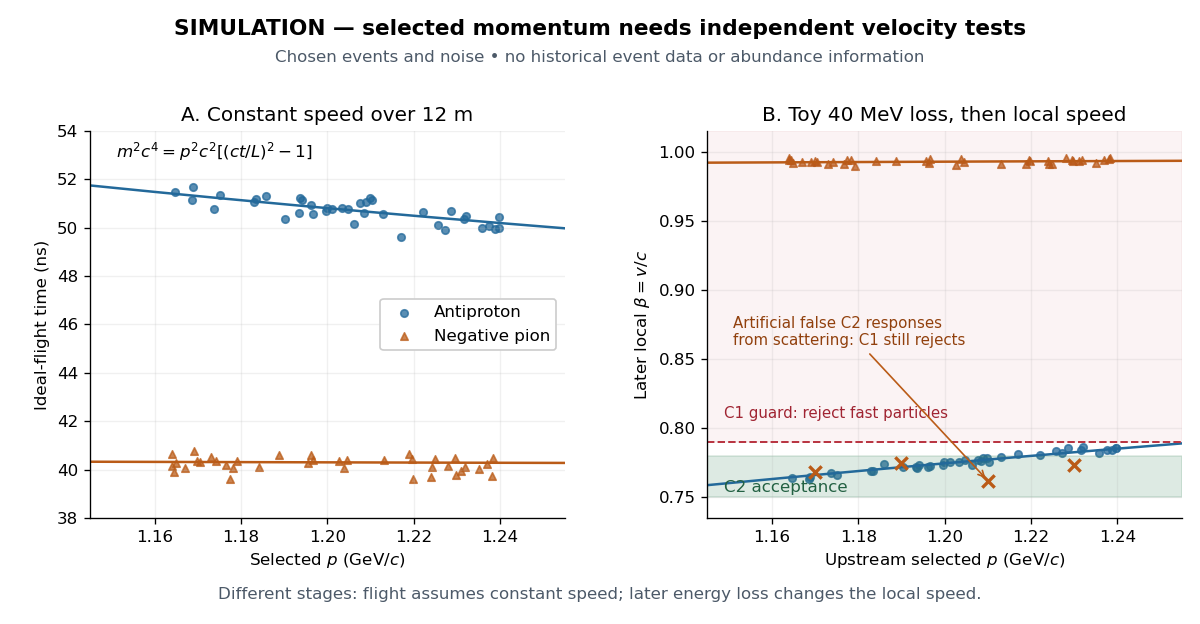
For example, the toy energy loss changes the central antiproton velocity from to . Directly substituting the slower downstream value together with the upstream momentum would overestimate the rest mass. The two panels thus describe different stages of a deliberately specified model; their numerical consistency depends on propagating energy between stages. Likewise, the scattered-pion markers represent an erroneous C2 response, not actual slow pions; an upstream C1 signal still rejects them.
The fixed-target production threshold concerns the incident accelerator beam, whereas antiproton mass from momentum and velocity concerns an outgoing secondary beam. To see the distinction, consider a free proton hitting a stationary free proton, producingThe final electric charge is and final baryon number is , as initially. Approximate all four final rest masses by the same proton rest mass . With metric signature , define the squared centre-of-mass energy by . The incident proton has total energy , and the target four-momentum is . Four-momentum conservation and the mass shell relation giveAt threshold the four final particles have zero relative momentum in their centre-of-momentum frame, so . HenceOnly of new rest energy is created. The larger incident kinetic energy is required because the final system must also carry the initial laboratory momentum. The incident total energy at threshold is ; neither this nor is the selected secondary momentum.
The 1955 authors explicitly qualified the stationary-nucleon threshold: target nucleon motion inside an atomic nucleus can lower the required incident energy.[ref]
The kinematic reason is visible for two on-shell incoming nucleons:A target momentum directed against the beam increases . Applying this illustration to a bound nucleon also requires binding energy and residual-nucleus recoil; the free stationary-target result is therefore not a universal sharp threshold for a copper target. A low observed secondary momentum is entirely compatible with a much larger accelerator kinetic energy.
Articles by others on the same topic



An antiproton is the antiparticle of the proton, which is one of the fundamental constituents of atomic nuclei. In particle physics, every particle has a corresponding antiparticle that has the same mass but opposite charge and other quantum numbers. Specifically, an antiproton has: - A mass equal to that of a proton (approximately 938.3 MeV/c²). - A negative electric charge (-1e), as opposed to the positive charge (+1e) of a proton.