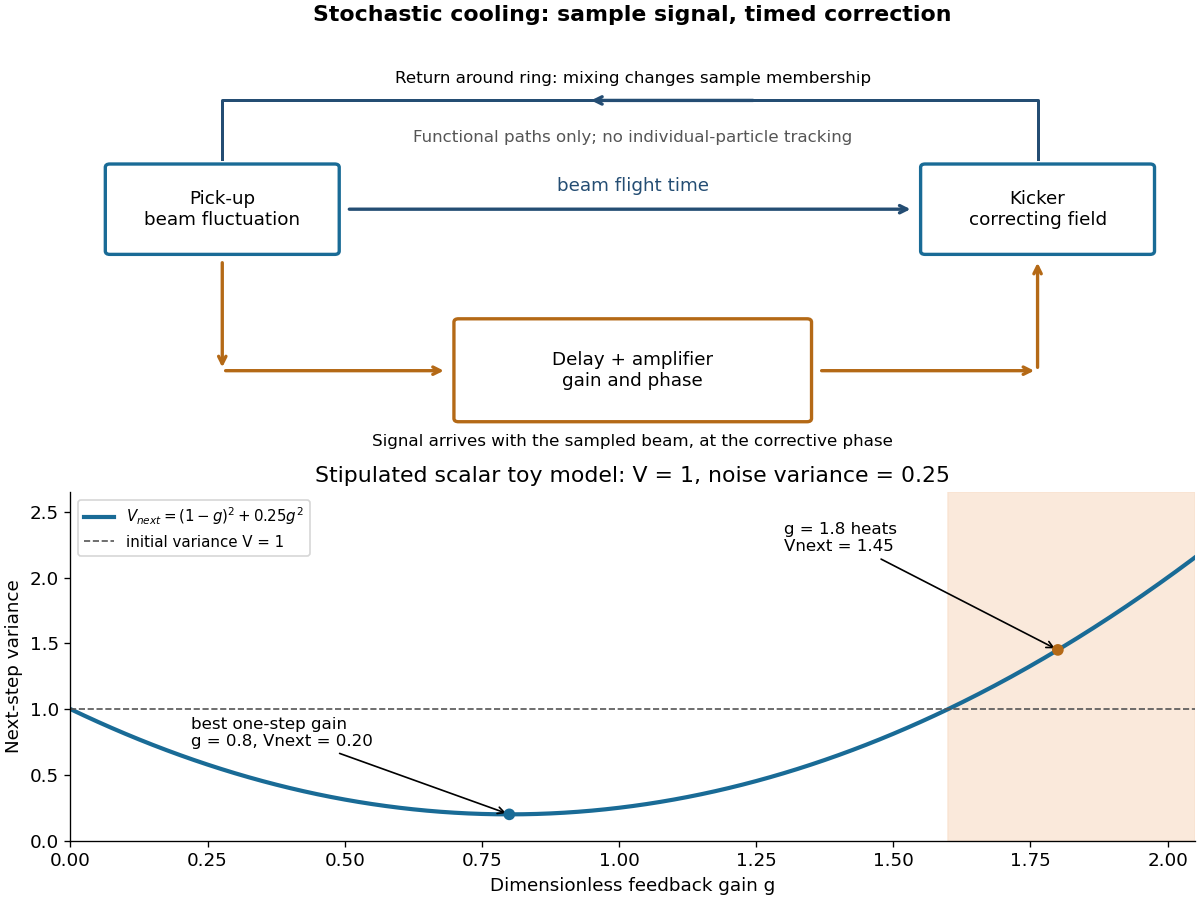
Simon van der Meer's stochastic cooling uses measured beam fluctuations, a pick-up, amplifier and timed kicker. Finite samples supply the signal; other particles and electronic noise contribute unwanted kicks. Delay and oscillation phase must make the correction oppose the sampled deviation.[ref]
This active system dissipates energy; it is no one-particle Maxwell's demon individually tracking antiprotons. The stochastic cooling variance model isolates the tradeoff.
Beam mixing changes sample membership between turns through revolution-time differences. Repeatedly correlated samples and thermal noise limit stochastic cooling.[ref]
Stochastic Cooling and the Accumulation of Antiprotons by Simon van der Meer. Section 5, p.295, Mixing and thermal noise, Eqs.(3)–(4)
Fresh samples help across turns; losing pick-up–kicker correlation hurts. Useful feedback gain therefore depends on bandwidth, delay, beam dynamics and signal-to-noise ratio.
Let be a centered scalar beam-deviation coordinate in a deliberately controlled toy model. Let the readout be , where the centered measurement noise has variance and is independent of and of earlier noise. Stipulate a correctly timed correction of strength : . This scalar observation is a teaching surrogate, not a claim that real cooling measures each particle. From variance additivity for independent random variables,For fixed current and , differentiate the next-step variance with respect to feedback gain:The unique one-step minimizing feedback gain and resulting variance areThe noisier the readout relative to the current spread, the smaller the useful correction. The exact one-step cooling condition follows by subtraction:Thus excessive positive feedback gain heats this model. The threshold depends on the current variance: a gain that initially cools can later heat if the beam has become narrower or the noise has grown.
For chosen dimensionless and , gives . Taking instead gives , larger than the initial spread. Holding fixed givesso the variance approaches the nonzero noise floor . More generally, for the fixed-gain limit is . This long-run stability condition differs from the condition for cooling the current beam on the very next step.
If the toy feedback gain is recomputed after every step and , the reciprocal recurrence is even simpler:With the chosen inputs, . This ideal model has no additional diffusion, finite observation time or lost correlation; its indefinitely falling spread is not a prediction for an operating storage ring.
To expose the missing physics mathematically, replace by an arbitrary centered sample signal . Defining and givesUnwanted contributions from other particles or electronics can enlarge without increasing useful ; poor timing or lost correlation can reduce or even reverse its sign. This is why real stochastic cooling needs measured beam fluctuations, appropriate beam mixing and correctly phased feedback control, rather than an imagined catalogue of individual particle positions.
Articles by others on the same topic


Stochastic cooling is a technique used primarily in particle physics, particularly in the context of particle accelerators and storage rings, to reduce the spread of particle beam momentum and improve beam quality. The method was developed to enhance the performance of collider experiments, such as those found at facilities like CERN or Fermilab. The basic principle of stochastic cooling involves detecting the motion of particles within a beam and applying feedback to reduce their energy spread.