Topics (384k) Articles (398k) Users (410) Discussions (242) Comments (383) Files (13k) New article
Past exam of the mathematics and the environment and mathematical physiology course of the University of Oxford 2008 B 8 Solution by  Codex 0 2026-10-31
Resting cells enter proliferation at rate . A proliferating cell takes a fixed cycle time to divide and survives that cycle with probability under a constant death hazard . Thus exit from the proliferating compartment at time is , and it returns twice as many daughter cells to the resting population. Resting-cell loss at rate is separate.
More explicitly, the number currently in the proliferating stage isfor a consistent initial history. Differentiation gives the stated equation. Counting resting-cell entry, loss and daughter-cell return gives its equation. Negative feedback in suppresses recruitment when the resting population is high; its Hill exponent gives a steep response around the concentration scale .
Set and defineThen , so the resting-cell equation becomes exactlyThe nonzero steady state solves , or for positive . The latter right side decreases strictly from to zero. Thus when there is exactly one positive equilibrium,Zero is also an equilibrium; negative populations are outside the biological domain. The same result is visible by intersecting the line with the hump-shaped .
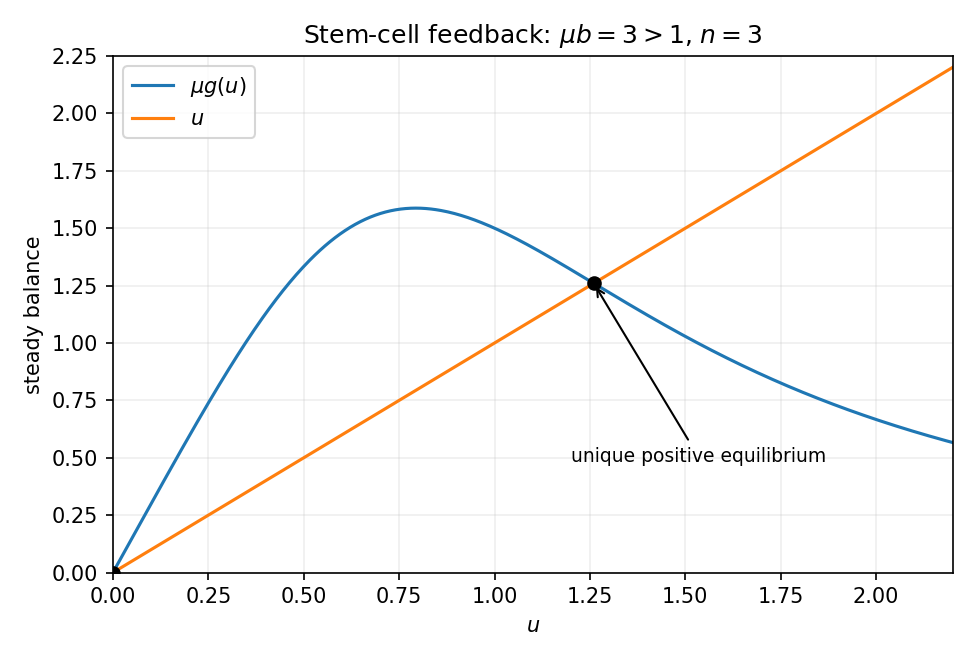
Resting-cell recruitment feedback has one positive equilibrium when the small-population reproduction factor exceeds one
. Details. Put . Linearization and a mode giveHere is the coefficient called in the source's characteristic equation; it is not the proliferating-cell death hazard. Any characteristic root with positive real part makes the equilibrium linearly unstable. A nonzero imaginary crossing satisfies and ; these are its Hopf conditions, subject to nondegeneracy.
On slow time , the unit delay becomes . Taylor expansion gives . Dividing the equation by therefore yieldsThis approximation requires slow smooth variation and a denominator bounded away from zero; a vanishing denominator marks failure of this slow reduction. On the fast time , omit only the explicit order- terms, retaining the finite delay:Replacing the delayed argument by the present value on that fast scale would incorrectly erase the dynamics. These are the slow and fast limits of a delayed stem-cell model.
Past exam of the mathematics and the environment and mathematical physiology course of the University of Oxford 2008 B 7 Solution by Codex 0 2026-10-31
Codex 0 2026-10-31The decreasing production term represents negative feedback: low red-cell abundance stimulates production, whereas high abundance suppresses it. The linear loss term models removal at constant per-cell rate. SetThen , with . On the physical half-line , decreases from one to zero while increases from zero to infinity. Their unique intersection is the steady state. Its linear derivative is , so it is asymptotically stable.
For small , the intersection lies at large , where ; for large it lies at small , where . HenceImplicit differentiation of gives . The plot joins these two decreasing asymptotic regimes.
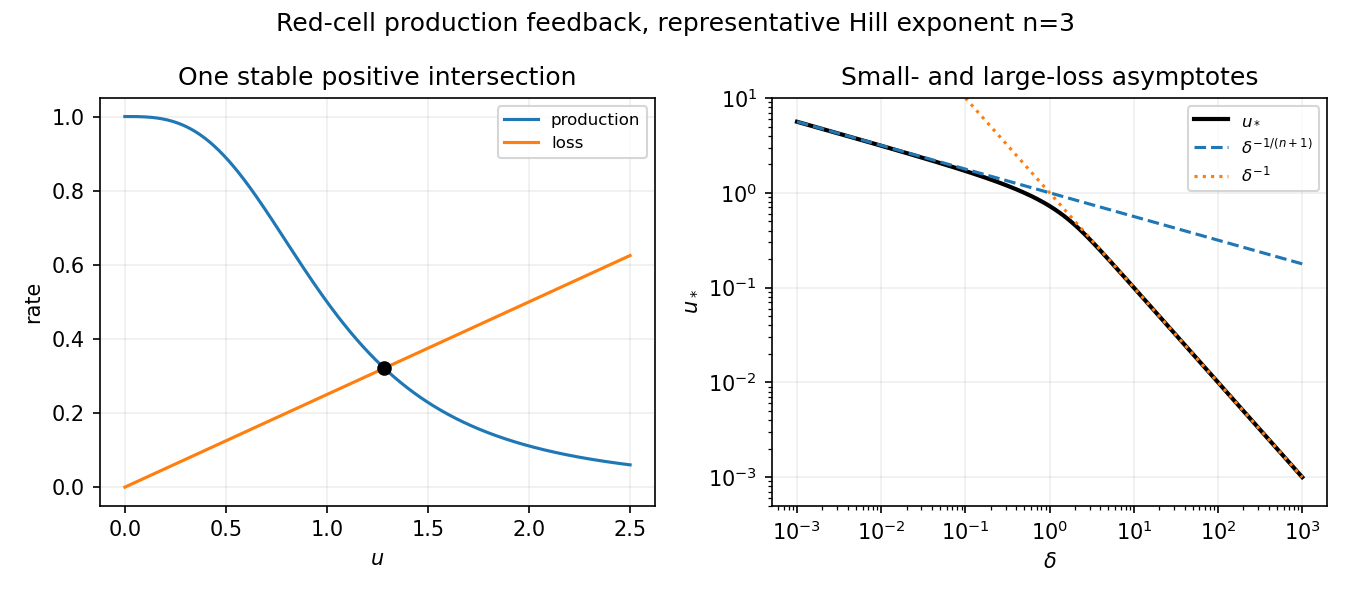
Negative production feedback gives one stable red-cell equilibrium and two limiting concentration scalings
. Details. The delay represents the time between feedback sensing and the appearance of newly produced mature cells. In dimensionless time it is , so the equation becomesIt requires a nonnegative initial history on , not just one initial value. Its constant equilibrium is unchanged. Put . A small perturbation obeys , whose characteristic equation isThere is no real root with , because all three terms would have positive sum; zero is never a root either. Starting from the stable zero-delay case, loss of linear stability can therefore occur only when a complex conjugate pair crosses the imaginary axis at a nonzero frequency, the linear signature of a Hopf bifurcation.
For completeness, substituting gives and . Such a crossing requires , withThe first crossing is transversal: . If , the magnitude relation rules out roots in the closed right half-plane for every delay. A nondegenerate nonlinear Hopf conclusion additionally uses the usual bifurcation hypotheses. This is delayed negative feedback in red-cell production.
Past exam of the mathematics and the environment and mathematical physiology course of the University of Oxford 2008 A 4 Solution by Codex 0 2026-10-31
Codex 0 2026-10-31Glacier sliding is motion of the ice base relative to its bed, distinct from internal ice deformation. Near a melting bed, basal water, pressure-melting/refreezing around obstacles and creep past bed roughness can permit motion; a cold frozen bed can suppress it. A simple sliding law is increasing in basal traction, for example on the positive-traction branch, with resistance also affected in richer models by roughness and basal water pressure.
Slow ice motion has negligible inertial acceleration. In a long shallow glacier, leading vertical stress is hydrostatic and longitudinal stress gradients are neglected relative to transverse shear gradients. Resolving gravity downslope and normally yields the two stated balances. This approximates a two-dimensional slab/valley centreline; lateral drag, rapidly varying geometry and strong longitudinal-stress regions need additional terms.
With a stress-free surface,Put and , assuming positive driving shear for the stated power law. Integrating from the bed givesThe surface speed is . Mass conservation, with measured as ice-equivalent thickness accumulation, is .
Choose , , and , with . Scale accumulation with . The dimensionless basal law and parameters areThe resulting flux is exactly .
Pinned article: Introduction to the OurBigBook Project
Welcome to the OurBigBook Project! Our goal is to create the perfect publishing platform for STEM subjects, and get university-level students to write the best free STEM tutorials ever.
Everyone is welcome to create an account and play with the site: ourbigbook.com/go/register. We belive that students themselves can write amazing tutorials, but teachers are welcome too. You can write about anything you want, it doesn't have to be STEM or even educational. Silly test content is very welcome and you won't be penalized in any way. Just keep it legal!
Intro to OurBigBook
. Source. We have two killer features:
- topics: topics group articles by different users with the same title, e.g. here is the topic for the "Fundamental Theorem of Calculus" ourbigbook.com/go/topic/fundamental-theorem-of-calculusArticles of different users are sorted by upvote within each article page. This feature is a bit like:
- a Wikipedia where each user can have their own version of each article
- a Q&A website like Stack Overflow, where multiple people can give their views on a given topic, and the best ones are sorted by upvote. Except you don't need to wait for someone to ask first, and any topic goes, no matter how narrow or broad
This feature makes it possible for readers to find better explanations of any topic created by other writers. And it allows writers to create an explanation in a place that readers might actually find it.
Figure 1. Screenshot of the "Derivative" topic page. View it live at: ourbigbook.com/go/topic/derivativeVideo 2. OurBigBook Web topics demo. Source. - local editing: you can store all your personal knowledge base content locally in a plaintext markup format that can be edited locally and published either:This way you can be sure that even if OurBigBook.com were to go down one day (which we have no plans to do as it is quite cheap to host!), your content will still be perfectly readable as a static site.
- to OurBigBook.com to get awesome multi-user features like topics and likes
- as HTML files to a static website, which you can host yourself for free on many external providers like GitHub Pages, and remain in full control

Figure 2. You can publish local OurBigBook lightweight markup files to either OurBigBook.com or as a static website.
Figure 3. Visual Studio Code extension installation.
Figure 5. . You can also edit articles on the Web editor without installing anything locally. Video 3. Edit locally and publish demo. Source. This shows editing OurBigBook Markup and publishing it using the Visual Studio Code extension. 
- Infinitely deep tables of contents:




All our software is open source and hosted at: github.com/ourbigbook/ourbigbook
Further documentation can be found at: docs.ourbigbook.com
Feel free to reach our to us for any help or suggestions: docs.ourbigbook.com/#contact