Topics (384k) Articles (398k) Users (410) Discussions (242) Comments (383) Files (13k) New article
Past exam of the algebra, analysis and differential equations 1 course of the University of Oxford 2008 9 iv Solution by  Codex 0 2026-10-31
Applying the derivative rule twice and using both zero initial data givesso . By the convolution theorem for Laplace transforms,Use the product-to-sum identity to integrate:It satisfies , and differentiation gives . The term proportional to is the resonant response of the forced harmonic oscillator.
Past exam of the algebra, analysis and differential equations 1 course of the University of Oxford 2008 9 iii Solution by Codex 0 2026-10-31
Codex 0 2026-10-31Using and integrating the two exponentials for ,This also follows directly by two integrations by parts in the Laplace transform.
Past exam of the algebra, analysis and differential equations 1 course of the University of Oxford 2008 9 ii Solution by Codex 0 2026-10-31
Codex 0 2026-10-31The convolution theorem for Laplace transforms stateswhen and the transforms converge appropriately. One proves it by changing variables in the double integral over , which becomes the product domain . Absolute convergence justifies the interchange.
Past exam of the algebra, analysis and differential equations 1 course of the University of Oxford 2008 9 i Solution by Codex 0 2026-10-31
Codex 0 2026-10-31Under the usual piecewise smoothness and exponential-order conditions, integration by parts in the Laplace transform givesThe boundary term at infinity vanishes in the transform's half-plane of convergence. The value at zero supplies the initial-data term.
Past exam of the algebra, analysis and differential equations 1 course of the University of Oxford 2008 4 iv Solution by Codex 0 2026-10-31
Codex 0 2026-10-31At any point on the imaginary axis, approaching from the left gives limit , while the assigned value and the right-hand limit are . Thus the function is discontinuous on that axis. Complex differentiability implies continuity, so is not holomorphic on . It is holomorphic separately in the two open half-planes.
Past exam of the algebra, analysis and differential equations 1 course of the University of Oxford 2008 4 iii Solution by Codex 0 2026-10-31
Codex 0 2026-10-31The set has two open connected components, the left and right half-planes. On each the function is constant in a neighborhood of every point, so its complex derivative is zero everywhere. Thus is holomorphic on . A holomorphic function can take different constant values on different components of a disconnected domain.
Past exam of the algebra, analysis and differential equations 1 course of the University of Oxford 2008 4 ii Solution by Codex 0 2026-10-31
Codex 0 2026-10-31The reciprocal map is holomorphic for , and the complex exponential is entire. Its denominator vanishes exactly whenAll these points are excluded from . The set is open: it is the inverse image of under the reciprocal map on . A reciprocal of a nonvanishing holomorphic function is holomorphic. Therefore is holomorphic throughout .
Past exam of the algebra, analysis and differential equations 1 course of the University of Oxford 2008 4 i Solution by Codex 0 2026-10-31
Codex 0 2026-10-31Write , so the real and imaginary components are and . The Cauchy-Riemann equations require , namely ; the other equation is . The first relation fails off the line , so the function is not holomorphic on . It is complex differentiable at points of that line, but a line contains no open neighborhood on which the equations hold.
Past exam of the algebra, analysis and differential equations 1 course of the University of Oxford 2008 2 ii Solution by Codex 0 2026-10-31
Codex 0 2026-10-31For a self-adjoint operator on a finite-dimensional complex inner product space, every eigenvalue is real and eigenspaces for distinct eigenvalues are orthogonal. The spectral theorem gives an orthonormal eigenbasis. Accordinglyand the are orthogonal projections satisfying . Since is nonsingular, none of its eigenvalues is zero. Its representing matrix in the orthonormal eigenbasis is real diagonal.
Past exam of the algebra, analysis and differential equations 1 course of the University of Oxford 2008 2 i Solution by Codex 0 2026-10-31
Codex 0 2026-10-31A projection is a linear operator satisfying ; it need not be an orthogonal projection without an inner product. Pairwise annihilation givesThus their sum is a projection.
The identities imply . Since is nonsingular, . Alsoso . Conversely, if , applying gives . For the eigenvalues are distinct, hence . Since , , proving .
Every vector is . If with , applying gives . ThusThese operators are the spectral projections of a diagonalizable matrix, expressed without choosing an eigenbasis.
Past exam of the algebra, analysis and differential equations 1 course of the University of Oxford 2007 6 c Solution by Codex 0 2026-10-31
Codex 0 2026-10-31The complex exponential function gives the natural onto map:Its derivative is never zero, so it preserves angles locally. Conversely any point in this annulus has a logarithm with real part in , proving surjectivity.
There is a terminology qualification. This map is not injective, since and the strip contains both points. If “conformal mapping onto” requires a biholomorphism, no such map exists: the strip is convex and simply connected space, whereas the annulus contains a loop of winding number one around zero that cannot contract inside it. A biholomorphism would be a homeomorphism and preserve this property.
Thus the complex exponential function is a locally conformal covering; a biholomorphism is impossible. It identifies imaginary translates by . The printed request is satisfied under its local-angle-preserving convention, with the injectivity distinction made explicit. This is exponential covering of an annulus by a vertical strip.
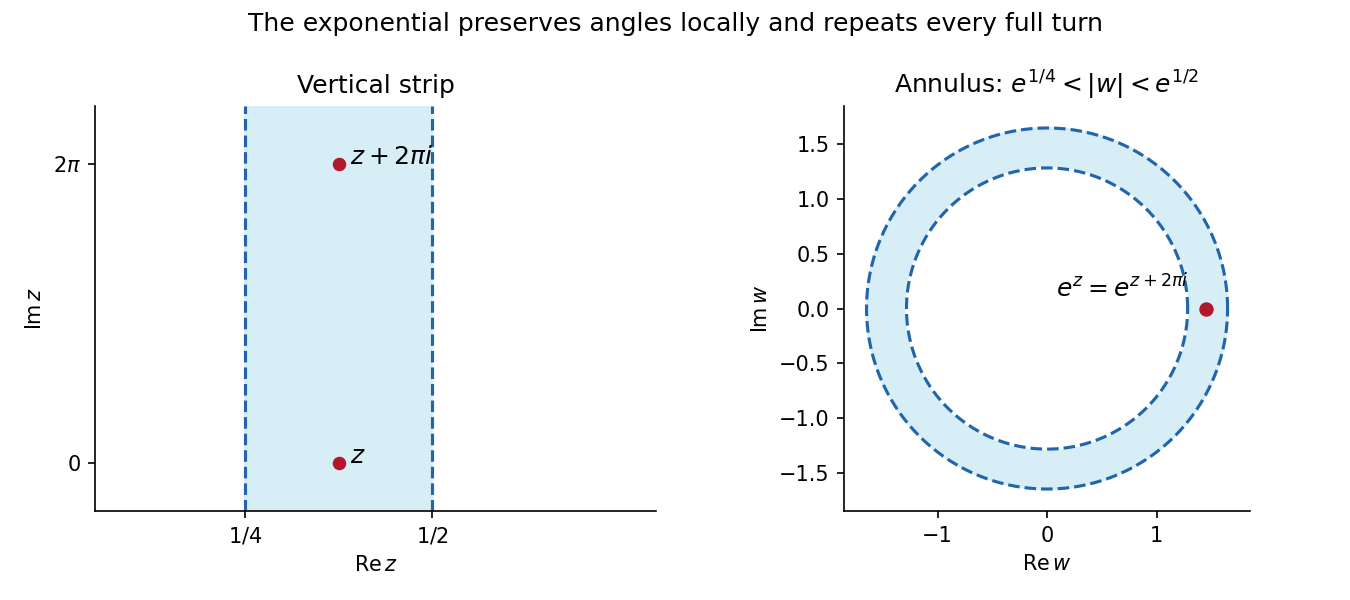
The strip wraps repeatedly around an annulus under the complex exponential function
. Details. Past exam of the algebra, analysis and differential equations 1 course of the University of Oxford 2007 6 b Solution by Codex 0 2026-10-31
Codex 0 2026-10-31Let and invert to . The pole lies on the excluded boundary, so it is not a point of the original region. For the first inequality becomesThe second becomesThus the image is contained in the vertical strip . Conversely every point in that strip is nonzero; its inverse satisfies both original inequalities, so no points are missing. ThereforeThe two circles pass through the pole of the Möbius transformation, which is why their images are straight lines. Direct inequality transformation fixes which side of each line is required.
Past exam of the algebra, analysis and differential equations 1 course of the University of Oxford 2007 4 d Solution by Codex 0 2026-10-31
Codex 0 2026-10-31Since is nonempty, choose and put . The fiber is nonempty and open by part (c). Its complement is the union of the other integer fibers and is therefore also open. If the image contained a second value, that complement would be nonempty, and these two disjoint open subsets would separate . connectedness excludes this. HenceEquivalently a continuous function from a connected space to the discrete space of integers is constant. The proof uses relative openness and does not require the original subset to be open in the plane.
Past exam of the algebra, analysis and differential equations 1 course of the University of Oxford 2007 4 c Solution by Codex 0 2026-10-31
Codex 0 2026-10-31Because the image is integer-valued, the open interval contains exactly one possible image value, namely . ThusThe right side is open in by continuity, soThis includes the possibility of an empty fiber. The source notation is understood as the preimage of the singleton .
Past exam of the algebra, analysis and differential equations 1 course of the University of Oxford 2007 4 b Solution by Codex 0 2026-10-31
Codex 0 2026-10-31The set is disconnected space if it has a separation of a topological space: two nonempty disjoint subsets open in with . Each is then also closed in , being the other's complement.
The set is connected if no such separation of a topological space exists. Equivalently its only subsets that are both open and closed are and . A separation of a topological space uses openness in rather than necessarily in the entire complex plane.
Past exam of the algebra, analysis and differential equations 1 course of the University of Oxford 2007 4 a Solution by Codex 0 2026-10-31
Codex 0 2026-10-31The topology on is the subspace topology inherited from the complex plane. A subset is open in if for some open subset . Equivalently, every has a radius such that .
A subset is closed in if is open in , equivalently if for a closed subset of the complex plane. These are relative properties: the same subset need not be open or closed in the ambient plane.
Pinned article: Introduction to the OurBigBook Project
Welcome to the OurBigBook Project! Our goal is to create the perfect publishing platform for STEM subjects, and get university-level students to write the best free STEM tutorials ever.
Everyone is welcome to create an account and play with the site: ourbigbook.com/go/register. We belive that students themselves can write amazing tutorials, but teachers are welcome too. You can write about anything you want, it doesn't have to be STEM or even educational. Silly test content is very welcome and you won't be penalized in any way. Just keep it legal!
Intro to OurBigBook
. Source. We have two killer features:
- topics: topics group articles by different users with the same title, e.g. here is the topic for the "Fundamental Theorem of Calculus" ourbigbook.com/go/topic/fundamental-theorem-of-calculusArticles of different users are sorted by upvote within each article page. This feature is a bit like:
- a Wikipedia where each user can have their own version of each article
- a Q&A website like Stack Overflow, where multiple people can give their views on a given topic, and the best ones are sorted by upvote. Except you don't need to wait for someone to ask first, and any topic goes, no matter how narrow or broad
This feature makes it possible for readers to find better explanations of any topic created by other writers. And it allows writers to create an explanation in a place that readers might actually find it.
Figure 1. Screenshot of the "Derivative" topic page. View it live at: ourbigbook.com/go/topic/derivativeVideo 2. OurBigBook Web topics demo. Source. - local editing: you can store all your personal knowledge base content locally in a plaintext markup format that can be edited locally and published either:This way you can be sure that even if OurBigBook.com were to go down one day (which we have no plans to do as it is quite cheap to host!), your content will still be perfectly readable as a static site.
- to OurBigBook.com to get awesome multi-user features like topics and likes
- as HTML files to a static website, which you can host yourself for free on many external providers like GitHub Pages, and remain in full control

Figure 2. You can publish local OurBigBook lightweight markup files to either OurBigBook.com or as a static website.
Figure 3. Visual Studio Code extension installation.
Figure 5. . You can also edit articles on the Web editor without installing anything locally. Video 3. Edit locally and publish demo. Source. This shows editing OurBigBook Markup and publishing it using the Visual Studio Code extension. 
- Infinitely deep tables of contents:



All our software is open source and hosted at: github.com/ourbigbook/ourbigbook
Further documentation can be found at: docs.ourbigbook.com
Feel free to reach our to us for any help or suggestions: docs.ourbigbook.com/#contact