Orthogonal projection
ID: orthogonal-projection

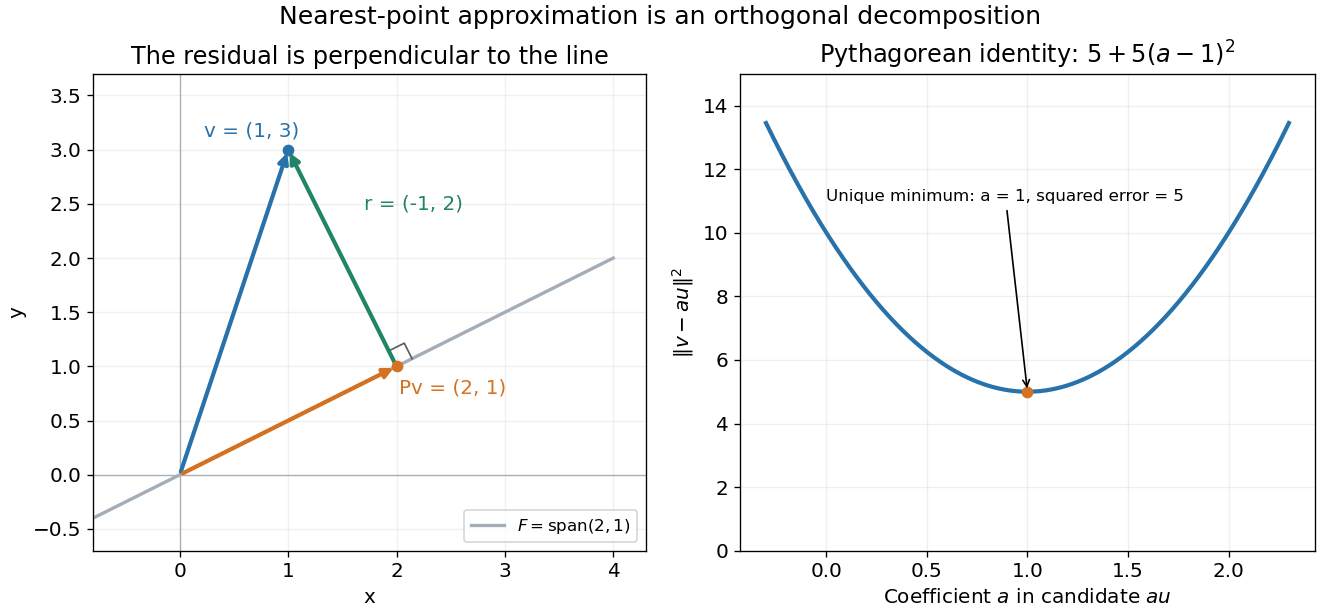
The orthogonal projection onto a closed subspace of a Hilbert space sends to its component in the orthogonal decompositionThe residual is orthogonal to every permitted direction. For any , the Pythagorean theorem givesThus uniquely minimizes the distance to . It is a linear map, is idempotent, and is nonexpansive: ; taking gives .
In , project onto the line spanned by . The inner product givesThe check confirms orthogonality, and . Projecting again changes nothing, since the result already lies on the line.

For a finite orthonormal basis of , the same operation is , using the convention linear in the first argument. Replacing coordinate vectors by functions gives exactly the same approximation principle. For in the real L2 space on and , the directions are orthogonal, with squared norms and . Their inner products with are and zero, soDirect integration gives the squared error . For any competing affine polynomial, the orthogonal residual yieldsEvery deviation from , adds a nonnegative error. The best function need not pass through any selected data point: it minimizes an integrated error across the whole interval.
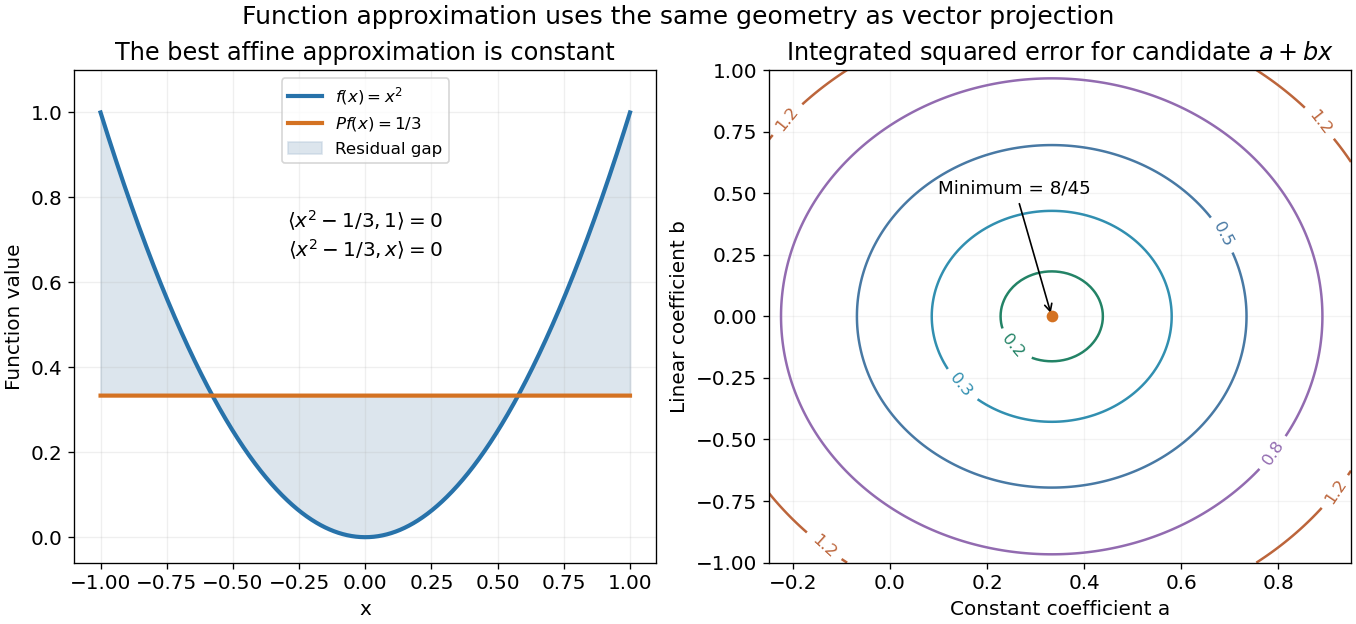
Projecting x squared onto affine functions gives the constant one third and minimum integrated squared error 8/45
. Details. 
New to topics? Read the docs here!