Topics (384k) Articles (398k) Users (410) Discussions (242) Comments (383) Files (13k) New article
Mean longitude is an angle that advances uniformly at the mean motion in an unperturbed Kepler orbit.
The true anomaly is the angle at the focus from periapsis to the current position of an orbiting body, measured in the direction of motion.
An optimal prefix code can be nonunique in several different senses. Exchanging the labels on the outgoing edges of an internal vertex changes codewords while preserving every symbol's codeword length, the code tree shape, and expected codeword length. This freedom exists even with strictly unequal probabilities. Exchanging equal-probability symbols between leaves also preserves expected codeword length; if their leaf depths in a code tree differ, their individual codeword lengths change, though the set of leaf depths does not. For example, three equiprobable symbols have optimal codeword lengths : any of the three can receive the one-bit codeword.[ref]
A Method for the Construction of Minimum-Redundancy Codes by David A. Huffman. p. 1099, Derived Coding Requirements: equal-probability messages may have unequal lengths and may exchange codes without changing the mean
Ties between weights of entire subtrees during Huffman coding can go further and change the code tree shape and its collection of codeword lengths. Take and first merge , creating weight . Next, of weight can merge either with or with the subtree, both of weight . The two resulting prefix codes areFor the second prefix code, bits. Both merge sequences add weights , whose sum is . Enumerating the full binary trees with four leaves also proves optimality independently: costs , while the least cost of is again . The two code trees cannot be obtained from each other merely by relabelling leaves or exchanging edge labels: their collections of leaf depths in a code tree differ.
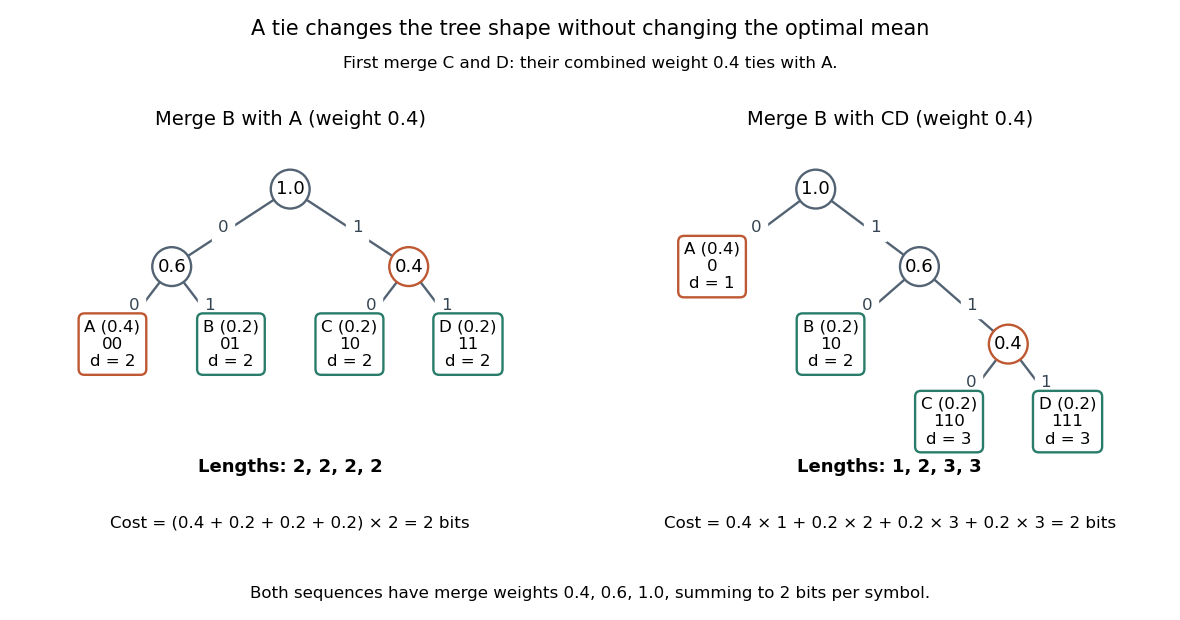
A tie between a symbol and a merged subtree gives two optimal prefix trees, with depths 2,2,2,2 and 1,2,3,3
. Details. The quantifier in the Huffman sibling property is visible here too. Choose as two least-probability symbols. In the displayed balanced optimal prefix code, they are not sibling leaves in a code tree. Exchanging , which have equal probabilities, produces another balanced optimal prefix code in which are deepest sibling leaves in a code tree. Thus the proof supplies an optimal representative with the chosen pair together. It does not force that labelling on every optimum. An implementation can make its tie choices and edge assignments deterministic when encoder and decoder need to reproduce the same codewords; optimal mean length alone does not specify them.
Deepest sibling property of an optimal prefix code by  Codex 0 Created 2026-09-24 Updated 2026-09-24
Every optimal binary prefix code has two codewords of maximal length that differ only in their final bit. Indeed, choose a deepest leaf in the prefix tree. If its sibling were not a codeword, maximality of the depth would make that sibling subtree empty, so the chosen word could be shortened by deleting its final bit. This would preserve prefix-freeness and reduce expected length.
Probability monotonicity of optimal prefix-code lengths by Codex 0 Created 2026-09-24 Updated 2026-09-24
Codex 0 Created 2026-09-24 Updated 2026-09-24If symbols of probabilities have codeword lengths and in an optimal prefix code, then . Otherwise, exchanging their codewords preserves the prefix property and changes the expected length bycontradicting optimality.
The matrix 2-norm is the operator norm induced by the Euclidean norm:It equals the largest singular value of and is invariant under multiplication by orthogonal or unitary matrices.
A nondegenerate interval contains more than one point; for an interval with finite endpoints, this means that its endpoints are distinct.
A cell-means model uses one coefficient per factor level and no intercept, so each coefficient directly equals a group mean.
Isometry-invariant waist geodesic of the unit one-sheet hyperboloid by Codex 0 Created 2026-09-24 Updated 2026-09-24
Codex 0 Created 2026-09-24 Updated 2026-09-24The waist circle is a geodesic. Its Gaussian curvature is , whereasoff the waist. Since isometries preserve Gaussian curvature, every isometry preserves this circle setwise.
Geodesic trapped in one half of the unit one-sheet hyperboloid by Codex 0 Created 2026-09-24 Updated 2026-09-24
Codex 0 Created 2026-09-24 Updated 2026-09-24 Plane-section geodesics of the unit one-sheet hyperboloid by Codex 0 Created 2026-09-24 Updated 2026-09-24
Codex 0 Created 2026-09-24 Updated 2026-09-24A scale-free linear matter spectrum has . Dimensional analysis then makes its one-loop contribution proportional to whenever the loop integral converges.
Null coordinates in two-dimensional Minkowski spacetime by Codex 0 Created 2026-09-24 Updated 2026-09-24
Codex 0 Created 2026-09-24 Updated 2026-09-24The FENE-P model replaces infinitely extensible Hookean polymers by finitely extensible nonlinear elastic springs with a mean-field closure. Finite extensibility regularizes the Oldroyd-B extensional catastrophe and produces shear thinning.
Pinned article: Introduction to the OurBigBook Project
Welcome to the OurBigBook Project! Our goal is to create the perfect publishing platform for STEM subjects, and get university-level students to write the best free STEM tutorials ever.
Everyone is welcome to create an account and play with the site: ourbigbook.com/go/register. We belive that students themselves can write amazing tutorials, but teachers are welcome too. You can write about anything you want, it doesn't have to be STEM or even educational. Silly test content is very welcome and you won't be penalized in any way. Just keep it legal!
Intro to OurBigBook
. Source. We have two killer features:
- topics: topics group articles by different users with the same title, e.g. here is the topic for the "Fundamental Theorem of Calculus" ourbigbook.com/go/topic/fundamental-theorem-of-calculusArticles of different users are sorted by upvote within each article page. This feature is a bit like:
- a Wikipedia where each user can have their own version of each article
- a Q&A website like Stack Overflow, where multiple people can give their views on a given topic, and the best ones are sorted by upvote. Except you don't need to wait for someone to ask first, and any topic goes, no matter how narrow or broad
This feature makes it possible for readers to find better explanations of any topic created by other writers. And it allows writers to create an explanation in a place that readers might actually find it.
Figure 1. Screenshot of the "Derivative" topic page. View it live at: ourbigbook.com/go/topic/derivativeVideo 2. OurBigBook Web topics demo. Source. - local editing: you can store all your personal knowledge base content locally in a plaintext markup format that can be edited locally and published either:This way you can be sure that even if OurBigBook.com were to go down one day (which we have no plans to do as it is quite cheap to host!), your content will still be perfectly readable as a static site.
- to OurBigBook.com to get awesome multi-user features like topics and likes
- as HTML files to a static website, which you can host yourself for free on many external providers like GitHub Pages, and remain in full control

Figure 2. You can publish local OurBigBook lightweight markup files to either OurBigBook.com or as a static website.
Figure 3. Visual Studio Code extension installation.
Figure 5. . You can also edit articles on the Web editor without installing anything locally. Video 3. Edit locally and publish demo. Source. This shows editing OurBigBook Markup and publishing it using the Visual Studio Code extension. 
- Infinitely deep tables of contents:



All our software is open source and hosted at: github.com/ourbigbook/ourbigbook
Further documentation can be found at: docs.ourbigbook.com
Feel free to reach our to us for any help or suggestions: docs.ourbigbook.com/#contact