
Rolling a sheet into a circular cylinder bends it without changing its internal lengths and angles. Fitting that same sheet smoothly onto a sphere requires distortion of its first fundamental form. Gaussian curvature distinguishes these situations: it measures the intrinsic curvature of a smooth surface, even though its simplest definition uses how the surface bends in Euclidean space.
The Gaussian curvature at a point is the determinant of the shape operator, or the product of the two principal curvatures:Here is the first fundamental form and is the second fundamental form, with . Regularity makes . Reversing the unit normal negates and both principal curvatures, leaving Gaussian curvature unchanged. [ref]
https://ghomi.math.gatech.edu/Classes/Math497C/LectureNotes9.pdf. Ghomi, Lecture Notes 9, §2.2: determinant formula and independence of normal choice
The sign describes bending at the point: positive Gaussian curvature means the principal curvatures have the same nonzero sign, as at an elliptic point; negative Gaussian curvature means opposite signs, as on a saddle; zero Gaussian curvature means at least one principal curvature vanishes. Zero Gaussian curvature at a single point does not imply that a neighborhood is a plane. [ref]
https://ghomi.math.gatech.edu/Classes/Math497C/LectureNotes10.pdf. Ghomi, Lecture Notes 10, §2.3.1: the sign of Gaussian curvature
Four worked models make the signs concrete:
- On a plane, the unit normal is constant, so the shape operator is zero and .
- On a sphere of radius , the outward unit normal gives . Thus , , and .
- On the lateral surface of a circular cylinder of radius , the outward unit normal gives and . Hence but : there is extrinsic curvature despite intrinsic flatness. The shape operator calculation above gives , , , so the determinant formula gives the same result.
- For the upward-oriented saddle with , the gradient vanishes at the origin. The fundamental forms of a graph surface therefore giveThe shape operator has eigenvalues , giving and . Away from the origin, Gaussian curvature of a graph surface gives ; the label applies only at the marked point.
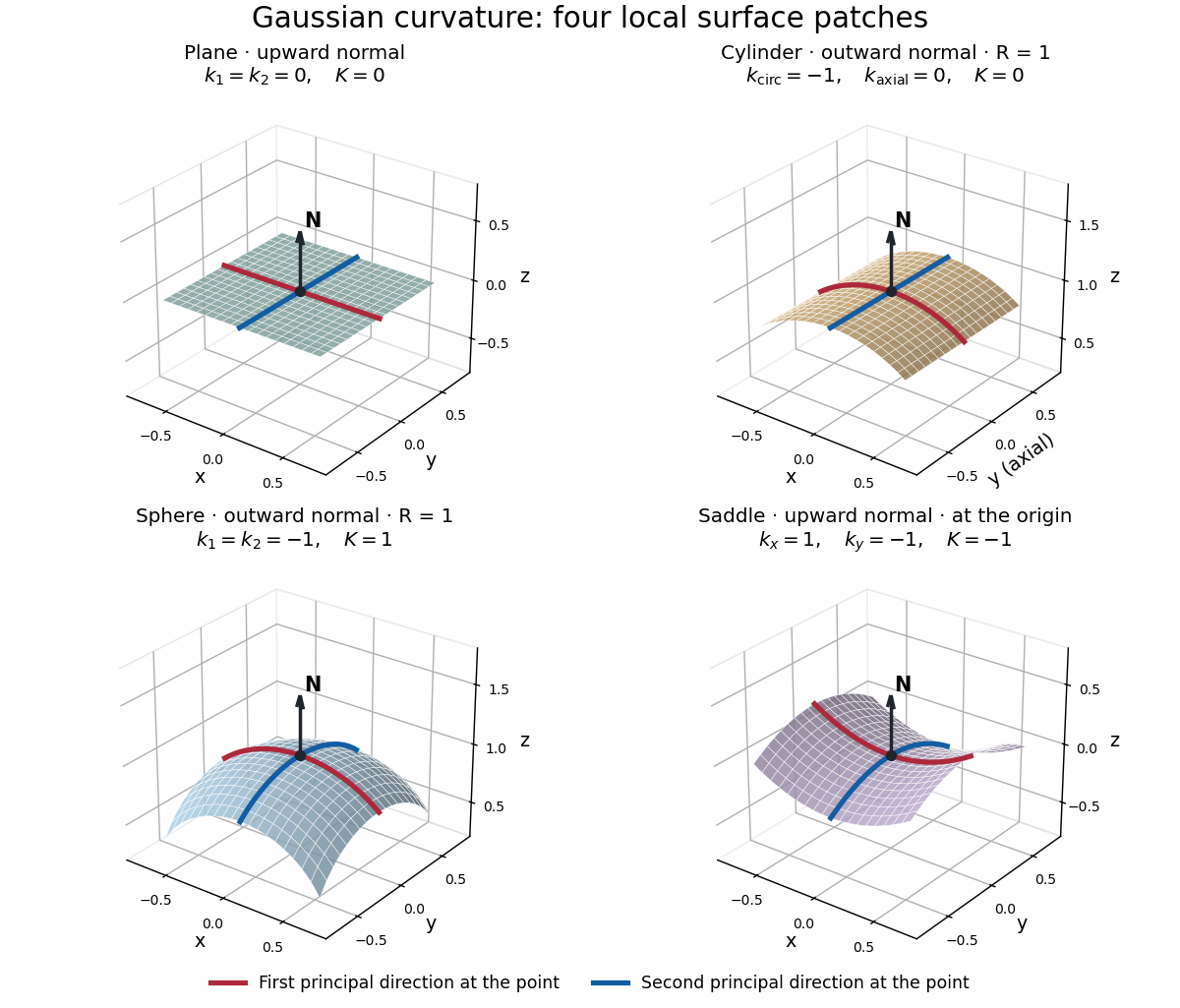
Plane, outward cylinder, outward sphere, and upward saddle compared by their principal curvatures and Gaussian curvature
. Details. The patches use a common length unit, with for the sphere and circular cylinder. The marked red and blue curves have principal directions at the black point; the arrow is the chosen unit normal. For physical lengths, principal curvature and mean curvature have units of inverse length, while Gaussian curvature has units of inverse squared length. Rescaling a surface by divides its principal curvatures by and its Gaussian curvature by . Writing the saddle as restores an explicit length scale: .
The Theorema Egregium says that Gaussian curvature depends only on the first fundamental form and its first two coordinate derivatives. A local isometry therefore preserves Gaussian curvature, even if the shape operator and the principal curvatures change. [ref]
https://ghomi.math.gatech.edu/Classes/Math497C/LectureNotes11.pdf. Ghomi, Lecture Notes 11, §2.5: Theorema Egregium
Here is the outline, rather than a full proof. The Gauss formula splits second derivatives of a parametric surface into tangential Christoffel symbols and the second fundamental form. The Christoffel symbols are determined by the first fundamental form and its first derivatives. Commuting the next partial derivatives gives the Gauss equation, which identifies with the intrinsic sectional curvature computed from the Riemann curvature tensor. Thus the apparently extrinsic product is determined by the Riemannian metric. [ref]
https://ghomi.math.gatech.edu/Classes/Math497C/LectureNotes12.pdf. Ghomi, Lecture Notes 12, §§2.6–2.7: Gauss formula and metric-based curvature
One can see the distinction directly by rolling a plane strip with coordinates into the circular cylinder . Both have , so the map is a local isometry, and is one-to-one on an open strip of width less than . Extending over all real numbers wraps around periodically; it does not give a global isometry between the entire plane and the entire circular cylinder. A nonempty open patch of a sphere cannot be flattened by a local isometry into a plane, because its Gaussian curvature cannot become zero. The obstruction concerns preservation of the first fundamental form, rather than a particular drawing or choice of seam.


Gaussian curvature is a measure of the intrinsic curvature of a surface at a given point. It is defined as the product of two principal curvatures at that point, which are the maximum and minimum curvatures of the surface in two perpendicular directions.
New to topics? Read the docs here!