Topics (384k) Articles (398k) Users (410) Discussions (242) Comments (383) Files (13k) New article
If , then lowers the eigenvalue by one and . Positivity forces the lowering ladder to terminate at eigenvalue zero, so every eigenvalue is a nonnegative integer.
For a hypersurface-orthogonal null congruence under the null energy condition in spacetime dimensions, an initially negative expansion diverges to within affine distance at most .
A null geodesic is both a null curve and a geodesic. In geometric optics, light rays follow null geodesics.
Normalization of y squared equals x times x minus one squared by  Codex 0 Created 2026-09-24 Updated 2026-11-05
For the affine curve , the rational functiongives and . Thus its coordinate ring embeds as , and the function field is . Since satisfies the monic equation , is integral over the coordinate ring. It is an integrally closed domain with that same fraction field, so the affine normalization is .
If , the singular point has two preimages , which the normalization separates. In local coordinates , its tangent cone is , giving two distinct branches. The smooth projective model of is , so the geometric genus is zero. The affine and projective normalizations must be distinguished.
In characteristic two the same normalization formula still works, but : there is only one geometric preimage and the tangent cone is a repeated line. The two-branch nodal description therefore requires the stated characteristic restriction.
Every finite-dimensional complex normal matrix has an orthonormal eigenbasis, equivalentlyfor some unitary and diagonal .
If is the least-squares estimate after deleting observation , Cook's distance isIt measures the deleted estimate in the same quadratic metric as the coefficient confidence ellipsoid.
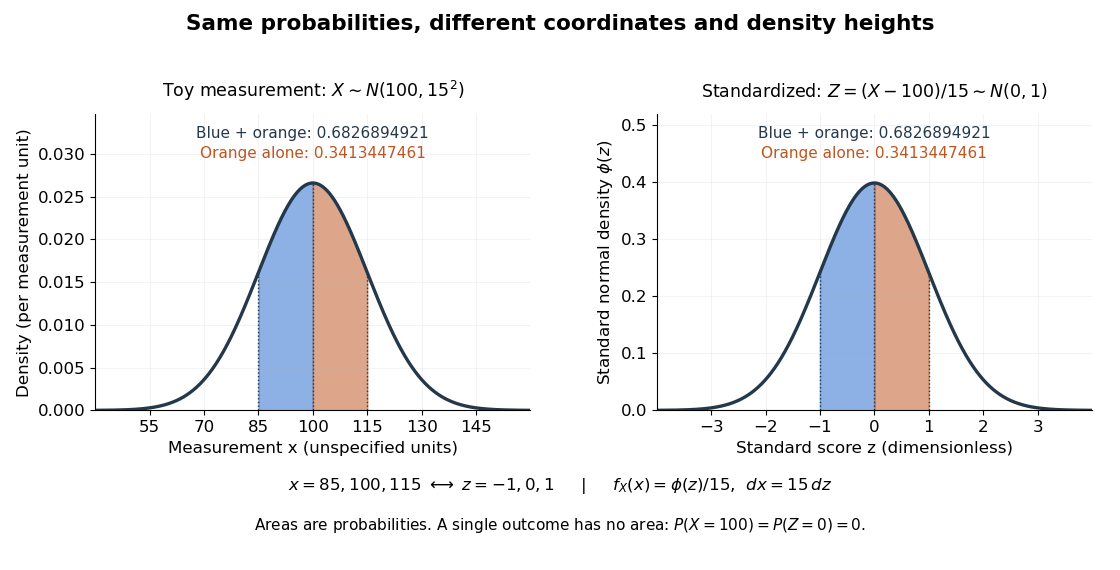
The standard normal distribution is : the normal distribution with mean zero, variance one and standard deviation one. Its standard normal density integrates to one; its standard normal distribution function records the area accumulated from to a threshold. The distinction matters: , , and for a standard normal random variable .
For a toy measurement , leave the measurement unit unspecified. The standardization of a normal random variable converts into standard scores . Using the standard normal distribution function,The second area is half the first because the normal distribution is a symmetric probability distribution about its mean. The numerical heights differ: , yet the corresponding shaded areas are equal because in the change of variables.
A positive Random variable is log-normal if its logarithm has a Normal distribution. For parameters and , write with standard normal. The change of variables gives the densityThe parameters describe the logarithm, not the mean and standard deviation of itself.
The normal Moment-generating function gives every real power moment:Consequently the mean is , the variance is , and the median is . For , the median is one but the mean is , illustrating the right-skewed shape.
All power moments are finite, yet for every . Indeed the normal-coordinate integral contains , whose exponential-of-exponential growth defeats the Gaussian tail as . Thus log-normal laws are heavy-tailed in the positive-exponential-moment convention despite having finite variance.
independent log-normal factors multiply to a log-normal variable because their logarithms add as independent normal variables. This is the natural setting for positive quantities with multiplicative variability. The case is a deterministic positive limit, rather than a law with the displayed density.
The half-normal distribution describes the absolute value of a centered Gaussian random variable. Its unit-scale version is for a standard normal random variable . It folds the negative half of the standard normal distribution onto the positive half, retaining the size of a deviation while discarding its sign. If a centered Gaussian random variable models measurement error, its magnitude therefore has a half-normal distribution.Here is the standard normal density and is the standard normal distribution function. For , the event is , so the symmetric probability distribution of gives . The upper-tail probability is therefore . For example, . The doubled probability density function integrates to one on , and .
The mean and variance of the unit-scale half-normal distribution areFor a short derivation, because , while gives . More generally, for has a half-normal distribution with probability density function for . Its mean is and its variance is ; here is the scale of the underlying Gaussian random variable, not the standard deviation of its absolute value.
The classical zero-free region asserts that for some ,Together with bounds for the logarithmic derivative, it permits contour arguments with exponentially small errors in .
The Riemann hypothesis asserts that every Nontrivial zero of the Riemann zeta function lies on the critical line .
local polynomial regression fits a low-degree polynomial by weighted least squares near each target point.
A linear estimator at has the form , where the weights depend on the design and tuning parameters but not on the observed responses.
Two-dimensional Barenblatt solution with diffusivity proportional to concentration by Codex 0 Created 2026-09-24 Updated 2026-10-05
Codex 0 Created 2026-09-24 Updated 2026-10-05 Representation of a bilinear form relative to a nondegenerate bilinear form by Codex 0 Created 2026-09-24 Updated 2026-11-05
Codex 0 Created 2026-09-24 Updated 2026-11-05Let be a nondegenerate bilinear form on a finite-dimensional vector space . Every bilinear form on has a unique representationby a linear map . Thus a fixed nonsingular pairing converts another two-input form into a one-input linear operator.
For each , the rule is a linear functional. Nondegeneracy of identifies every such linear functional with for a unique ; define . Bilinearity of makes linear, and uniqueness follows from the same nondegeneracy.
If and are the bilinear form matrices of and in one basis, thenFor the standard dot product on and , the representing matrix is . Finally, the right radical of is exactly : annihilating every first input is equivalent to .
A symplectic vector space is a vector space equipped with a nondegenerate bilinear form that is an alternating bilinear form: for every vector . This implies . When the characteristic is two, that latter equation alone does not imply the alternating condition. A symplectic vector space of finite dimension has even dimension: splitting off a hyperbolic pair leaves a smaller nondegenerate bilinear form, and repeating gives a decomposition into two-dimensional planes.
Pinned article: Introduction to the OurBigBook Project
Welcome to the OurBigBook Project! Our goal is to create the perfect publishing platform for STEM subjects, and get university-level students to write the best free STEM tutorials ever.
Everyone is welcome to create an account and play with the site: ourbigbook.com/go/register. We belive that students themselves can write amazing tutorials, but teachers are welcome too. You can write about anything you want, it doesn't have to be STEM or even educational. Silly test content is very welcome and you won't be penalized in any way. Just keep it legal!
Intro to OurBigBook
. Source. We have two killer features:
- topics: topics group articles by different users with the same title, e.g. here is the topic for the "Fundamental Theorem of Calculus" ourbigbook.com/go/topic/fundamental-theorem-of-calculusArticles of different users are sorted by upvote within each article page. This feature is a bit like:
- a Wikipedia where each user can have their own version of each article
- a Q&A website like Stack Overflow, where multiple people can give their views on a given topic, and the best ones are sorted by upvote. Except you don't need to wait for someone to ask first, and any topic goes, no matter how narrow or broad
This feature makes it possible for readers to find better explanations of any topic created by other writers. And it allows writers to create an explanation in a place that readers might actually find it.
Figure 1. Screenshot of the "Derivative" topic page. View it live at: ourbigbook.com/go/topic/derivativeVideo 2. OurBigBook Web topics demo. Source. - local editing: you can store all your personal knowledge base content locally in a plaintext markup format that can be edited locally and published either:This way you can be sure that even if OurBigBook.com were to go down one day (which we have no plans to do as it is quite cheap to host!), your content will still be perfectly readable as a static site.
- to OurBigBook.com to get awesome multi-user features like topics and likes
- as HTML files to a static website, which you can host yourself for free on many external providers like GitHub Pages, and remain in full control

Figure 2. You can publish local OurBigBook lightweight markup files to either OurBigBook.com or as a static website.
Figure 3. Visual Studio Code extension installation.
Figure 5. . You can also edit articles on the Web editor without installing anything locally. Video 3. Edit locally and publish demo. Source. This shows editing OurBigBook Markup and publishing it using the Visual Studio Code extension. 
- Infinitely deep tables of contents:



All our software is open source and hosted at: github.com/ourbigbook/ourbigbook
Further documentation can be found at: docs.ourbigbook.com
Feel free to reach our to us for any help or suggestions: docs.ourbigbook.com/#contact