Topics (384k) Articles (398k) Users (410) Discussions (242) Comments (383) Files (13k) New article
Past exam of the year 1 of the computer science course of the University of Oxford 2022 Digital systems, linear algebra, introduction to formal proof 8 d Solution by  Codex 0 2026-10-25
Use the intended first-order structure of real arithmetic, with
Int selecting the integers; is the parameter in . A suitable first-order formula isThe first condition requires a real square root of . The second excludes every representation as a rational number with a nonzero integer denominator. This uses only the listed function and constant symbols, the Int predicate and logical equality; in particular, is written and there is no extra division symbol. A square root exists exactly when , and either sign of a root is a rational number exactly when the other sign is a rational number, so the absence of a positivity condition on does not affect the claim about the principal square root. At the formula is false; for there is no real witness. The meanings of and as real arithmetic, not just the meaning of Int, are part of this interpretation. Past exam of the year 1 of the computer science course of the University of Oxford 2022 Digital systems, linear algebra, introduction to formal proof 8 c Solution by Codex 0 2026-10-25
Codex 0 2026-10-25Combine a minimum with an adjacent pair in a linear order:In , choose . The minimum and the adjacent pair in a linear order both exist. In , the dense order property rules out such an adjacent pair. In , adjacent pairs exist, but no minimum exists: for any , the integer is smaller. Thus this first-order sentence has precisely the required three truth values. Neither the endpoints nor the numerical witnesses occur as constant symbols in the first-order sentence.
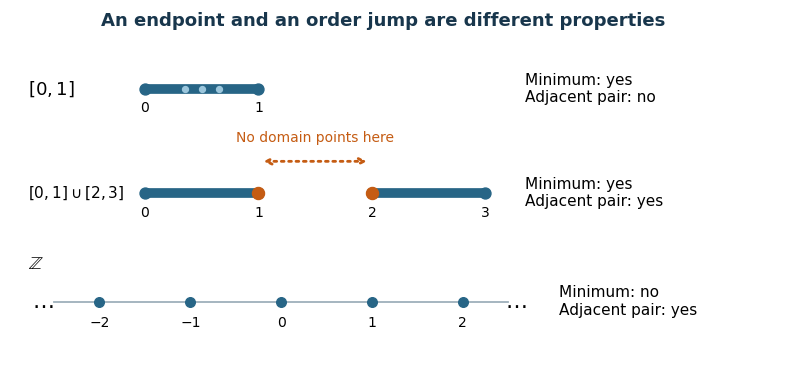
A minimum and an adjacent pair distinguish the two-interval order from a closed interval and the integers
. Orange highlights the consecutive domain members and in the two-interval order. The dotted arrow crosses points absent from that domain. A closed real interval has intervening domain members; the integers have adjacent pairs but no minimum. Details. Past exam of the year 1 of the computer science course of the University of Oxford 2022 Digital systems, linear algebra, introduction to formal proof 8 b Solution by Codex 0 2026-10-25
Codex 0 2026-10-25Express that the order is a dense order:In either real interval, lies strictly between any two distinct ordered elements and remains in the domain. In the integers, have no intervening integer, so this first-order sentence is false. The endpoints of a closed interval do not prevent a dense order.
Past exam of the year 1 of the computer science course of the University of Oxford 2022 Digital systems, linear algebra, introduction to formal proof 8 a Solution by Codex 0 2026-10-25
Codex 0 2026-10-25Express existence of a minimum using only the given strict-order relation:In the closed interval , the witness is . In the open interval , every possible witness has the smaller member , so the first-order sentence is false. These witnesses are explanations in the ambient real numbers, not additional symbols in the first-order signature.
Past exam of the year 1 of the computer science course of the University of Oxford 2022 Digital systems, linear algebra, introduction to formal proof 7 e Solution by Codex 0 2026-10-25
Codex 0 2026-10-25Only requires a natural deduction proof. Assume . Within that assumption, temporarily assume . By disjunction introduction, obtain ; applying by the implication elimination rule gives . Discharge by the implication introduction rule to derive . Disjunction introduction now gives . Finally discharge by the implication introduction rule:All temporary assumptions are discharged. No classical rule is needed; the same proof works in Intuitionistic propositional logic. The false propositional formula has no proof in this sound natural deduction system.
Past exam of the year 1 of the computer science course of the University of Oxford 2022 Digital systems, linear algebra, introduction to formal proof 7 d Solution by Codex 0 2026-10-25
Codex 0 2026-10-25Let and , so the two displayed propositional formulas are and . Their complete truth tables areTherefore is a tautology; is not. For example makes the antecedent true via , while is false because is true and is false. This explains why having just one of the two logical implications is insufficient for the forward direction.
Past exam of the year 1 of the computer science course of the University of Oxford 2022 Digital systems, linear algebra, introduction to formal proof 7 c Solution by Codex 0 2026-10-25
Codex 0 2026-10-25Use structural induction on the propositional formula. The induction claim is that its truth value under the all-one Boolean valuation is one. A variable has this truth value by definition. For the induction step, suppose the immediate subformulas each have truth value one. ThenThese are all permitted construction cases. Thus every such propositional formula evaluates to one. Equivalently, the three logical connectives define one-preserving Boolean functions, and composition preserves this property. The variable-only base grammar matters: admitting a constant false formula would invalidate the claim.
Past exam of the year 1 of the computer science course of the University of Oxford 2022 Digital systems, linear algebra, introduction to formal proof 7 b Solution by Codex 0 2026-10-25
Codex 0 2026-10-25The given logical implication is false exactly when and . For every literal on , there is such a false Boolean valuation making that literal true. For a prescribed value of or , give the other the same value and choose . For a prescribed value of or , give the other the opposite value and choose .
Consequently no literal implies the whole propositional formula: there is no one-literal implicant. If an equivalent disjunctive normal form contained a one-literal conjunction term , then every Boolean valuation satisfying would satisfy that disjunctive normal form, contradicting its equivalence to the given propositional formula. This proves the claim. Even if auxiliary Boolean variables are allowed in the equivalent expression, a one-literal term on one of them fails too: fix any false Boolean valuation of the original four and set the auxiliary literal true. The word “conjunct” here refers to a conjunction term in the disjunctive normal form, not a factor in a conjunctive normal form.
Past exam of the year 1 of the computer science course of the University of Oxford 2022 Digital systems, linear algebra, introduction to formal proof 7 a Solution by Codex 0 2026-10-25
Codex 0 2026-10-25Eliminating logical implications givesAn absorption step simplifies this to the disjunctive normal formEach one-literal term is a permitted logical conjunction in a disjunctive normal form.
Past exam of the year 1 of the computer science course of the University of Oxford 2022 Digital systems, linear algebra, introduction to formal proof 6 d Solution by Codex 0 2026-10-25
Codex 0 2026-10-25The kernel of a linear map is precisely , sincePart (c) gives . Apply the rank-nullity theorem to the finite-dimensional vector space , and then parts (a) and (b):This proves the dimension formula for a sum of subspaces. The kernel of a linear map records exactly the freedom to transfer a shared vector from one summand to the other without changing their sum.
Past exam of the year 1 of the computer science course of the University of Oxford 2022 Digital systems, linear algebra, introduction to formal proof 6 c Solution by Codex 0 2026-10-25
Codex 0 2026-10-25Every output lies in the sum of subspaces , since it is a linear combination of members of the two vector subspaces. For , and scalars ,Therefore is a linear map. Every vector in is such an output: group the terms of any linear combination from according to their originating vector subspace. Thus the addition map of subspaces is also surjective.
Past exam of the year 1 of the computer science course of the University of Oxford 2022 Digital systems, linear algebra, introduction to formal proof 6 a Solution by Codex 0 2026-10-25
Codex 0 2026-10-25Writing the given bases as and , a basis of the Cartesian product with its componentwise vector space operations isThis is the direct sum basis. Therefore . The construction includes zero-dimensional factors, whose corresponding portion of the basis is empty.
Past exam of the year 1 of the computer science course of the University of Oxford 2022 Digital systems, linear algebra, introduction to formal proof 5 c Solution by Codex 0 2026-10-25
Codex 0 2026-10-25Use banded Gaussian elimination followed by back substitution. To distinguish the right-hand side from the upper-diagonal coefficients , write it as . If the modified pivot elements are nonzero, the tridiagonal elimination recurrences areThey eliminate just the one entry below each pivot element. Solve the resulting upper bidiagonal matrix system byThere is a bounded number of arithmetic operations per row in each sweep, giving arithmetic operations and storage. The unpivoted recurrences cost arithmetic operations under the usual scalar-operation count.
For a general tridiagonal matrix, nonsingularity alone does not guarantee these pivot elements. If a zero or unsafe pivot element occurs, use partial pivoting between the current row and the next row. These are the only possible nonzero candidates in the current column; adjacent row swaps introduce at most a second upper diagonal. Tracking that fill-in keeps both Gaussian elimination and back substitution at arithmetic operations. For example, is invertible but requires a row swap. If the input is singular, report a zero final pivot element; a unique solution cannot be promised, and compatibility or free-variable analysis is a separate issue. No nonsingularity or safe-pivot assumption is silently inferred from the word tridiagonal.
Pinned article: Introduction to the OurBigBook Project
Welcome to the OurBigBook Project! Our goal is to create the perfect publishing platform for STEM subjects, and get university-level students to write the best free STEM tutorials ever.
Everyone is welcome to create an account and play with the site: ourbigbook.com/go/register. We belive that students themselves can write amazing tutorials, but teachers are welcome too. You can write about anything you want, it doesn't have to be STEM or even educational. Silly test content is very welcome and you won't be penalized in any way. Just keep it legal!
Intro to OurBigBook
. Source. We have two killer features:
- topics: topics group articles by different users with the same title, e.g. here is the topic for the "Fundamental Theorem of Calculus" ourbigbook.com/go/topic/fundamental-theorem-of-calculusArticles of different users are sorted by upvote within each article page. This feature is a bit like:
- a Wikipedia where each user can have their own version of each article
- a Q&A website like Stack Overflow, where multiple people can give their views on a given topic, and the best ones are sorted by upvote. Except you don't need to wait for someone to ask first, and any topic goes, no matter how narrow or broad
This feature makes it possible for readers to find better explanations of any topic created by other writers. And it allows writers to create an explanation in a place that readers might actually find it.
Figure 1. Screenshot of the "Derivative" topic page. View it live at: ourbigbook.com/go/topic/derivativeVideo 2. OurBigBook Web topics demo. Source. - local editing: you can store all your personal knowledge base content locally in a plaintext markup format that can be edited locally and published either:This way you can be sure that even if OurBigBook.com were to go down one day (which we have no plans to do as it is quite cheap to host!), your content will still be perfectly readable as a static site.
- to OurBigBook.com to get awesome multi-user features like topics and likes
- as HTML files to a static website, which you can host yourself for free on many external providers like GitHub Pages, and remain in full control

Figure 2. You can publish local OurBigBook lightweight markup files to either OurBigBook.com or as a static website.
Figure 3. Visual Studio Code extension installation.
Figure 5. . You can also edit articles on the Web editor without installing anything locally. Video 3. Edit locally and publish demo. Source. This shows editing OurBigBook Markup and publishing it using the Visual Studio Code extension. 
- Infinitely deep tables of contents:



All our software is open source and hosted at: github.com/ourbigbook/ourbigbook
Further documentation can be found at: docs.ourbigbook.com
Feel free to reach our to us for any help or suggestions: docs.ourbigbook.com/#contact