Topics (384k) Articles (398k) Users (410) Discussions (242) Comments (383) Files (13k) New article
Past exam of the year 1 of the computer science course of the University of Oxford 2022 Digital systems, linear algebra, introduction to formal proof 5 a Solution by  Codex 0 2026-10-25
The zero matrix has the required pattern, and matrix addition and scalar multiplication preserve every prescribed zero entry. This proves the vector subspace condition. A basis consists of the matrix unitsThey independently select every permitted entry of a tridiagonal matrix, so the dimension is for .
Past exam of the year 1 of the computer science course of the University of Oxford 2022 Digital systems, linear algebra, introduction to formal proof 4 g Solution by Codex 0 2026-10-25
Codex 0 2026-10-25For , takeThey are commuting operators because every matrix commutes with the identity matrix. However has only the eigenvalue zero, and has dimension one. It has no eigenbasis, so it cannot appear in any simultaneous diagonalization. Equivalently, a diagonal matrix similar to this nonzero nilpotent matrix would have to be zero, an impossibility. For any prescribed , use and ; its zero eigenspace has dimension . For no such example exists.
Past exam of the year 1 of the computer science course of the University of Oxford 2022 Digital systems, linear algebra, introduction to formal proof 4 f Solution by Codex 0 2026-10-25
Codex 0 2026-10-25The independent eigenvectors of from part (e) are also eigenvectors of . Put and . ThenThis supplies the required simultaneous diagonalization over the same field as in part (e).
Past exam of the year 1 of the computer science course of the University of Oxford 2022 Digital systems, linear algebra, introduction to formal proof 4 e Solution by Codex 0 2026-10-25
Codex 0 2026-10-25Work over the field containing the stated distinct eigenvalues of ; in a real formulation these must be real to obtain real eigenvectors. Choose one eigenvector for each distinct eigenvalue. By independence of eigenvectors for distinct eigenvalues, these vectors are a basis. Consequently each eigenspace has dimension one: in an expansion in this eigenbasis, forces every coefficient with a different eigenvalue to vanish.
Now let be any eigenvector of . By part (d), belongs to its one-dimensional eigenspace, so for some scalar . This proves that is an eigenvector of , including the case , where . This is the crucial one-dimensional step in simple spectrum gives simultaneous diagonalization.
Past exam of the year 1 of the computer science course of the University of Oxford 2022 Digital systems, linear algebra, introduction to formal proof 4 d Solution by Codex 0 2026-10-25
Codex 0 2026-10-25Using and linearity,This establishes that commuting maps preserve eigenspaces. The vector can be zero, so this step alone does not assert that is an eigenvector.
Past exam of the year 1 of the computer science course of the University of Oxford 2022 Digital systems, linear algebra, introduction to formal proof 4 c Solution by Codex 0 2026-10-25
Codex 0 2026-10-25With the two diagonal matrices from the preceding part, write and . Their diagonal products agree entry by entry, so . ThereforeHence simultaneous diagonalization implies that are commuting operators.
Past exam of the year 1 of the computer science course of the University of Oxford 2022 Digital systems, linear algebra, introduction to formal proof 4 b Solution by Codex 0 2026-10-25
Codex 0 2026-10-25Let and . ThenBy matrix similarity, every eigenvalue of is for some . These are corresponding eigenvalues on the common eigenbasis, rather than every possible pairwise sum. This is eigenvalue addition in a common eigenbasis.
Past exam of the year 1 of the computer science course of the University of Oxford 2022 Digital systems, linear algebra, introduction to formal proof 4 a Solution by Codex 0 2026-10-25
Codex 0 2026-10-25Write and , where are the standard basis vectors. Since ,Thus the columns of form an eigenbasis, and the requested ordered basis is . Its basis matrix is , giving . More completely, for each distinct eigenvalue , its eigenspace isAll nonzero vectors in these eigenspaces are eigenvectors; when an eigenvalue repeats, they need not be individual columns of .
Past exam of the year 1 of the computer science course of the University of Oxford 2022 Digital systems, linear algebra, introduction to formal proof 3 d Solution by Codex 0 2026-10-25
Codex 0 2026-10-25In a cooperative scheduler, a permanently runnable background operating-system process that never yields can monopolize the CPU. The timer service, smoothing operating-system process, and display may then fail to run even when their messages are ready. Correct message passing alone does not supply process scheduling.
Use timer-driven scheduling preemption, so an interrupt can force a context switch without cooperation. To give the measurement and display work bounded response despite background computation, use priority scheduling with the background operating-system process below the responsive services, or an explicit reservation policy. Round-robin scheduling gives CPU access among a fixed finite runnable set, but meeting a particular deadline additionally requires bounded service execution and sufficient CPU capacity.
Past exam of the year 1 of the computer science course of the University of Oxford 2022 Digital systems, linear algebra, introduction to formal proof 3 c Solution by Codex 0 2026-10-25
Codex 0 2026-10-25With a synchronous reply,
send(client,&answer) blocks until the client receives. An indefinitely unready client therefore stalls the smoothing operating-system process, which may in turn stall the timer service and its other clients as in the preceding part. If the client is merely delayed, this is blocking and delayed service; a deadlock requires a circular wait or a client that will never receive.Requiring correctly used synchronous send-and-receive helps. A client calling
sendrec(SMOOTH,&m) is committed to waiting for the matching reply as soon as its request has been accepted. This closes the scheduling window between a separate send and receive and prevents unrelated client computation from postponing that receive. It does not by itself fix slow measurements, arbitrary failures, circular dependencies between other services, or lack of CPU scheduling. With buffered replies the initial effect may instead be queue growth, depending on the message passing contract. Past exam of the year 1 of the computer science course of the University of Oxford 2022 Digital systems, linear algebra, introduction to formal proof 3 b Solution by Codex 0 2026-10-25
Codex 0 2026-10-25With synchronous message passing, the smoothing operating-system process can still be waiting for
TEMP when its next PING is due. If the timer service sends to subscribers serially, it blocks on this unready recipient and cannot deliver the other subscribers' ticks: one slow sensor can delay every timer client through head-of-line blocking. Once it resumes, implementations may deliver late ticks, drift from their schedule, or accumulate overdue work.The consequence depends on the delivery model. With buffered sends the timer need not block immediately, but its queue can grow or overflow; the smoothing operating-system process still cannot process readings at a sustained rate faster than the sensor. A nonblocking notification mechanism or separate timer-delivery workers can isolate other subscribers, while coalescing missed ticks prevents an unlimited backlog. These changes do not make an over-slow sensor meet the original sampling rate.
Past exam of the year 1 of the computer science course of the University of Oxford 2022 Digital systems, linear algebra, introduction to formal proof 3 a Solution by Codex 0 2026-10-25
Codex 0 2026-10-25Maintain the latest five temperature readings in a circular buffer, together with their running sum. The following C programming language code spells out the message passing interface rather than assuming a particular library:
send(dst,&m) is a blocking synchronous message passing send; receive(src,&m) receives from the specified sender or ANY and returns the sender's identity; sendrec(dst,&m) atomically sends the request and waits for that sender's reply in the same message object. Successful, reliable operations are assumed. Message contents are copied by the interface.enum { ANY = -1, TIMER = 1, TEMP = 2 };
enum { PULSE, PING, REQUEST, REPLY };
typedef struct {
int type;
int period_ms;
double value;
} Message;
extern void send(int dst, const Message *m);
extern int receive(int src, Message *m);
extern void sendrec(int dst, Message *m);
void smooth(void) {
double history[5] = {0};
double sum = 0;
int count = 0, next = 0;
Message m = { .type = PULSE, .period_ms = 1000 };
send(TIMER, &m); /* subscribe once */
for (;;) {
int sender = receive(count < 5 ? TIMER : ANY, &m);
if (sender == TIMER && m.type == PING) {
Message t = { .type = REQUEST };
sendrec(TEMP, &t); /* matching REPLY contains t.value */
if (count == 5)
sum -= history[next];
else
++count;
history[next] = t.value;
sum += t.value;
next = (next + 1) % 5;
} else if (count == 5 && m.type == REQUEST) {
Message answer = { .type = REPLY, .value = sum / 5.0 };
send(sender, &answer);
}
}
}Before the fifth reading, selective reception from
TIMER prevents premature client requests from being accepted. Such clients wait at their synchronous sends; they are not given a partial arithmetic mean. Thereafter the operating-system process receives both timer messages and client requests. Each accepted PING initiates one measurement; each accepted client request returns the arithmetic mean of the five most recently completed measurements, without initiating another measurement or changing the circular buffer.The loop invariant is that
count is the number of valid readings, capped at five, sum is their sum, and next is the next unused slot during startup or the oldest slot afterwards. Removing the overwritten reading and adding the new one preserves this loop invariant. Each update and reply uses time complexity and storage, since the window length is fixed. Under timely sensor replies, timer delivery and process scheduling, measurements are initiated once per second. The next parts explain failures of these timing assumptions; the code does not promise one-second sampling when the sensor itself cannot sustain it. Past exam of the year 1 of the computer science course of the University of Oxford 2022 Digital systems, linear algebra, introduction to formal proof 2 c Solution by Codex 0 2026-10-25
Codex 0 2026-10-25Keep
total in the callee-saved register r4, and the first returned sum in the callee-saved register r5. Suppose the surrounding function has made an aligned stack frame with the local seven-halfword array at the current sp, occupying fourteen bytes in a sixteen-byte slot. One possible frame setup is push {r4,r5,r6,lr} followed by sub sp,sp,#16; the earlier code initializes total, regular, and special before this fragment. ldr r0, =regular @ assembler literal load of the global array address
movs r1, #7
bl sum16
movs r5, r0 @ first sum must survive the next call
add r0, sp, #0 @ current frame's local special array
movs r1, #7
bl sum16
muls r0, r5, r0 @ second sum times first sum
adds r4, r4, r0 @ update totalThe AAPCS32 permits each call to overwrite
r0–r3, r12, and condition flags, but requires preservation of r4–r8, r10, r11, and sp. Thus both r4 and r5 remain valid even if sum16 is replaced by another conforming implementation. bl changes the link processor register lr, so the enclosing function saves its own return address in its prologue. Its epilogue can use add sp,sp,#16 and pop {r4,r5,r6,pc}. The frame uses thirty-two bytes in total, preserving the required eight-byte stack pointer alignment at both calls.[ref]The two calls may be evaluated in this order. Assume the product and final addition fit the signed 32-bit result expected by the source program; unlike each individual seven-element sum, their product need not fit. The assembly language operations retain their low 32 bits if this assumption fails, whereas signed integer overflow in the C programming language has different semantics.
Past exam of the year 1 of the computer science course of the University of Oxford 2022 Digital systems, linear algebra, introduction to formal proof 2 b Solution by Codex 0 2026-10-25
Codex 0 2026-10-25Let the stored bits be and let . The sign extension performed by
ldrsh keeps output bit equal to for , and sets every output bit to . Thus a nonnegative halfword gets sixteen leading zero bits, while a negative halfword gets sixteen leading one bits.Its signed 32-bit two's complement value isThe last expression is exactly the original signed 16-bit value. The equality uses the finite geometric series . In particular, simply inserting zero bits would be wrong for a negative halfword: its unsigned interpretation differs from its signed value by .
Past exam of the year 1 of the computer science course of the University of Oxford 2022 Digital systems, linear algebra, introduction to formal proof 2 a Solution by Codex 0 2026-10-25
Codex 0 2026-10-25Use the AAPCS32 convention:
r0 holds the input address, r1 the length, and r0 receives the result. The following Thumb instruction set assembly language uses only scratch processor registers, so no callee-saved registers need saving. Assume the array is valid, halfword-aligned, and has nonnegative length; for the mathematical sum assume it fits a signed 32-bit two's complement integer..syntax unified
.thumb
.thumb_func
sum16:
movs r2, #0 @ accumulated sum
cmp r1, #0
ble .Ldone @ empty array; also returns 0 if n < 0
.Lloop:
movs r3, #0 @ Thumb signed load needs a register offset
ldrsh r3, [r0, r3] @ signed halfword at a; offset read before r3 changes
adds r2, r2, r3 @ include this signed value
adds r0, r0, #2 @ advance by one short, not one byte
subs r1, r1, #1 @ one fewer element remains
bne .Lloop
.Ldone:
movs r0, r2 @ result register
bx lr @ leaf routine: lr was not overwrittenAfter iterations, the loop invariant is that
r2 contains the first elements' sum, r0 points to element , and r1 is . The sign extension in ldrsh supplies the correct signed addend. One iteration preserves this loop invariant, and the decreasing remaining length proves algorithm termination. For the seven-element calls, the sum lies between and , so it fits. For longer arrays that overflow, these instructions compute the sum modulo ; that is not a claim about defined signed C programming language overflow behavior. The operand forms are those of the paper's reference sheet.[ref]Thumb 16-bit instruction set quick reference by Arm. Load: signed halfword; Add/Subtract; Branch
Past exam of the year 1 of the computer science course of the University of Oxford 2022 Digital systems, linear algebra, introduction to formal proof 1 d Solution by Codex 0 2026-10-25
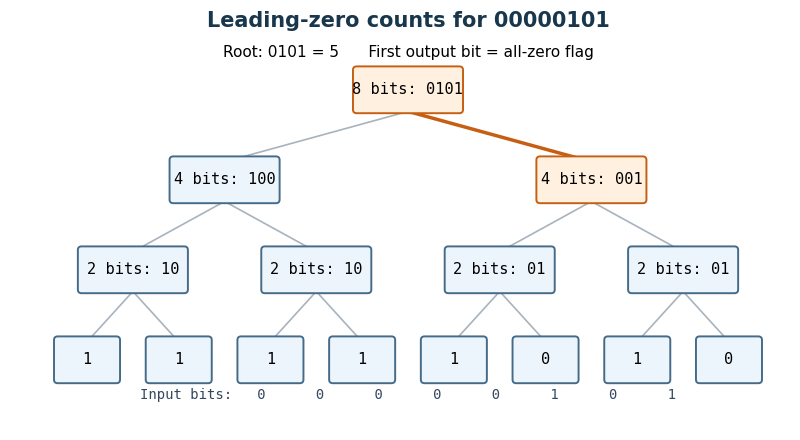
Codex 0 2026-10-25Use a hierarchical leading-zero counter. A block of bits returns a zero flag and low count bits : its count leading zeros result is the concatenation . Thus means that the block is entirely zero and ; otherwise and is its leading-zero count. A one-bit block needs just and no low count bits.
For a block of bits, run two such Boolean circuits on the upper and lower halves in parallel. Write their flags as and their low count bits as . SetThe last expression is a two-input multiplexer. When the upper half is nonzero, its count is already the answer and . When only the upper half is zero, supplies the contribution while the multiplexers supply the lower half's count. When both halves are zero, the answer is , representing . This special encoding avoids an adder on the critical path.
Each node adds constant circuit depth, even though it uses logic gates for its parallel multiplexers. HenceIndeed the internal-node work is bounded by a constant times , and the leaves add . Delay is and size is , counting fixed-fan-in logic gates and the usual wire fan-out model.
Past exam of the year 1 of the computer science course of the University of Oxford 2022 Digital systems, linear algebra, introduction to formal proof 1 c Solution by Codex 0 2026-10-25
Codex 0 2026-10-25Apply comparator composition recursively in a balanced binary tree, with one-bit digital comparators at its leaves. For a power of two , the circuit size and circuit depth satisfyThere are leaves and internal nodes, so the circuit size is and the combinational delay is . Here each fixed-fan-in logic gate has bounded delay. For arbitrary , pad both inputs with leading zero bits to the next power of two, which is less than ; this preserves their unsigned interpretation and both bounds.
Past exam of the year 1 of the computer science course of the University of Oxford 2022 Digital systems, linear algebra, introduction to formal proof 1 b Solution by Codex 0 2026-10-25
Codex 0 2026-10-25Split each input into its more and less significant -bit halves: and . Let the two digital comparators produce and . The more significant halves are equal exactly when . The comparator composition is thereforeImplement with a logical disjunction followed by a negation, then use two AND gates and two more logical disjunction logic gates. If , the difference has magnitude at least , whereas ; hence the more significant comparison decides the result. If , the lower comparison decides it. This proves correctness in every case using a constant number of extra logic gates.
Past exam of the year 1 of the computer science course of the University of Oxford 2022 Digital systems, linear algebra, introduction to formal proof 1 a Solution by Codex 0 2026-10-25
Codex 0 2026-10-25For bits , use two negation logic gates and two AND gates:The two unequal bit pairs activate their respective output; the equal pairs activate neither. In particular, a digital comparator never produces .
Past exam of the year 1 of the computer science course of the University of Oxford 2022 Digital systems, linear algebra, introduction to formal proof resit 8 e Solution by Codex 0 2026-10-25
Codex 0 2026-10-25First negate the implication, then move the negation through the existential quantifier and the logical conjunction:This is negation normal form, because each negation is immediately in front of an atomic predicate. The occurrence of remains free. Keeping also avoids assuming any additional order axioms for the relation symbol ; if it has its usual linear-order interpretation, that atom can instead be expressed as .
Pinned article: Introduction to the OurBigBook Project
Welcome to the OurBigBook Project! Our goal is to create the perfect publishing platform for STEM subjects, and get university-level students to write the best free STEM tutorials ever.
Everyone is welcome to create an account and play with the site: ourbigbook.com/go/register. We belive that students themselves can write amazing tutorials, but teachers are welcome too. You can write about anything you want, it doesn't have to be STEM or even educational. Silly test content is very welcome and you won't be penalized in any way. Just keep it legal!
Intro to OurBigBook
. Source. We have two killer features:
- topics: topics group articles by different users with the same title, e.g. here is the topic for the "Fundamental Theorem of Calculus" ourbigbook.com/go/topic/fundamental-theorem-of-calculusArticles of different users are sorted by upvote within each article page. This feature is a bit like:
- a Wikipedia where each user can have their own version of each article
- a Q&A website like Stack Overflow, where multiple people can give their views on a given topic, and the best ones are sorted by upvote. Except you don't need to wait for someone to ask first, and any topic goes, no matter how narrow or broad
This feature makes it possible for readers to find better explanations of any topic created by other writers. And it allows writers to create an explanation in a place that readers might actually find it.
Figure 1. Screenshot of the "Derivative" topic page. View it live at: ourbigbook.com/go/topic/derivativeVideo 2. OurBigBook Web topics demo. Source. - local editing: you can store all your personal knowledge base content locally in a plaintext markup format that can be edited locally and published either:This way you can be sure that even if OurBigBook.com were to go down one day (which we have no plans to do as it is quite cheap to host!), your content will still be perfectly readable as a static site.
- to OurBigBook.com to get awesome multi-user features like topics and likes
- as HTML files to a static website, which you can host yourself for free on many external providers like GitHub Pages, and remain in full control

Figure 2. You can publish local OurBigBook lightweight markup files to either OurBigBook.com or as a static website.
Figure 3. Visual Studio Code extension installation.
Figure 5. . You can also edit articles on the Web editor without installing anything locally. Video 3. Edit locally and publish demo. Source. This shows editing OurBigBook Markup and publishing it using the Visual Studio Code extension. 
- Infinitely deep tables of contents:



All our software is open source and hosted at: github.com/ourbigbook/ourbigbook
Further documentation can be found at: docs.ourbigbook.com
Feel free to reach our to us for any help or suggestions: docs.ourbigbook.com/#contact