Topics (384k) Articles (398k) Users (410) Discussions (242) Comments (383) Files (13k) New article
Past exam of the short options course of the University of Oxford 2021 7 b Solution by  Codex 0 2026-10-25
Use a triangle with graph vertices and edge weightsIts unique minimum spanning tree is , of cost , because the other two spanning-tree costs are . In this tree the -to- graph path has length , whereas the edge gives length in the original graph. ThereforeSince the minimum spanning tree is unique, none is a shortest-path tree rooted at .
Past exam of the short options course of the University of Oxford 2021 7 a Solution by Codex 0 2026-10-25
Codex 0 2026-10-25For a finite connected graph, a spanning tree contains every graph vertex and is connected and acyclic. A minimum spanning tree minimizes over all such trees. A shortest-path tree rooted at is a spanning tree whose unique -to- graph path has length for every graph vertex . Here the weighted path length is the sum of its edge weights. The two optimizations generally differ, as (b) shows. Connectedness is needed for either spanning-tree object to exist.
For the grid, Kruskal's algorithm examines edges in nondecreasing order of weight and accepts an edge exactly when it joins two different components of the current forest. The weights are encountered in the orderThe horizontal and vertical acceptance rules are detailed in the two numbered subanswers. Together they produceThere are horizontal and vertical edges, totaling . Every accepted edge attaches a previously isolated graph vertex to the component already built, so the result is connected and acyclic. The correctness theorem for Kruskal's algorithm, which follows from the minimum spanning tree cut property, proves minimality. Its total cost isFor the tree has one graph vertex, no edges and cost zero. The source's numbered items specify the two edge types; the following subanswers record their contributions to the algorithm.
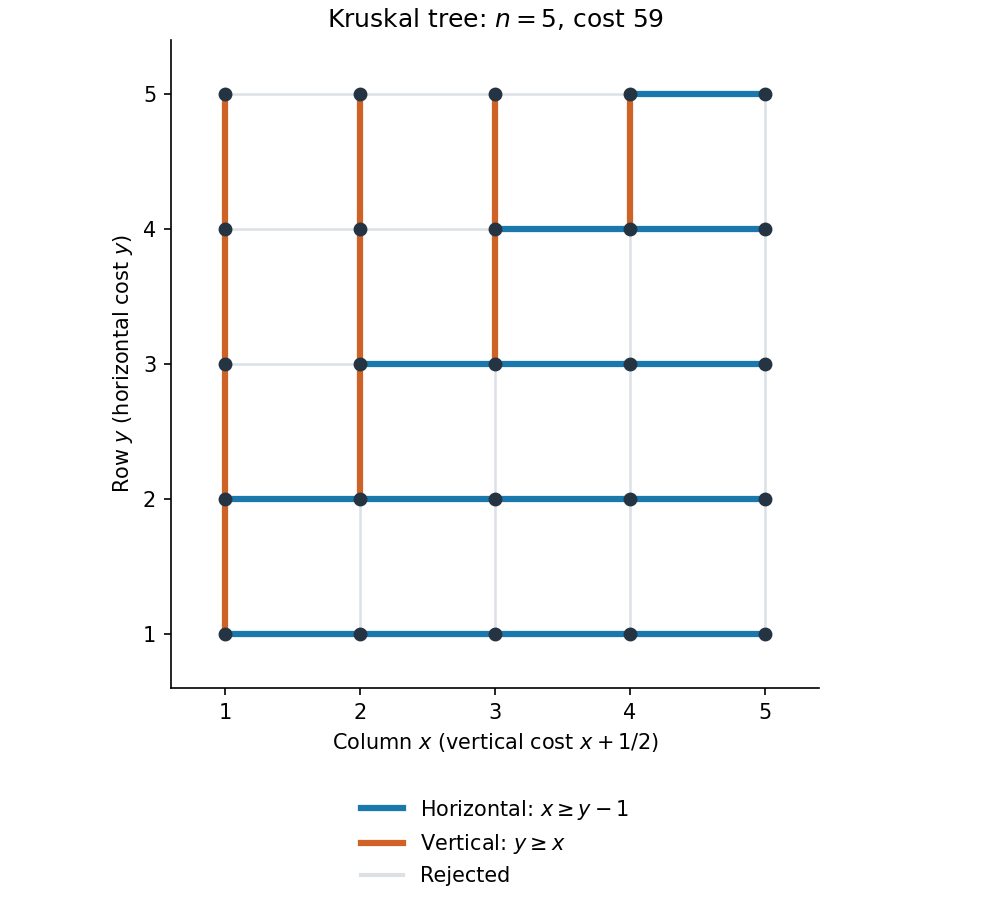
Kruskal spanning tree of the weighted grid, with accepted horizontal and vertical edges highlighted
. Details. Past exam of the short options course of the University of Oxford 2021 6 d Solution by Codex 0 2026-10-25
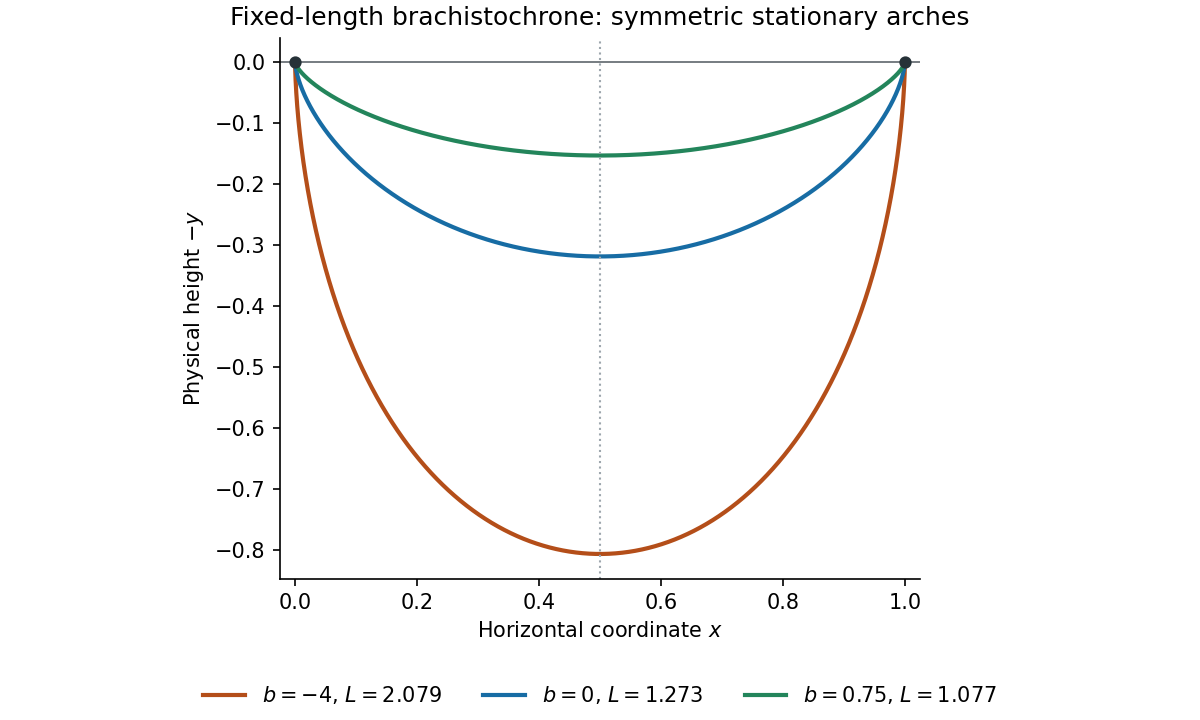
Codex 0 2026-10-25Put . Since , both and . Using in the integral for givesHence the physical track is symmetric about , with . For , , andis positive before and negative after . Therefore the physical height has its unique minimum at , withThe depth has a maximum there. This proves the intended claim for every finite-time member ; has the degeneracy described in (a).
Past exam of the short options course of the University of Oxford 2021 6 c Solution by Codex 0 2026-10-25
Codex 0 2026-10-25With , setThen the first integral gives . On the descending and ascending halves of the physical track choose respectively and , so that . Solving for givesThe unsquared equation requires . At this says ; it is not permissible to retain other values merely because the displayed formula for has a squared denominator.
For completeness, the Euler-Lagrange equation also gives . Thus decreases through zero exactly once, so the chosen parameter runs through the whole single arch without an extra branch. Differentiating the formula for and dividing by gives, continuously also at ,Using yieldsSince , the arc length is obtained by cancelling one factor of in . The conditions and becomeThese determine a unique parameter pair for each . To see uniqueness, regard as the expected value of under a probability density function proportional to on . Differentiation under the integral sign gives the covariance identityThe first argument decreases with and the second increases. The strict sign follows by applying to two independent unequal values and averaging; the integrable endpoint singularity of causes no problem. As , the weight concentrates at , so . As , endpoint estimates give numerator and denominator , so . Continuity then covers every . At one recovers the cycloid and .
Smoothness qualification. Near ,and the other endpoint has . These are smooth graphs on , not graphs on the closed interval. Indeed a finite endpoint slope would make the conserved diverge as . The travel time remains finite becauseThus the printed phrase “smooth solution” must be understood on the interior, with improper endpoint limits. The variational calculation supplies necessary stationary arches; it does not by itself prove global minimality in every larger class of tracks.
Pinned article: Introduction to the OurBigBook Project
Welcome to the OurBigBook Project! Our goal is to create the perfect publishing platform for STEM subjects, and get university-level students to write the best free STEM tutorials ever.
Everyone is welcome to create an account and play with the site: ourbigbook.com/go/register. We belive that students themselves can write amazing tutorials, but teachers are welcome too. You can write about anything you want, it doesn't have to be STEM or even educational. Silly test content is very welcome and you won't be penalized in any way. Just keep it legal!
Intro to OurBigBook
. Source. We have two killer features:
- topics: topics group articles by different users with the same title, e.g. here is the topic for the "Fundamental Theorem of Calculus" ourbigbook.com/go/topic/fundamental-theorem-of-calculusArticles of different users are sorted by upvote within each article page. This feature is a bit like:
- a Wikipedia where each user can have their own version of each article
- a Q&A website like Stack Overflow, where multiple people can give their views on a given topic, and the best ones are sorted by upvote. Except you don't need to wait for someone to ask first, and any topic goes, no matter how narrow or broad
This feature makes it possible for readers to find better explanations of any topic created by other writers. And it allows writers to create an explanation in a place that readers might actually find it.
Figure 1. Screenshot of the "Derivative" topic page. View it live at: ourbigbook.com/go/topic/derivativeVideo 2. OurBigBook Web topics demo. Source. - local editing: you can store all your personal knowledge base content locally in a plaintext markup format that can be edited locally and published either:This way you can be sure that even if OurBigBook.com were to go down one day (which we have no plans to do as it is quite cheap to host!), your content will still be perfectly readable as a static site.
- to OurBigBook.com to get awesome multi-user features like topics and likes
- as HTML files to a static website, which you can host yourself for free on many external providers like GitHub Pages, and remain in full control

Figure 2. You can publish local OurBigBook lightweight markup files to either OurBigBook.com or as a static website.
Figure 3. Visual Studio Code extension installation.
Figure 5. . You can also edit articles on the Web editor without installing anything locally. Video 3. Edit locally and publish demo. Source. This shows editing OurBigBook Markup and publishing it using the Visual Studio Code extension. 
- Infinitely deep tables of contents:




All our software is open source and hosted at: github.com/ourbigbook/ourbigbook
Further documentation can be found at: docs.ourbigbook.com
Feel free to reach our to us for any help or suggestions: docs.ourbigbook.com/#contact