For a finite connected graph, a spanning tree contains every graph vertex and is connected and acyclic. A minimum spanning tree minimizes over all such trees. A shortest-path tree rooted at is a spanning tree whose unique -to- graph path has length for every graph vertex . Here the weighted path length is the sum of its edge weights. The two optimizations generally differ, as (b) shows. Connectedness is needed for either spanning-tree object to exist.
For the grid, Kruskal's algorithm examines edges in nondecreasing order of weight and accepts an edge exactly when it joins two different components of the current forest. The weights are encountered in the orderThe horizontal and vertical acceptance rules are detailed in the two numbered subanswers. Together they produceThere are horizontal and vertical edges, totaling . Every accepted edge attaches a previously isolated graph vertex to the component already built, so the result is connected and acyclic. The correctness theorem for Kruskal's algorithm, which follows from the minimum spanning tree cut property, proves minimality. Its total cost isFor the tree has one graph vertex, no edges and cost zero. The source's numbered items specify the two edge types; the following subanswers record their contributions to the algorithm.
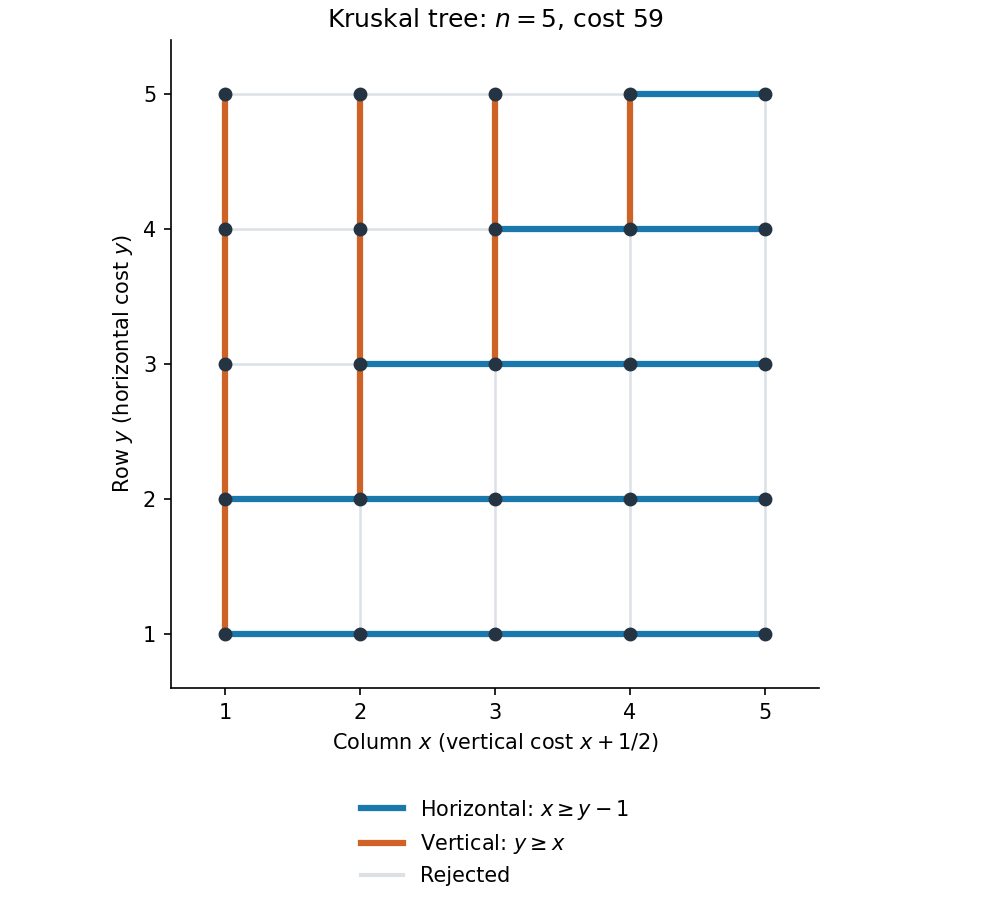
Kruskal spanning tree of the weighted grid, with accepted horizontal and vertical edges highlighted
. Details. 
Articles by others on the same topic
There are currently no matching articles.