Topics (384k) Articles (398k) Users (410) Discussions (242) Comments (383) Files (13k) New article
Cold air leaving an opened enclosure must displace warmer air, so its driving acceleration is set by reduced gravity, rather than by unrestricted fall through vacuum. The ideal gas law at approximately common pressure gives a fractional mass density contrast of order . Balancing gravitational potential energy against kinetic energy gives exchange speed over height , and time . Geometry, entrainment and shelves change its coefficient and can lengthen the time for complete replacement. The estimate describes the initial buoyancy-driven exchange.
For a rectangular potential barrier of height , width , and equal constant potentials outside, a particle with has exterior wave number and interior decay constant . Write the three wavefunctions as , , and . Continuity of the wavefunction and its derivative at both interfaces determines the transmission probability in the title. Equal exterior velocities are what permit the last equality.
For , , soKeeping only estimates the exponentially dominant quantum tunnelling suppression; the interface prefactor can still change a numerical answer by a factor of order one.
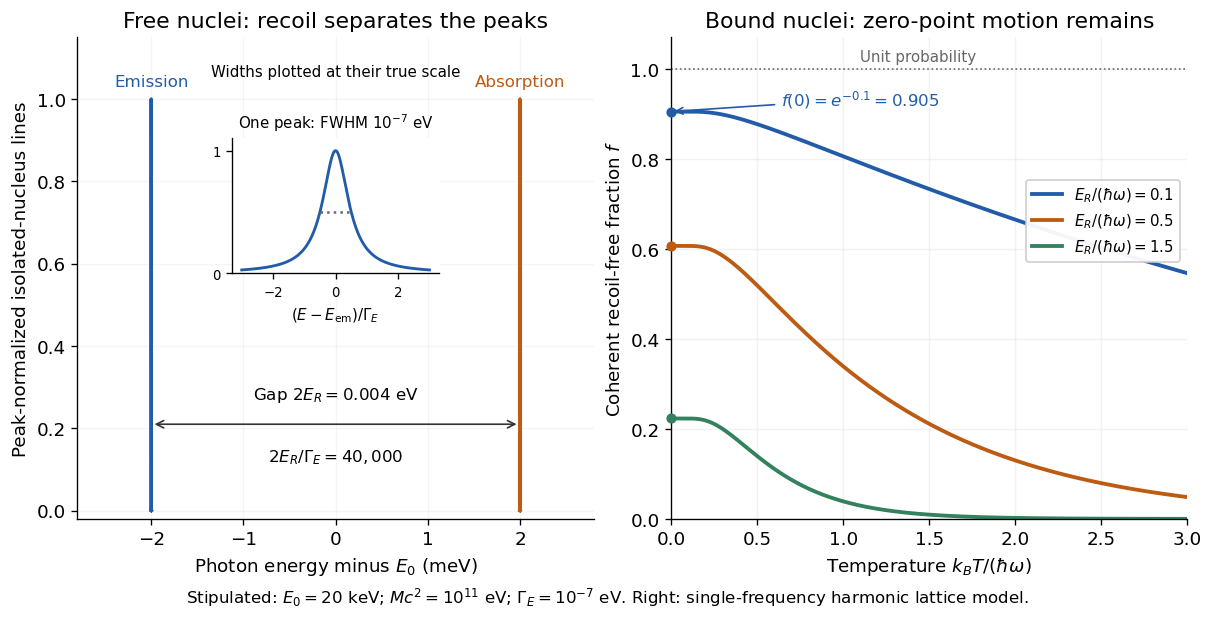
The Lamb-Mössbauer factor is the fraction in the coherent elastic line. In the harmonic-lattice approximation it is a Debye–Waller factor. Write the displacement of the emitting or absorbing atomic nucleus relative to its equilibrium site as , put , and define the angular wavenumber . Choose the equilibrium site so that . Its directional displacement variance is . A harmonic solid in thermal equilibrium has a Gaussian distribution for this displacement, whose characteristic function gives the elastic amplitudeTaking the squared magnitude gives the intensity fractionThe factor belongs to the amplitude exponent; it disappears when the amplitude is squared. For an isotropic solid, , so an equivalent expression is . Directional and three-dimensional mean squared displacements must not be substituted for one another without this factor.
An Einstein solid approximation replaces the vibrational spectrum by one positive angular frequency . For the directional quantum harmonic oscillator, with the same effective mass as in ,Here is the Boltzmann constant and is temperature. This follows by taking the expected value of in each oscillator energy eigenstate, , and averaging with the Boltzmann distribution. Substitution givesThe zero-temperature limit retains zero-point energy and a nonzero displacement variance. Cooling therefore increases the recoil-free fraction towards a limit below one for finite . At high temperature, the exponent tends to . This is a single-frequency approximation to a harmonic lattice's coherent elastic weight, not a complete description of all zero-net-energy processes of an isolated oscillator. Real vibrational spectra, directional binding and anharmonic motion can change its predictions.
Extend the stipulated teaching system by choosing , so . Then , while at . If source and absorber are independent, the fraction of events eligible for recoil-free emission followed by recoil-free absorption contains the product ; this gives for two zero-temperature copies. It is not the total probability of absorption, which also depends on the number of resonant atomic nuclei, geometry and spectral line overlap.
Acetone reacts with iodine to form iodoacetone, iodide, and a hydrogen ion:In water, denotes a solvated hydrogen ion; added hydrochloric acid provides acidic conditions.
Moorpark College's protocol mixes acetone, hydrochloric acid and water from burets in matched test tubes; pipet in iodine, swirl and time colour loss against white paper. Use water, then reacted solution, as references. Duplicate each mixture; keep total volume and run temperatures within .[ref]
Experiment 4: Chemical Kinetics: The Iodination of Acetone. Chemistry M01B Laboratory Manual, version 4.0 by Moorpark College Department of Chemistry; Version 4.0, Experiment 4, printed pp. 17–18: Procedure and Table 1
The stock dilutions give , , and . B and C separately double acetone and acid; D halves iodine. The manual supplies no measured times; it states zero partial order of reaction in iodine and asks students to determine the other exponents.[ref]
The endpoint measurement is a time to an operational colour threshold, not direct observation of a reaction intermediate. If the iodine disappearance rate is approximately constant until that endpoint, . Halving at fixed other concentrations then approximately halves without changing . A longer or shorter endpoint time alone is not a comparison of reaction rates unless the starting concentration is included. For an observed power-form rate law, doubling only acetone gives a rate ratio and hence ; doubling only acid similarly estimates its own partial order of reaction. Those are inference formulas, not asserted experimental results.
A useful proposed reaction mechanism would explain how iodine is consumed after an earlier transformation sets the throughput, making the observed reaction rate insensitive to iodine over a tested range. The observed zero exponent would contradict treating this net chemical equation as a single elementary reaction with directional rate law . It would not uniquely prove which reaction intermediate or earlier step is involved. Independently detecting a candidate reaction intermediate would provide another kind of evidence.
The excess-reactant approximation has an explicit scale: the baseline iodine inventory is only of the initial acetone inventory, and its net hydrogen ion production is of the initial acid inventory, assuming only the stated one-to-one chemical reaction. These are calculated bounds on composition change, not measured reaction orders. Mixing delay, a subjective colour threshold, and temperature drift limit the inference. Repeats and a fixed viewing geometry help; a calibrated absorbance trace could test linearity during conversion instead of relying on an endpoint alone. That extension would require a reference blank and a justified Beer-Lambert law calibration, rather than treating visible colour as an exact concentration. A zero-order reaction approximation in iodine must fail at depletion; it cannot imply consumption after no iodine remains.
A parallel first-order reaction mechanism consumes the same reactant through competing routes. Extend the product-split idea in catalytic selectivity by following both reaction products over time. Stipulate irreversible first-order reactions and in a uniformly mixed closed system of fixed volume and temperature. Initially only A is present, with concentration . With ,Here abbreviates a sum of rate constants, not an equilibrium constant. The rate equations are , , and . Integrating the last two after solving the first proves the expressions and their conserved total .
Choose two alternative models: model U has ; model V has . Both have , so every measurement of A alone is identical, even with no measurement error. Yet their P-to-Q concentration ratios at any are and , respectively. This is a precise failure of identifiability from that one observable. A calibrated measurement distinguishing P from Q resolves it within the stipulated two-route model.
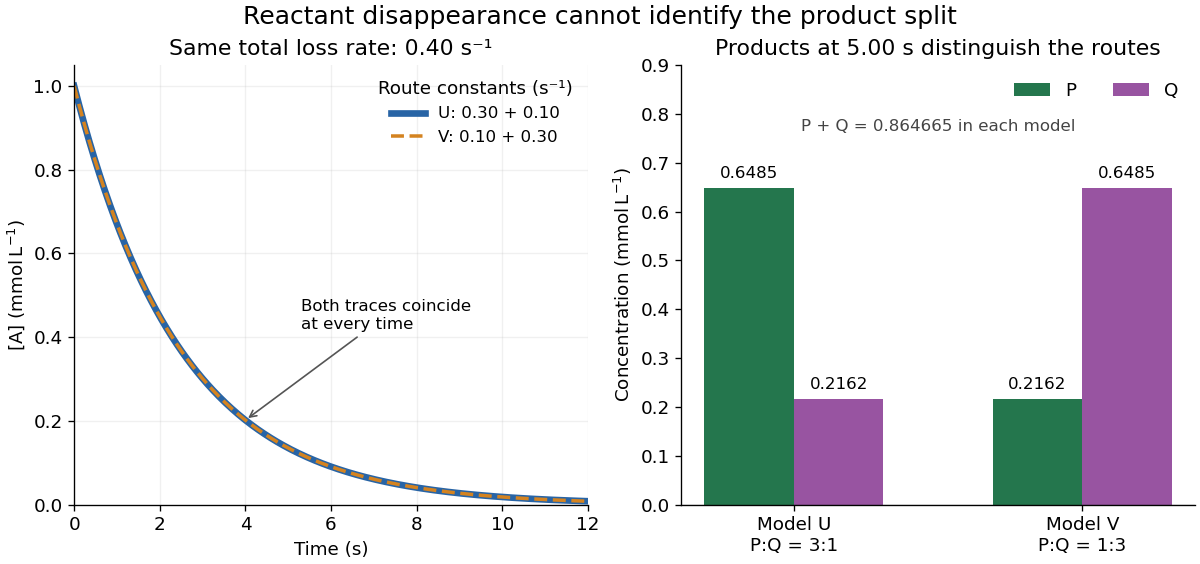
At , both models give . Model U gives ; model V exchanges these. Measuring only the summed reaction product concentration would also fail to distinguish them. Product-specific observations therefore answer a question that total conversion cannot. As with any reaction mechanism, fitting these observables still does not rule out a more elaborate untested route.
A consecutive first-order reaction mechanism passes material through a reaction intermediate. Consider a stipulated chemical reaction network , with constant positive rate constants, fixed temperature and volume, uniform mixing, and no reverse or competing chemical reactions. All three labels carry one conserved unit of material. Set and . The law of mass action givesAdding the three rate equations proves . Each step has a first-order reaction rate law; this does not make all three concentrations simple exponential decays.
For , the exact solution isTo derive the middle expression, substitute the first into the first-order linear differential equation for I and multiply by the integrating factor . Then , which can be integrated directly with the stated initial condition. The material balance supplies P without another integration.
The apparent division by zero at equal rate constants is removable. For , the same integrating factor givesThis is also the limit of the unequal-rate constant expression. Initially , so reaction product formation begins with zero slope despite immediate reactant loss. By contrast, a direct first-order reaction with the same has and nonzero initial slope. Their A traces agree exactly; their P traces do not.
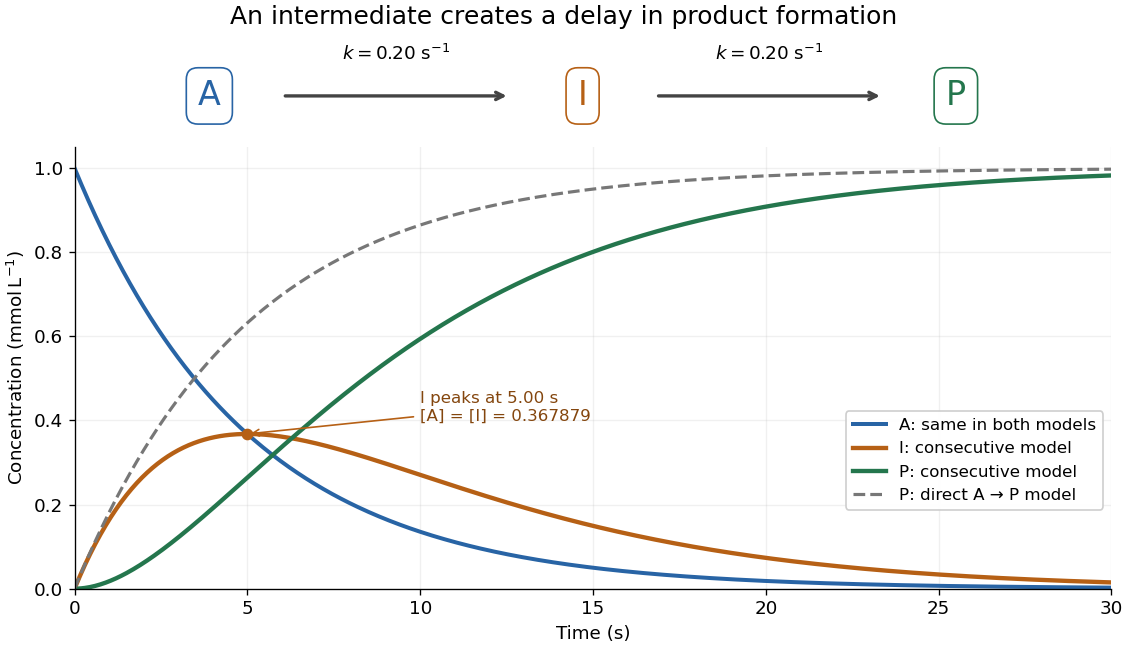
An accumulating reaction intermediate delays reaction product formation in a consecutive first-order reaction mechanism
. Original chosen model with and . Solid curves follow the exact three-species rate equations; the dashed P curve is a separate direct A-to-P model with the same A trace. These are model predictions, not measurements or an identified molecular reaction mechanism. Details.For the chosen equal-rate constant example, I peaks at , because . At that time and ; the direct model would already have . The peak means formation and consumption of I are momentarily equal, not that the whole system has reached chemical equilibrium.
More generally the peak is at , which is positive for either ordering of the two positive rate constants and tends to as they coincide. When , a brief initial adjustment can be followed by and approximately equal formation and consumption reaction rates. The exact solution states when this small-intermediate approximation can be reasonable. It is inappropriate for the illustrated equal-rate constant case: at the peak, over one third of the conserved material is I. Such timing matters if the goal is to collect a useful reaction intermediate before it becomes the final reaction product.
Finite-aperture stabilization of an inverted liquid surface by  Codex 0 Created 2026-10-18 Updated 2026-10-20
For a deep inviscid liquid above a gas of negligible inertia, an inverted free surface has dispersion relation , . The Rayleigh-Taylor instability affects . A bounded aperture can suppress it if its smallest allowed wavenumber is at least . The capillary length is and the marginal wavelength is . A pinned one-dimensional span of width with a half-sine lowest mode instead has , giving . A numerical maximum container size therefore also requires aperture geometry and contact-line boundary conditions; the marginal wavelength alone is not a universal diameter.
An encoding for radix sort must make the intended total order of sort keys agree with the lexicographic order of its fixed-width numerical digit tuples. The positional notation for bounded nonnegative integers has this property. At the most significant differing position , a one-unit numerical digit difference contributes , while all lower positions together contribute at mostThis geometric series shows why lower numerical digits cannot reverse that comparison. Leading zero padding works here because it preserves place values and the represented integer.
For signed integers in a known integer interval , encode and choose with . This order-preserving function is also injective: exactly when . For , the four-bit encodings of are after adding eight. Restore the original signed sort keys when displaying the complete sorting records; the encoding need not replace their data. Sorting the unsigned values of raw two's complement bit patterns would put nonnegative integers before negative ones, so their representation alone is not this ordered encoding.
For variable-length strings, first specify the alphabet order and whether a proper prefix precedes its extensions. As an original construction, use , let every string have length at most three, encode as one and as two, and append zeros to width three. Zero is reserved for an end marker strictly below every real symbol. The strings encode as in radix three, which preserves their lexicographic order. A differing real symbol decides the comparison; at a prefix boundary, the shorter string's zero comes before the extension's one or two. Left padding would instead encode as and as , reversing . Padding raw bytes with zero also fails if zero is an allowed data symbol: distinct strings can then receive the same encoding. A reserved end marker and an explicit symbol ordering are essential; byte order alone does not establish a desired human text order.
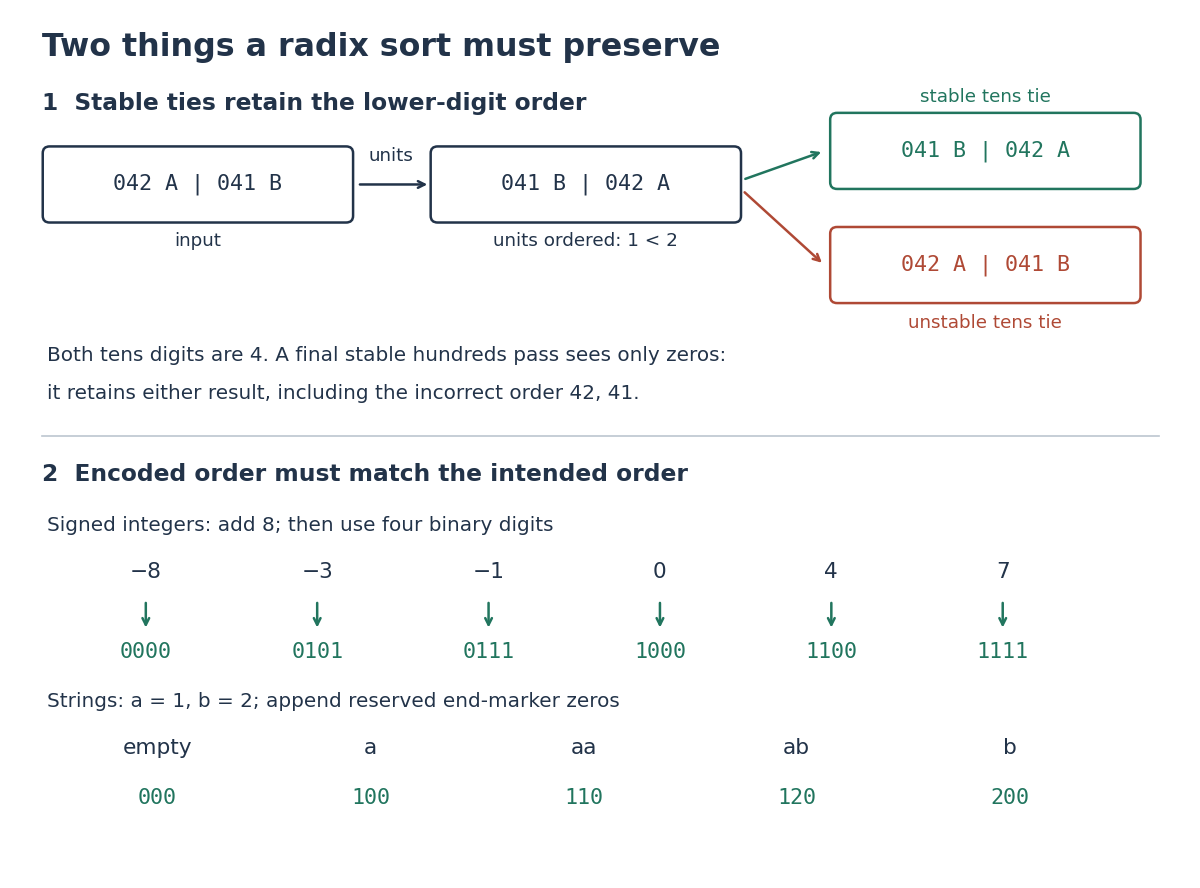
Stable ties preserve lower digits; suitable encodings preserve the intended order
. Original counterexample above: reversing a tens tie destroys the units order and a later stable hundreds pass cannot repair it. Below: signed integer offsets and a reserved end marker for bounded strings produce increasing fixed-width encodings. All entries are exact constructed examples. Details.A stable digit sort applies stable sorting to complete sorting records using one specified numerical digit of their encoded sort keys. Counting sort can supply it; stable record placement in counting sort moves records without discarding their associated data. Stability concerns equal current numerical digits, even when the full sort keys differ. This is the information-preservation step in least-significant-digit radix sort.[ref]
11.2 Counting Sort and Radix Sort. Open Data Structures: An Introduction by Pat Morin; §11.2.1, associated-data and stability paragraphs; §11.2.2, least-significant passes and correctness paragraph after Figure 11.8
An original two-record counterexample exposes the need for the tie rule. Start with at width three. A units pass gives . Both tens numerical digits are four. A deliberately unstable tens pass may reverse their tie and return : it is sorted by the tens numerical digit, yet its two-position suffixes are decreasing. The final stable hundreds pass sees two zeros and keeps this wrong order. Sorting permutation preservation still holds, but sortedness fails. Stability in the tens pass would have retained the units information.
With counting sort as the stable digit sort, each pass initializes counters, counts current numerical digits, constructs their prefix sums, and places complete sorting records. Thus each pass costs , and passes cost in Big O notation. Reuse the counters and two arrays of record references between passes: auxiliary space complexity is , rather than . Assume constant-cost numerical digit extraction, counter arithmetic, array indexing and record-reference movement; the bound counts these operations, not the cost of copying arbitrarily large payloads or performing arbitrary-precision integer arithmetic.
The benefit is avoiding a counter for every possible whole sort key: width has possibilities, while each pass needs only counters. A larger radix reduces the number of passes for a fixed key range but enlarges the counter array. The comparison sorting lower bound does not apply to these direct array indices; they reveal more than a two-way comparison. Nor does fixing make disappear: growing key width still increases work.
A least-significant-digit radix sort processes numerical digits from smallest to largest place value. Fix integers and , and take complete sorting records whose sort keys satisfy . Use exactly positions in positional notation with radix , including leading zeros. At pass , apply a stable digit sort to the current array usingThe floor function selects the integer quotient, and the remainder selects the current numerical digit. Move the complete sorting record, including its associated data. There are exactly passes, so this procedure terminates even for an empty array. The radix sort suffix invariant supplies its algorithm correctness argument.
For an original input, let the letters identify the attached data:Here , , and leading zeros only align place values; represents the integer five. The exact pass ledger is:After the units pass, the numerical digits are . The ties retain before and before before . This array is not yet ordered by its whole integer sort keys: still precedes . After the tens pass, the two-position suffixes are . In particular, now precedes : their tens numerical digits differ, so stable sorting does not require retaining their previous order. The hundreds pass produces the final sorted array, with all attached letters preserved.
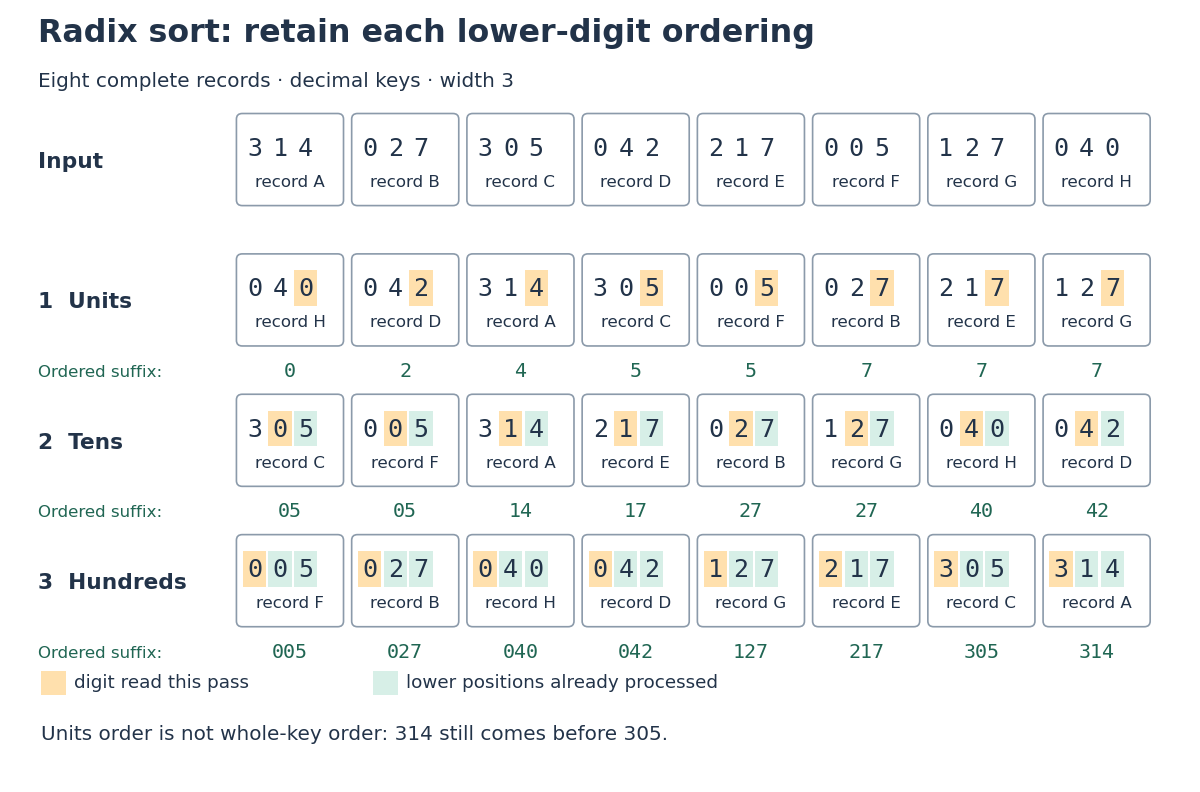
Three stable digit passes order successively longer suffixes
. Original decimal radix sort ledger. Each card carries an unchanged record label. Orange marks the numerical digit read in the current pass; green marks lower positions already processed. The suffix row beneath each pass shows precisely what is ordered, rather than claiming whole-key sortedness early. Details.The transfer of energy from electromagnetic radiation to matter. Optical reflection redirects the incident electromagnetic radiation, and transmission lets it pass through; absorption transfers some of its energy to the material instead.
A radiometer measures electromagnetic radiation through its received power. A radio radiometer can express that power as a noise temperature, allowing an unknown source to be compared with calibrated reference temperatures.
For a beam at a specified surface, fluence is the time-integrated incident light intensity: , with units of energy per area. It records how much energy arrived during an exposure rather than the instantaneous rate of delivery.
For a constant rectangular pulse, . Two pulses can therefore have equal fluence and different peak intensities if their durations differ. This matters in nonlinear optics, where the response can depend strongly on instantaneous intensity, and in comparing exposure protocols. Photon fluence instead counts incident photons per area; converting it to energy fluence requires the photon energies.
Pinned article: Introduction to the OurBigBook Project
Welcome to the OurBigBook Project! Our goal is to create the perfect publishing platform for STEM subjects, and get university-level students to write the best free STEM tutorials ever.
Everyone is welcome to create an account and play with the site: ourbigbook.com/go/register. We belive that students themselves can write amazing tutorials, but teachers are welcome too. You can write about anything you want, it doesn't have to be STEM or even educational. Silly test content is very welcome and you won't be penalized in any way. Just keep it legal!
Intro to OurBigBook
. Source. We have two killer features:
- topics: topics group articles by different users with the same title, e.g. here is the topic for the "Fundamental Theorem of Calculus" ourbigbook.com/go/topic/fundamental-theorem-of-calculusArticles of different users are sorted by upvote within each article page. This feature is a bit like:
- a Wikipedia where each user can have their own version of each article
- a Q&A website like Stack Overflow, where multiple people can give their views on a given topic, and the best ones are sorted by upvote. Except you don't need to wait for someone to ask first, and any topic goes, no matter how narrow or broad
This feature makes it possible for readers to find better explanations of any topic created by other writers. And it allows writers to create an explanation in a place that readers might actually find it.
Figure 1. Screenshot of the "Derivative" topic page. View it live at: ourbigbook.com/go/topic/derivativeVideo 2. OurBigBook Web topics demo. Source. - local editing: you can store all your personal knowledge base content locally in a plaintext markup format that can be edited locally and published either:This way you can be sure that even if OurBigBook.com were to go down one day (which we have no plans to do as it is quite cheap to host!), your content will still be perfectly readable as a static site.
- to OurBigBook.com to get awesome multi-user features like topics and likes
- as HTML files to a static website, which you can host yourself for free on many external providers like GitHub Pages, and remain in full control

Figure 2. You can publish local OurBigBook lightweight markup files to either OurBigBook.com or as a static website.
Figure 3. Visual Studio Code extension installation.
Figure 5. . You can also edit articles on the Web editor without installing anything locally. Video 3. Edit locally and publish demo. Source. This shows editing OurBigBook Markup and publishing it using the Visual Studio Code extension. 
- Infinitely deep tables of contents:




All our software is open source and hosted at: github.com/ourbigbook/ourbigbook
Further documentation can be found at: docs.ourbigbook.com
Feel free to reach our to us for any help or suggestions: docs.ourbigbook.com/#contact