Topics (384k) Articles (398k) Users (410) Discussions (242) Comments (383) Files (13k) New article
Radiocarbon dating uses the loss of carbon-14 relative to stable carbon after carbon exchange stops. It can measure either an isotope ratio by accelerator mass spectrometry or radioactive activity per fixed carbon content. Interpreting an age requires radiocarbon calibration and control of contamination and reservoir differences.
With no initial radiogenic argon-40 and complete daughter retention, the surviving potassium-40 population is and the accumulated daughter population is . Here is the total nuclear decay constant and is the argon-producing branching fraction. Their ratio gives the displayed age. The result measures closure of the mineral's isotope system under those assumptions.
The probability that an event of a specified kind produces a registered count in a specified arrangement. For a radiation detector, geometry, intervening material and the detector response can all affect detection efficiency.
The becquerel, symbol , is the SI unit of radioactive activity, with . An radioactive activity of one becquerel means one expected nuclear transformation per second under the stated conditions, not a guarantee of one event in every individual second.
Measured count rate need not equal radioactive activity. A particle detector registers only some decays because of geometry and detection efficiency, and one transformation can emit several particles or none detectable by that instrument. Activity also differs from deposited energy or absorbed dose: those depend on the emitted particles, their energies and where their interactions occur.
In his 1964 paper, Murray Gell-Mann proposed fractional-charge quarks, constructing baryons and mesons from them. He also distinguished a mathematical constituent model from the hypothesis of finite-mass physical particles. The successful bookkeeping did not itself settle that distinction.[ref]
A Schematic Model of Baryons and Mesons by Murray Gell-Mann. pp.214–215: triplet construction and discussion of physical versus mathematical quarks
George Zweig's 1964 CERN model used three constituents called aces, with fractional electric charge and baryon number . Its abstract also proposed an experimental search.[ref]
An SU3 Model for Strong Interaction Symmetry and Its Breaking (Version 2) by George Zweig. Version2 title page and abstract, dated21February1964
The theoretical construction and the experiment that might discriminate between interpretations are separate parts of the argument. The Omega baryon discovery experiment illustrates the power of testing an incomplete particle pattern against new observations.For a three-light-flavor example, take up quarks, down quarks and strange quarks with the following additive quantum numbers. Here denotes electric charge in units of the positive elementary charge , is baryon number, is strangeness, is the third component of isospin, and is flavor hypercharge. An antiquark reverses all five displayed values. These are flavor coordinates, not spatial coordinates or electroweak hypercharge.
Adding these columns immediately explains familiar hadrons. A proton with valence quarks has and ; a neutron with has and . A positive kaon with has , and . Thus the same constituent rules describe both baryons and mesons.
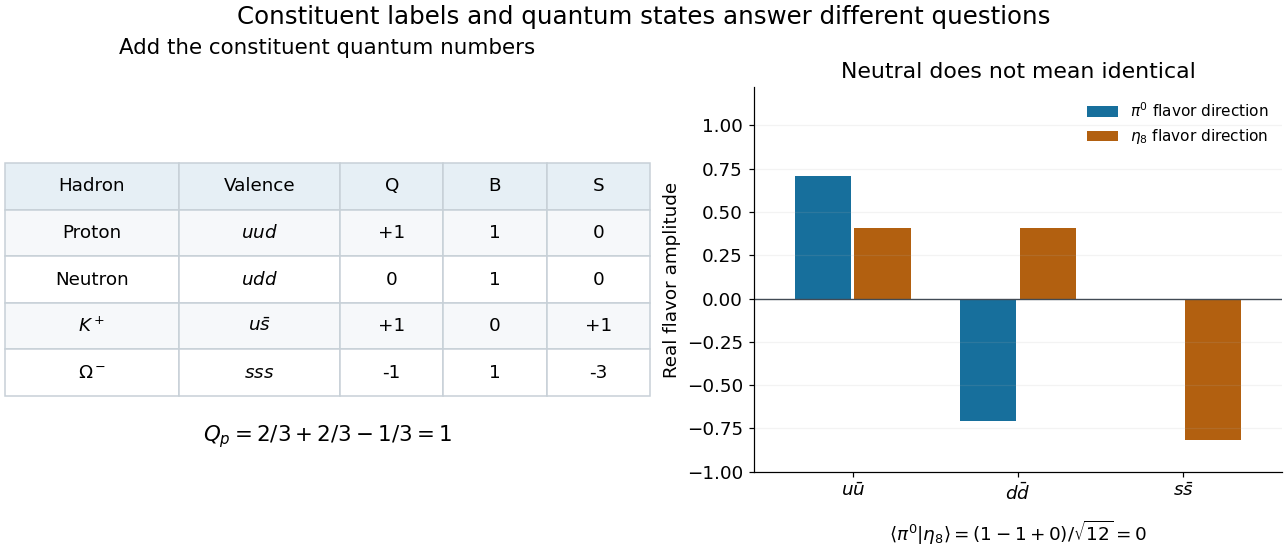
Adding constituent quantum numbers distinguishes charged and neutral hadrons
. Original arithmetic examples for the three-light-flavor quark model. The lower panel contrasts two orthogonal neutral flavor combinations: identical total electric charge does not make two states identical. These are ideal flavor basis states, not a mass fit or a reconstruction of an experimental event. Details.Two hadrons can have identical additive labels while differing in their internal state. The Lambda baryon and neutral Sigma baryon both have valence content , yet their total isospin differs. Likewise, the neutral pion flavor direction and the Eta octet state both have , but their inner product vanishes. Expanding that inner product gives . Constituent counting must therefore be supplemented by quantum superposition and the symmetry of the state.
The constituent-quark model describes a low-energy hadron using effective massive quarks and phenomenological interactions. Its constituent quark masses include strong-interaction dressing and differ from short-distance running quark masses.
For three light flavours and two spin states, an approximate spin-flavour symmetry acts on the six-dimensional single-quark spin-flavour space. A spatial ground-state three-quark colour singlet requires the symmetric representation of dimension . Under flavour symmetry and ordinary spin rotations, it decomposes as : the baryon decuplet has spin and the baryon octet spin . The product of spin and flavour factors can require a correlated sum, rather than a single unentangled product.
Finite-well confinement in a semiconductor heterostructure by  Codex 0 Created 2026-10-18 Updated 2026-10-20
Consider an original one-dimensional effective mass model with for and outside. Take the same positive effective mass everywhere, an abrupt interface, and no interactions. The wavefunction represents a transverse envelope; free motion parallel to the layer is outside this calculation. A double heterostructure laser need not be thin enough for this quantization to dominate its operation.
Set , , , and . The time-independent Schrödinger equation becomesHere denotes the dimensionless potential; a bound state has . Matching the wavefunction and its derivative at givesFor the even bound state, the interior solution is and the exterior solution is . For the odd bound state, replace by and by . The physical wavefunction is .
Wavefunction normalization includes both exterior tails, not just the active layer. Direct integration givesThe first two terms are the interior integral; the last is the total exterior integral. Thus the interior probability is , with the upper sign for even parity.
Choose . There is one even root in and one odd root in ; higher branches start beyond . Each left-hand side increases on its stated interval while decreases, proving uniqueness there. Numerically,These are calculated values of the chosen finite square well. The excited bound state lies closer to the barrier and has a longer exterior tail: being bound does not mean having unit probability inside the well.
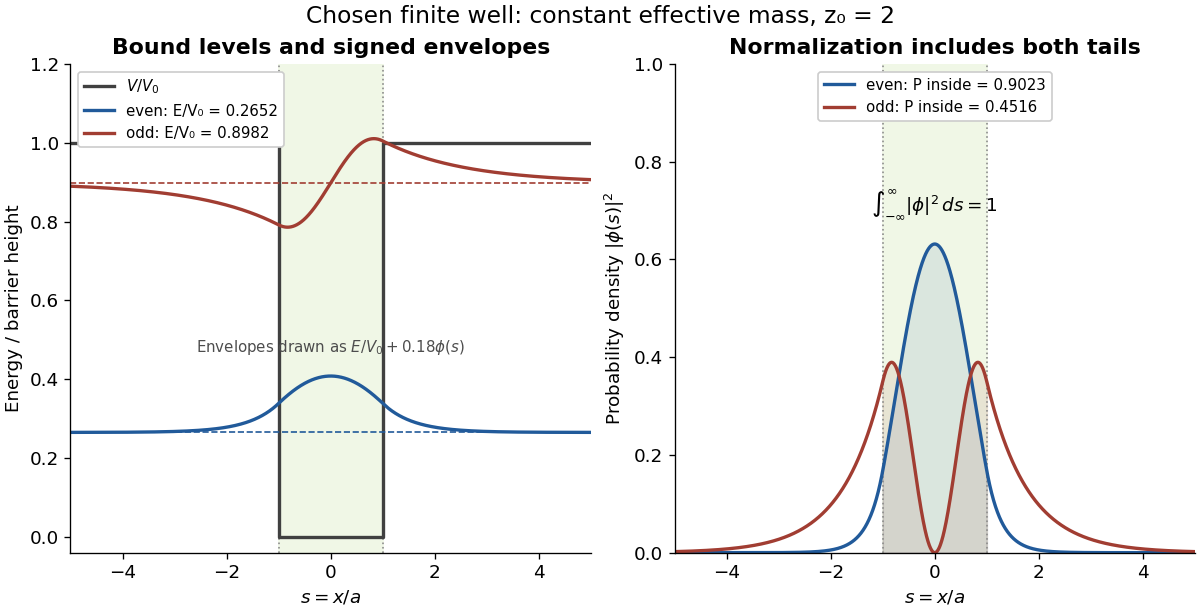
This model demonstrates electronic confinement, not optical refractive index confinement or a complete laser. Unequal effective masses, band bending, interface disorder and interactions require a more detailed model. In particular, continuity of the ordinary derivative above uses the chosen constant effective mass assumption.
A particle resonance is an unstable excitation inferred from an enhanced scattering or decay response near a characteristic energy. It is associated with a pole of the analytically continued scattering amplitude, rather than a permanently normalizable state that survives indefinitely.
For an isolated narrow resonance, a Breit-Wigner form relates the peak scale to a mass and a width, with lifetime approximately . Different final states probe different partial widths and branching fractions. Interference with nonresonant amplitudes, nearby thresholds and detector resolution can shift or distort the observed peak, so a bump's width need not equal the intrinsic decay width without a model. Conservation laws and angular distributions help identify which quantum numbers are compatible with the signal.
In inelastic scattering, the participants exchange energy with internal degrees of freedom, so their total translational kinetic energy need not be conserved.
X-ray scattering techniques use the change in a scattered photon's direction and, in inelastic measurements, its energy to probe matter. Inelastic X-ray scattering transfers energy to excitations such as phonons; elastic methods probe spatial structure without that energy transfer.
The angle between specified incoming and outgoing directions in a collision; the reference frame and outgoing particle must be stated.
A specified asymptotic configuration of the particles and their internal quantum states in quantum scattering. An incoming channel can scatter into several outgoing channels; S-matrix elements give their probability amplitudes with a stated probability current normalization. A channel can be energetically inaccessible even when other channels are open.
The change in incident and outgoing electron wavefunctions caused by the target Coulomb potential. It can invalidate a plane wave treatment in the Born approximation, especially for a large target atomic number.
For constant mass , a finite jump from potential energy zero at to at requires continuity of the wavefunction and its first derivative. With incidence only from the left and , put and . Matching and gives reflected probability amplitude and transmission amplitude . The transmission probability is , conserving probability current.
For , replace by , where is the tunnelling decay constant. The right-hand wavefunction is , with zero probability current. Its probability density decays on length , while its amplitude decays on length . The semi-infinite raised region gives total reflection, unlike a finite potential barrier allowing quantum tunnelling into a second allowed region.
A scattering cross-section divides the scattered rate per target by the incident particle flux. Its differential form resolves that rate by outgoing direction. It has units of area for three-dimensional scattering and length for two-dimensional scattering. In two dimensions, the convention gives by comparing outgoing and incident probability currents.
For a quantum rotor with angle period , let and prepare . Its only nonzero angular-momentum amplitudes are and . Their energies are and , respectively, soThe state revives after and its density at is the initial density rotated by . At there are four equal angular maxima. This is interference between a stationary component and a degenerate pair of counter-rotating components; it is not a uniformly rotating rigid profile. Angular-momentum and energy probabilities stay constant.
In 1977, H. Jeff Kimble, Mario Dagenais, and Leonard Mandel excited a dilute sodium atomic beam with a resonant dye laser. Apertures restricted the observed atoms; a microscope objective collected fluorescence perpendicular to both beams. A beam splitter sent the collected light to two photomultipliers. Shaped pulses drove the start and stop inputs of a time-to-digital converter; its delay histogram rose away from zero delay, indicating photon antibunching. Turning the atomic beam off measured scattered-laser backgrounds. More than one contributing atom and scattered light limited the comparison with an ideal isolated two-level system; the paper explicitly treated corrections.[ref]
Photon Antibunching in Resonance Fluorescence by Harry Jeffrey Kimble and others. 1977, p. 693, figure 2, equation (6), apparatus and atomic-beam-off/on control; MIT mirror
A simple reason for suppressed immediate re-emission is visible in an ideal two-level system. After spontaneous emission, the atom is in . Its emission operator obeys , so two instantaneous emissions are impossible. Excitation must rebuild the excited-state population before another emission. This argument explains the zero-delay idealization; the actual photon counting record additionally depends on collection, background, timing, and the number of contributing atoms.
Robert Hanbury Brown and Richard Q. Twiss sought angular sizes through correlations of detected light intensities. Their method multiplies detector outputs after detection, whereas a Michelson interferometer combines fields before detection.[ref]
Correlation between Photons in two Coherent Beams of Light by Robert Hanbury Brown and Richard Quentin Twiss. 1956, Nature 177, pp. 27–29, accessible opening paragraphs
A monochromatic discharge source illuminated a half-silvered beam splitter and two photodetectors. The averaged current product showed an excess near coincidence. Moving one detector introduced a delay that removed it, supplying a control. Slow response weakened the peak. This photon bunching is compatible with fluctuating classical light intensity.[ref]
One Hundred Years of Light Quanta by Roy Jay Glauber. 2005 individual Nobel lecture, pp. 86–88, figures 3–4
Pinned article: Introduction to the OurBigBook Project
Welcome to the OurBigBook Project! Our goal is to create the perfect publishing platform for STEM subjects, and get university-level students to write the best free STEM tutorials ever.
Everyone is welcome to create an account and play with the site: ourbigbook.com/go/register. We belive that students themselves can write amazing tutorials, but teachers are welcome too. You can write about anything you want, it doesn't have to be STEM or even educational. Silly test content is very welcome and you won't be penalized in any way. Just keep it legal!
Intro to OurBigBook
. Source. We have two killer features:
- topics: topics group articles by different users with the same title, e.g. here is the topic for the "Fundamental Theorem of Calculus" ourbigbook.com/go/topic/fundamental-theorem-of-calculusArticles of different users are sorted by upvote within each article page. This feature is a bit like:
- a Wikipedia where each user can have their own version of each article
- a Q&A website like Stack Overflow, where multiple people can give their views on a given topic, and the best ones are sorted by upvote. Except you don't need to wait for someone to ask first, and any topic goes, no matter how narrow or broad
This feature makes it possible for readers to find better explanations of any topic created by other writers. And it allows writers to create an explanation in a place that readers might actually find it.
Figure 1. Screenshot of the "Derivative" topic page. View it live at: ourbigbook.com/go/topic/derivativeVideo 2. OurBigBook Web topics demo. Source. - local editing: you can store all your personal knowledge base content locally in a plaintext markup format that can be edited locally and published either:This way you can be sure that even if OurBigBook.com were to go down one day (which we have no plans to do as it is quite cheap to host!), your content will still be perfectly readable as a static site.
- to OurBigBook.com to get awesome multi-user features like topics and likes
- as HTML files to a static website, which you can host yourself for free on many external providers like GitHub Pages, and remain in full control

Figure 2. You can publish local OurBigBook lightweight markup files to either OurBigBook.com or as a static website.
Figure 3. Visual Studio Code extension installation.
Figure 5. . You can also edit articles on the Web editor without installing anything locally. Video 3. Edit locally and publish demo. Source. This shows editing OurBigBook Markup and publishing it using the Visual Studio Code extension. 
- Infinitely deep tables of contents:




All our software is open source and hosted at: github.com/ourbigbook/ourbigbook
Further documentation can be found at: docs.ourbigbook.com
Feel free to reach our to us for any help or suggestions: docs.ourbigbook.com/#contact