Topics (384k) Articles (398k) Users (410) Discussions (242) Comments (383) Files (13k) New article

In the model of reversible enzyme inhibition, competitive inhibition makes substrate binding and inhibitor binding mutually exclusive: is allowed but is absent. Set , equivalently take . ThenFor the chosen , : the half-limiting substrate concentration rises from to , while the limiting reaction rate remains . At the inhibited reaction rate is , compared with the uninhibited . “Overcome by substrate” means that their ratio tends to one as , not that any finite addition removes the difference.
An inhibition constant sets an inhibitor concentration scale in an enzyme kinetics model. In the rapid-binding construction under reversible enzyme inhibition, and are dissociation constants. Smaller values favour the corresponding bound population at fixed free inhibitor concentration. More generally, fitted inhibition constants need not be true binding dissociation constants; a mechanism must justify that interpretation.[ref]
Symbolism and Terminology in Enzyme Kinetics (Recommendation 1981) by Nomenclature Committee of the International Union of Biochemistry. Symbolism and Terminology in Enzyme Kinetics, section 6.4, final paragraphs: operational inhibition constants versus explicitly defined dissociation constants
For example, choosing makes in this model, but does not imply that half of all enzyme is : and also contribute to the total population.
A frequency at which a specified driven response is resonant. The value can depend on the observable and damping: the electric current amplitude of a driven series RLC circuit peaks at , while a different circuit readout need not peak at the same frequency.
A resonator stores oscillatory energy in one or more normal modes. Driving near a mode's frequency can produce resonance. Losses limit the response and determine its quality factor. After the drive is removed, an isolated weakly damped mode decays approximately exponentially; an observed room response may combine many modes.
For real , choose a branch of the complex logarithm whose argument interval contains strictly, and integrate over an annular sector of angle . The one enclosed simple pole is , with residue . The circular arcs tend to zero, with bounds and .
Writing for the title integral and , the two radial segments and the residue theorem giveDivide by and equate real and imaginary parts. This gives and the title formula. When , the sector extends below the negative real axis; the principal complex logarithm therefore cannot be used throughout that sector. A cut along a ray just below the positive axis avoids this issue for every .
Indirect selection of bacterial mutants recovers a source using a related sample's tested phenotype, rather than directly challenging the retained lineage. A positive example uses a surviving replica biological colony to locate its unexposed source. A negative example uses failure to grow in one condition to locate a source that does grow elsewhere. The second is particularly useful for finding auxotrophy: dependence on an externally supplied nutrient.
Construct a four-by-four teaching layout with rows A–D and columns 1–4. The master has 13 biological colonies; A4, D1 and D4 are empty. A growth-supporting control replica grows at every occupied master site except B2 and C3. A replica lacking an assumed nutrient X grows at those same control sites except A2 and C1. All other requirements are stipulated equal. These are invented readouts, not observations from the Lederberg replica plating experiment.
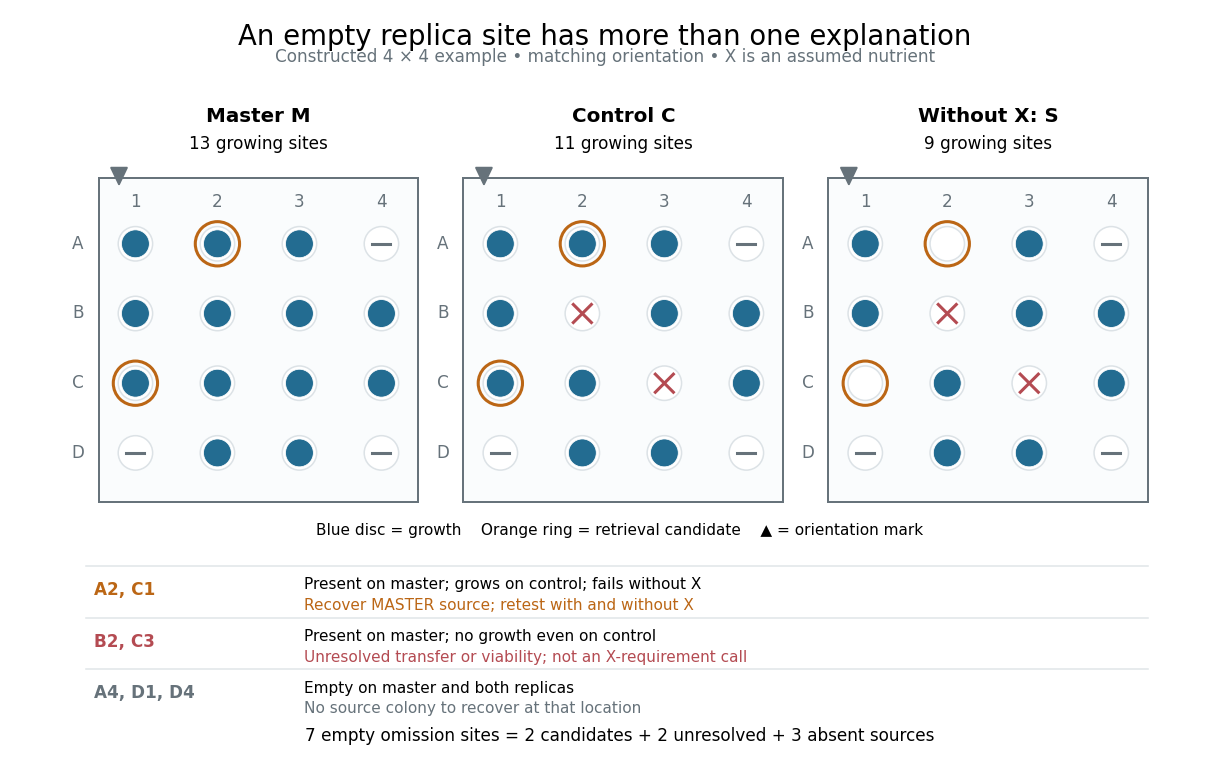
An original replica plating map separates retrieval candidates, unresolved transfer and absent sources
. Constructed four-by-four master, control and nutrient-X-omission readouts, viewed in the same orientation. Blue discs mean growth. Orange rings identify A2 and C1 for recovery from the master. Red crosses mark B2 and C3, which lack growth even on the control; gray dashes mark positions empty on the master. The lower comparison distinguishes these three explanations of an empty restrictive-replica site. No measured data or published plate illustration is reproduced. Details.Let , and be the finite sets of sites with growth on the master, control and X-omission replica respectively. In this construction , with cardinalitiesThe set differencecontains the two condition-dependent candidates. Pick from A2 and C1 on the master, then compare fresh samples of each recovered source with and without X. Restoration of growth when X is supplied supports an X-requirement phenotype, subject to the scientific controls; growth alone does not identify a particular gene or mutation.
By contrast,is unresolved sampling or viability in this first comparison. Neither site should be counted as an X-requirement candidate. The three sites outside have no master source to recover at all. The short logical argument is membership testing: a candidate must belong to , establishing control growth, and not belong to , establishing the contrasting readout. Being outside alone supplies only the second condition. Among the seven empty X-omission sites, two are candidates, two are unresolved and three have no master source. The beauty of the method is that a shared location turns this logical distinction into a practical retrieval route.
Replica plating controls distinguish a growth phenotype from failure of the copying process. A replica on a cell culture medium that supports the starting biological colonies is a touch-transfer scientific control: growth at a site demonstrates that viable biological cells reached that control site. If a source is visible on the master but absent on both control and restrictive replicas, the restrictive readout is unresolved. If it grows on the control but fails on the restrictive replica, the difference is a candidate condition-dependent phenotype.
The touch-transfer scientific control still cannot guarantee transfer to every other replica. A known growing comparison on the restrictive cell culture medium, repeat sampling, and retesting a recovered source address different possible failures. Likewise, an orientation mark checks which source a site represents; it cannot check whether any biological cells arrived. Gentle, aligned contact helps preserve the map. In Investigations in Molecular Cell Biology by Clare M. O’Connor, section 12.6: Exercise 2 - Replica plating and complementation, the instructions align master and carrier marks and call for light, even contact.[ref]
12.6: Exercise 2 - Replica plating and complementation. Investigations in Molecular Cell Biology by Clare M. O’Connor; Introductory light-touch instruction and steps 1–2: orientation marks, aligned inversion and gentle even contact
For indirect selection of bacterial mutants, keep the recovery route on the unexposed master. Returning a carrier that has touched a challenged replica to that master would introduce a possible exposure route. The original experiment's stray-bacteriophage check addresses contamination of the retained lineage, while the orientation and touch-transfer scientific controls address spatial identity and successful sampling. These questions must be checked separately.
Joshua Lederberg and Esther Lederberg reported replica plating in 1952. They autoclave-sterilized velveteen and secured it pile-up on a wood or cork cylinder with a metal hoop. Inverted agar plates touched the fabric lightly. Pencil marks or pin indentations fixed orientation. Complete-medium and minimal-medium replicas compared growth of biological colonies.[ref]
Replica plating and indirect selection of bacterial mutants by Joshua Lederberg and Esther Lederberg. pp. 399–402, Methods: Replica plating; Figure 1 caption; Results: plate orientation
Escherichia coli W-1 grew on plain agar; serial T-1 bacteriophage replicas showed resistant biological colonies at matching sites. Corresponding unexposed master regions seeded repeated broth-and-plain-agar enrichment, yielding resistant isolates. Stray-bacteriophage checks were negative; resistance persisted without challenge. This supported preexisting heritable resistance. The authors noted variable transfer and moisture-dependent resolution.[ref]
Replica plating and indirect selection of bacterial mutants by Joshua Lederberg and Esther Lederberg. pp. 401–403: transfer variability, Clonal occurrence of phage resistant mutants, Indirect selection and stray-phage checks; p. 404, Discussion
The Luria-Delbrück experiment uses variation between independently grown cell cultures to investigate the timing of resistant mutations. The Lederberg replica plating experiment adds a spatial route to a recoverable source: the tested samples identify an unexposed lineage. These are complementary arguments about mutation and natural selection. Growth readouts establish a tested phenotype; identifying the responsible nucleotide sequence requires other evidence, such as DNA sequencing.
Replica plating spatial correspondence is the preserved association between a master site and its sampled sites on replicas. Label a master site by an ordered pair , specifying its row and column. Keeping the same orientation and viewing convention makes that label refer to the same source on every plate. The biological colonies need not have identical outlines, because the transferred samples can contain different numbers of biological cells.
A simple orientation check shows why a circular outline is insufficient. In a constructed four-by-four layout, a half-turn sends to . Thus B2, or , would be confused with C3, or . Applying the half-turn twice returns the original ordered pair, but applying it once generally selects the wrong source. An asymmetric orientation mark fixes that ambiguity. Two contact transfers also preserve the handedness when all plates are viewed from the same side: any reflection in going from plate to fabric is undone in going from fabric to plate. A fabric-side view must not be silently substituted for a plate-side view.
Use natural units and assume open phase space, . In the parent's rest frame, define . Four-momentum conservation givesThe upper recoil-mass limit follows from . For positive , the lower recoil-mass limit follows in their pair rest frame and is attained when their relative momentum vanishes. If both recoil particles are massless, reaches zero with nonzero parallel momenta. If exactly one is massless, approaches the nonzero daughter's squared mass only when the massless particle becomes soft. Thus that upper bound is a supremum for a genuine three-body event with all massless particles of positive energy. If , the lower endpoint is likewise a soft limit. Multiplying the mass expressions for by restores energy units.
A boundary of phase space approached as a massless outgoing particle's energy tends to zero. A zero four-vector is not a physical positive-energy one-particle state. An energy bound requiring such a particle is a supremum or infimum, even when the closed kinematic interval is conventionally described using minimum and maximum. This distinction can matter when applying three-body formulas at mixed massive-massless recoil thresholds.
An antisymmetric tensor combines the electric polarization and magnetization of a medium. For Minkowski metric and units with light speed one, choose and , together with and . Then the Lorentz scalar interaction is . The bound charge and bound current have four-current , giving and . This current is identically conserved because partial derivatives commute and is antisymmetric.
A mirror receding at velocity from normally incident light produces two applications of the relativistic Doppler effect, one into the mirror rest frame and one back to the observer. In that rest frame, reflection preserves frequency. Consequently . Equivalently, continuity of wave phase on the moving surface gives , with and . For , the fractional frequency change is to first order.
Let be the angle between the source velocity and the emitted photon's propagation direction in the observer's frame. The relativistic Doppler effect gives . A ray transverse in that frame has , a redshift. A ray transverse in the source frame instead has by aberration of light, and , a blueshift.
The time at which a passing source is closest must also be specified. Put the observer at the origin and the source at at emission, with finite transverse offset . Reception occurs atEmission at closest approach means , a transverse observer-frame ray received at , hence a redshift. Reception at closest approach means , so and the ray has , hence a blueshift. Sending to zero does not remove the distinction between these two limiting event prescriptions. [ref]
https://web.mit.edu/8.286/www/quiz18/q1rp-euf18.pdf. MIT 8.286, transverse Doppler shifts, distinction between closest approach at emission and reception
With incident light travelling to the right, use positive object distance to the left, image distance to the right, and curvature radius toward a right-hand centre. For a ray hitting at small height , its incoming inclination, outgoing downward inclination and inward-normal downward inclination are , and . The paraxial approximation to Snell's law gives . Cancelling proves the title equation. Virtual conjugates and other centre orientations require corresponding signed distances. Applying the relation at both faces of a thin lens proves the lensmaker's equation.
Pinned article: Introduction to the OurBigBook Project
Welcome to the OurBigBook Project! Our goal is to create the perfect publishing platform for STEM subjects, and get university-level students to write the best free STEM tutorials ever.
Everyone is welcome to create an account and play with the site: ourbigbook.com/go/register. We belive that students themselves can write amazing tutorials, but teachers are welcome too. You can write about anything you want, it doesn't have to be STEM or even educational. Silly test content is very welcome and you won't be penalized in any way. Just keep it legal!
Intro to OurBigBook
. Source. We have two killer features:
- topics: topics group articles by different users with the same title, e.g. here is the topic for the "Fundamental Theorem of Calculus" ourbigbook.com/go/topic/fundamental-theorem-of-calculusArticles of different users are sorted by upvote within each article page. This feature is a bit like:
- a Wikipedia where each user can have their own version of each article
- a Q&A website like Stack Overflow, where multiple people can give their views on a given topic, and the best ones are sorted by upvote. Except you don't need to wait for someone to ask first, and any topic goes, no matter how narrow or broad
This feature makes it possible for readers to find better explanations of any topic created by other writers. And it allows writers to create an explanation in a place that readers might actually find it.
Figure 1. Screenshot of the "Derivative" topic page. View it live at: ourbigbook.com/go/topic/derivativeVideo 2. OurBigBook Web topics demo. Source. - local editing: you can store all your personal knowledge base content locally in a plaintext markup format that can be edited locally and published either:This way you can be sure that even if OurBigBook.com were to go down one day (which we have no plans to do as it is quite cheap to host!), your content will still be perfectly readable as a static site.
- to OurBigBook.com to get awesome multi-user features like topics and likes
- as HTML files to a static website, which you can host yourself for free on many external providers like GitHub Pages, and remain in full control

Figure 2. You can publish local OurBigBook lightweight markup files to either OurBigBook.com or as a static website.
Figure 3. Visual Studio Code extension installation.
Figure 5. . You can also edit articles on the Web editor without installing anything locally. Video 3. Edit locally and publish demo. Source. This shows editing OurBigBook Markup and publishing it using the Visual Studio Code extension. 
- Infinitely deep tables of contents:



All our software is open source and hosted at: github.com/ourbigbook/ourbigbook
Further documentation can be found at: docs.ourbigbook.com
Feel free to reach our to us for any help or suggestions: docs.ourbigbook.com/#contact