Topics (119k) Articles (119k) Users (290) Discussions (237) Comments (383) Files (715) New article
A Python wrapper over a bunch of numeric and computer algebra system packages to try and fully replace MATLAB et. al.
For example, their
Quickstart tutorial at: www.sagemath.org/tour-quickstart.html From this we see that they are very opinionated, you don't need to import anything, everything has a pre-defined global name, which is convenient, e.g.:is the 3D vector space over the rationals. This also suggests that they are quite focused on computer algebra as opposed to numerical.
This is likely a joke binet, but the idea is epic: its members would in principle take the hardest courses and purposefully get bad grades on them to improve the grades of others, as grades are always normalized to a normal distribution.
Turing machine regex tape notation is Ciro Santilli's made up name for the notation used e.g. at:Most of it is just regular regular expression notation, with a few differences:
- denotes the right or left edge of the (zero initialized) tape. It is often omitted as we always just assume it is always present on both sides of every regex
A,B,C,DandEdenotes the current machine state. This is especially common notation in the context of the BB(5) problem<and>next to the state indicate if the head is on top of the left or right element. E.g.:indicates that the head11 (01)^n <A 00 (0011)^{n+2}Ais on top of the last1of the last sequence of n01s to the left of the head.
This notation is very useful, as it helps compress long repeated sequences of Turing machine tape and extract higher level patterns from them, which is how you go about understanding a Turing machine in order to apply Turing machine acceleration.
In Qiskit at: qiskit/hello.py.
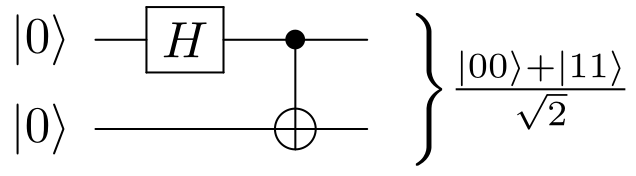
Quantum circuit that generates the Bell state
. Source. E.g. with our qiskit/hello.py, we obtain the Bell state circuit:
OPENQASM 2.0;
include "qelib1.inc";
qreg q[2];
creg c[2];
h q[0];
cx q[0],q[1];
measure q[0] -> c[0];
measure q[1] -> c[1];One would hope that they are not Turing complete, this way they may serve as a way to pass on data in such a way that the receiver knows they will only be doing so much computation in advance to unpack the circuit. So it would be like JSON is for JavaScript.
These appear to be benchmarks that don't involve running anything concretely, just compiling and likely then counting gates:
The Busy Beaver Competition: a historical survey by Pascal Michel by  Ciro Santilli 40 Updated 2025-07-16
Ciro Santilli 40 Updated 2025-07-16We ust use the if mod notation definition as mentioned at: math.stackexchange.com/questions/4305972/what-exactly-is-a-collatz-like-problem/4773230#4773230
Course plan:
- Section "Programmer's model of quantum computers"
- look at a Qiskit hello world
- e.g. ours: qiskit/hello.py
- learn about quantum circuits.
- tensor product in quantum computing
- First we learn some quantum logic gates. This shows an alternative, and extremely important view of a quantum computer besides a matrix multiplication: as a circuit. Fundamental subsections:
- quantum algorithms
But what is quantum computing? by 3Blue1Brown
. Source. Ubuntu 23.04 install:
sudo apt install rbaseHello world:
R -e 'print("hello world")'As mentioned in True Genius: The Life and Science of John Bardeen page 224, the idea of symmetry breaking was a major motivation in Josephson's study of the Josephson effect.
Ciro Santilli invented this term, it refers to mechanisms in which you put an animal in a virtual world that the animal can control, and where you can measure the animal's outputs.
- MouseGoggles www.researchsquare.com/article/rs-3301474/v1 | twitter.com/hongyu_chang/status/1704910865583993236
- Fruit fly setup from Penn State: scitechdaily.com/secrets-of-fly-vision-for-rapid-flight-control-and-staggeringly-fast-reaction-speed/
So we see that the classification is quite simple, much like the classification of finite fields, and in strict opposition to the classification of finite simple groups (not to mention the 2023 lack of classification for non simple finite groups!)
Pinned article: Introduction to the OurBigBook Project
Welcome to the OurBigBook Project! Our goal is to create the perfect publishing platform for STEM subjects, and get university-level students to write the best free STEM tutorials ever.
Everyone is welcome to create an account and play with the site: ourbigbook.com/go/register. We belive that students themselves can write amazing tutorials, but teachers are welcome too. You can write about anything you want, it doesn't have to be STEM or even educational. Silly test content is very welcome and you won't be penalized in any way. Just keep it legal!
Intro to OurBigBook
. Source. We have two killer features:
- topics: topics group articles by different users with the same title, e.g. here is the topic for the "Fundamental Theorem of Calculus" ourbigbook.com/go/topic/fundamental-theorem-of-calculusArticles of different users are sorted by upvote within each article page. This feature is a bit like:
- a Wikipedia where each user can have their own version of each article
- a Q&A website like Stack Overflow, where multiple people can give their views on a given topic, and the best ones are sorted by upvote. Except you don't need to wait for someone to ask first, and any topic goes, no matter how narrow or broad
This feature makes it possible for readers to find better explanations of any topic created by other writers. And it allows writers to create an explanation in a place that readers might actually find it.
Figure 1. Screenshot of the "Derivative" topic page. View it live at: ourbigbook.com/go/topic/derivativeVideo 2. OurBigBook Web topics demo. Source. - local editing: you can store all your personal knowledge base content locally in a plaintext markup format that can be edited locally and published either:This way you can be sure that even if OurBigBook.com were to go down one day (which we have no plans to do as it is quite cheap to host!), your content will still be perfectly readable as a static site.
- to OurBigBook.com to get awesome multi-user features like topics and likes
- as HTML files to a static website, which you can host yourself for free on many external providers like GitHub Pages, and remain in full control

Figure 2. You can publish local OurBigBook lightweight markup files to either OurBigBook.com or as a static website.
Figure 3. Visual Studio Code extension installation.
Figure 5. . You can also edit articles on the Web editor without installing anything locally. Video 3. Edit locally and publish demo. Source. This shows editing OurBigBook Markup and publishing it using the Visual Studio Code extension. 
- Infinitely deep tables of contents:



All our software is open source and hosted at: github.com/ourbigbook/ourbigbook
Further documentation can be found at: docs.ourbigbook.com
Feel free to reach our to us for any help or suggestions: docs.ourbigbook.com/#contact