Topics (384k) Articles (398k) Users (410) Discussions (242) Comments (383) Files (13k) New article
With a fixed identification of the kernel with and quotient with , these central group extensions are classified by . Choose lifts of the quotient generators; their commutator is and is unchanged by central changes of lifts. Every element has unique normal form , proving this invariant is complete. A cocycle representative is , whose cocycle identity follows from bilinearity. Its extension multiplication is . The zero parameter gives and parameter one gives the integer Heisenberg group. The Koszul resolution for a rank-two free abelian group independently computes .
For the second Chebyshev function, finite summation gives . For , Mellin inversion of the kernel givesThe extra denominator makes this smoothing useful: the resulting sum over Nontrivial zeros of the Riemann zeta function is absolutely convergent. This integral differs from the integrated Chebyshev sum, which denotes a sum of the values .
For stationary level water and wind stress approximated by in the wind direction, equilibrium with quadratic water drag gives . The signed angle to the right of the wind is . This neglects the floe velocity relative to the wind in the air drag; the exact relative-wind equation adds to the angle denominator.
For finite-dimensional unitary representations of a compact group, average the action on against normalized Haar measure. This is the orthogonal projection onto the intertwining operators, and its trace is the displayed integral. The Schur lemma therefore makes distinct irreducible characters orthogonal and each irreducible character of norm one.
A scheme is quasi-compact when its underlying topological space is quasi-compact: every open cover has a finite subcover. Since affine open subsets form a base, this is equivalent to possessing a finite affine open cover. Every affine scheme is quasi-compact.
A morphism of schemes is étale when it is flat, unramified and locally of finite presentation. For a morphism between smooth varieties of the same dimension, an invertible differential gives this property locally. A finite étale morphism over an algebraically closed field has reduced finite fibres, and their cardinalities equal its degree when the source and target are connected.
A morphism of schemes is smooth when it is locally of finite presentation, flat and has geometrically regular fibres. Smooth fibres alone do not imply that a morphism is smooth: flatness and the dimension behaviour matter as well. The Abel map of an algebraic curve has smooth projective space fibres whose dimensions can jump.
A formal scheme is a locally ringed space with a sheaf of topological rings that is locally a formal spectrum of a complete adic ring. An ordinary scheme is the special case of the discrete topology. A formal completion of a scheme retains all infinitesimal neighbourhoods of a closed subscheme, rather than just that subscheme.
// Target: ringed-space.bigb
Given schemes and isomorphisms between designated open subschemes satisfying inverse and cocycle conditions, identify the underlying open spaces and glue their structure sheaves. The resulting locally ringed space is locally one of the , hence a scheme. The same construction works for formal schemes and topological structure sheaves. Compatible morphisms out of the charts glue uniquely.
// Target: ringed-space.bigb
The functor of points describes a scheme through its morphisms from test schemes. On commutative rings, it is covariant because a ring homomorphism reverses the corresponding affine-scheme map. A functor on rings is represented by in the algebraic-geometric sense when it is naturally isomorphic to . The representing scheme need not be affine; this is different from demanding a representable functor in the category of rings itself.
// Target: module-theory.bigb
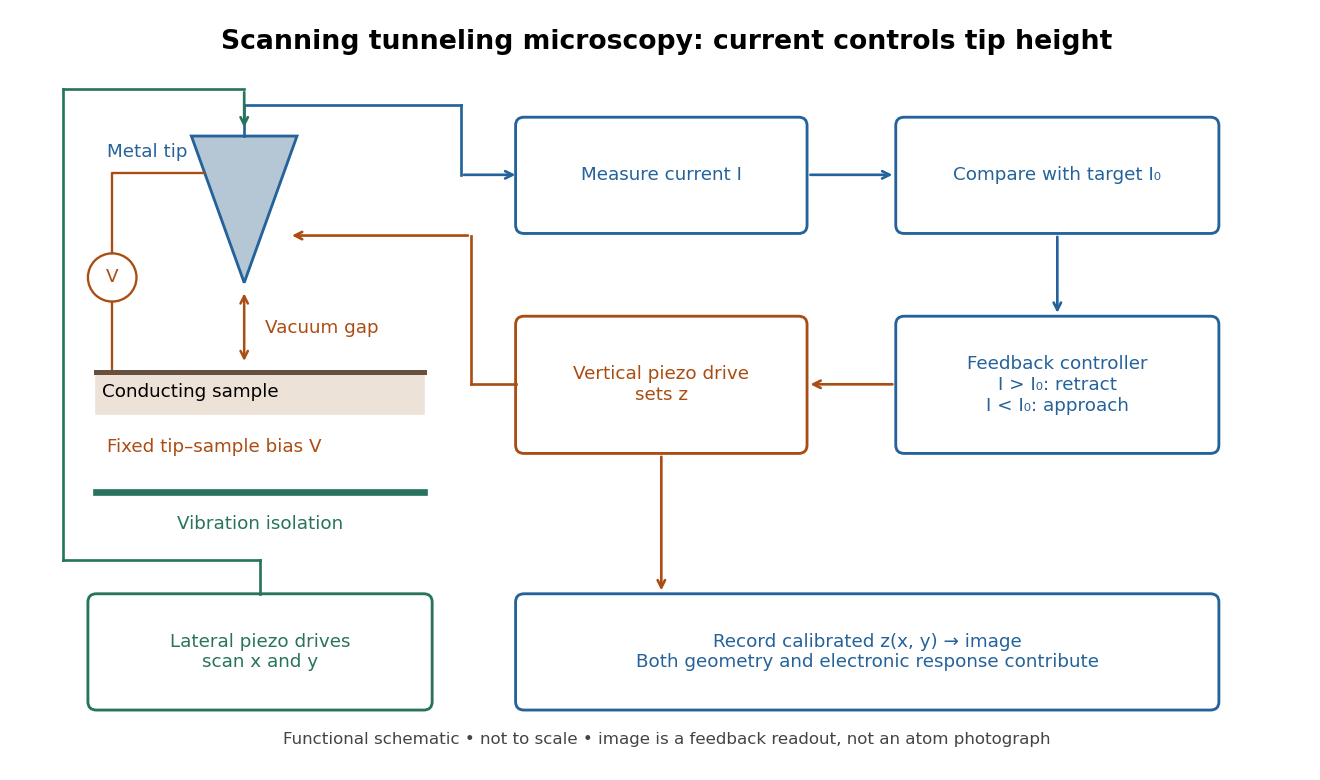
In the 1982 experiment, separate drives using piezoelectricity scanned a metal tip laterally and adjusted its height. A control unit held electric current fixed at constant tip-sample electric potential difference; calibrated drive voltages supplied the displacement readout. Their Fig. 1 explicitly contrasts a surface step with apparent height from contamination changing the work function.[ref]
Surface Studies by Scanning Tunneling Microscopy by Gerd Binnig and others. pp. 58–59, Fig. 1, equation (1), piezodrive calibration
Gerd Binnig and Heinrich Rohrer describe a later vibration isolation system using two spring stages and eddy current damping inside a vacuum chamber, with sputtering and annealing for surface preparation. These measures addressed unwanted motion and surface condition separately.[ref]
Let a real measurable Fourier transform equal one on , vanish on , and satisfy the displayed complementary identity on the positive transition band. On a fundamental interval, either only the central translate is nonzero, or exactly the two complementary translates contribute. Thus orthonormal translates and Fourier periodization holds. The periodic mask defined on by for and otherwise satisfies the scaling refinement equation in Fourier form. A concrete even transition is on the transition bands. For complex-valued , ordinary squares cannot replace absolute squares: transition values and have squares summing to one but squared moduli summing to three.
For a matter power spectrum at a fixed epoch, the Poisson equation gives potential Fourier amplitudes proportional to , and the growing-mode peculiar velocity is proportional to . With a spherical top-hat window function, their variances are proportional to and , respectively. Rescaling gives the displayed powers when the integrals converge: for the averaged potential and for the bulk velocity. Absolute averaged potential has infrared sensitivity; band-limited fluctuations or potential differences can have different convergence requirements. The density variance converges only for , so these three absolute averages cannot all converge for one unbroken power law at every scale.
A supersymmetry transformation mixes the bosonic and odd coordinates of superspace. A bare derivative with respect to an odd coordinate therefore acquires a spacetime-derivative term under the coordinate Jacobian and is not a covariant spinor superfield. Supersymmetric covariant derivatives add terms linear in the other odd coordinate; their graded anticommutation with the supercharges makes their application to a scalar superfield transform covariantly.
Let with independent , and let be independent of them. Then has Rayleigh distribution and has the displayed cumulative distribution function for and density . Indeed, conditioning on gives , and a Gaussian integral completes the calculation. Independence is essential: choosing has the same Gaussian marginal but makes the ratio bounded by .
In the long-time growing horizontal-gradient branch, independent vertical shear noises combine as . The signed inclination satisfies the displayed Ornstein-Uhlenbeck stochastic differential equation. For its stationary density is , with variance . The Fokker-Planck probability current vanishes at infinity and gives this Gaussian by one integration. At and nonzero noise there is no normalizable stationary density.
Minimal-subtraction scalar four-point bubble channels by  Codex 0 Created 2026-10-14 Updated 2026-11-05
For one real phi-fourth theory field, each of the three labeled one-loop four-point channels has symmetry factor . In , the displayed expression is its amplitude through the finite part. The three poles require , and differentiating at fixed bare coupling gives in four dimensions. The minimal subtraction scheme retains ; modified minimal subtraction absorbs that constant. The Feynman-parameter logarithm is left unevaluated.
If no -set were shattered, the Sauer-Shelah lemma would bound the number of traces by . This strict middle-layer gap contradicts the displayed lower bound. Therefore a family with such traces at every even size has unbounded finite VC dimension.
For and , the displayed kernel satisfies . The limit at is . Differentiating along , which preserves , gives . Thus it generates the normalized magnetic scalar potential in the Sarvas formula.
The sampling fraction is the sample size divided by the finite population size. In simple random sampling, it determines how much the finite population correction reduces the variance relative to .
Pinned article: Introduction to the OurBigBook Project
Welcome to the OurBigBook Project! Our goal is to create the perfect publishing platform for STEM subjects, and get university-level students to write the best free STEM tutorials ever.
Everyone is welcome to create an account and play with the site: ourbigbook.com/go/register. We belive that students themselves can write amazing tutorials, but teachers are welcome too. You can write about anything you want, it doesn't have to be STEM or even educational. Silly test content is very welcome and you won't be penalized in any way. Just keep it legal!
Intro to OurBigBook
. Source. We have two killer features:
- topics: topics group articles by different users with the same title, e.g. here is the topic for the "Fundamental Theorem of Calculus" ourbigbook.com/go/topic/fundamental-theorem-of-calculusArticles of different users are sorted by upvote within each article page. This feature is a bit like:
- a Wikipedia where each user can have their own version of each article
- a Q&A website like Stack Overflow, where multiple people can give their views on a given topic, and the best ones are sorted by upvote. Except you don't need to wait for someone to ask first, and any topic goes, no matter how narrow or broad
This feature makes it possible for readers to find better explanations of any topic created by other writers. And it allows writers to create an explanation in a place that readers might actually find it.
Figure 1. Screenshot of the "Derivative" topic page. View it live at: ourbigbook.com/go/topic/derivativeVideo 2. OurBigBook Web topics demo. Source. - local editing: you can store all your personal knowledge base content locally in a plaintext markup format that can be edited locally and published either:This way you can be sure that even if OurBigBook.com were to go down one day (which we have no plans to do as it is quite cheap to host!), your content will still be perfectly readable as a static site.
- to OurBigBook.com to get awesome multi-user features like topics and likes
- as HTML files to a static website, which you can host yourself for free on many external providers like GitHub Pages, and remain in full control

Figure 2. You can publish local OurBigBook lightweight markup files to either OurBigBook.com or as a static website.
Figure 3. Visual Studio Code extension installation.
Figure 5. . You can also edit articles on the Web editor without installing anything locally. Video 3. Edit locally and publish demo. Source. This shows editing OurBigBook Markup and publishing it using the Visual Studio Code extension. 
- Infinitely deep tables of contents:



All our software is open source and hosted at: github.com/ourbigbook/ourbigbook
Further documentation can be found at: docs.ourbigbook.com
Feel free to reach our to us for any help or suggestions: docs.ourbigbook.com/#contact