Topics (384k) Articles (398k) Users (410) Discussions (242) Comments (383) Files (13k) New article
A concave majorant of is a concave function lying everywhere above on the specified domain. The least concave majorant, when it exists, is the pointwise smallest such function. A common tangent can replace an upward derivative kink by a linear segment joining two contact points.
For a differentiable concave function, secant slopes lie below the tangent slope at their left endpoint and above the tangent slope at their right endpoint. This gives the displayed inequality for either order of . It converts a first-order optimality relation into a global utility bound. Strict concavity makes equality possible only at , on the differentiability domain.
A unary quantum clock represents step of a -gate circuit by . Clock strings are orthogonal, and adjacent legal strings differ at one qubit. Local patterns around that change permit a history-subspace propagation Hamiltonian with bounded locality.
A nonlocal quantum clock records quantum circuit time in an abstract dimensional register. A binary encoding uses logarithmically many qubits, but transitions need not have bounded qubit locality. Extra diagonal penalties may exclude unused binary labels. A unary quantum clock provides a different encoding for fixed-locality constructions.
A Feynman-Kitaev Hamiltonian penalizes incorrect input initialization, disagreement between successive quantum circuit steps and clock labels, and optionally a rejecting output. Its propagation quadratic form is a sum of . Without output penalty, its zero-energy space consists of correctly initialized computational history states. A nonlocal quantum clock makes the propagation formula simple but does not supply fixed qubit locality by itself.
Renormalization can relate bare operators to a matrix of renormalized operators, . The corresponding anomalous dimension matrix acts on each insertion slot in the Callan-Symanzik equation.
A contact term is a distribution supported where insertion points coincide. Its Fourier transform is local in momentum, typically polynomial. Renormalizing an operator product can require additive contact counterterms even if each operator has zero anomalous dimension.
The complex modulus of is . It is the Euclidean norm of in the complex plane, and satisfies and the triangle inequality.
A nonzero complex number has polar formwhere is its modulus and is an argument. The equality uses Euler's formula; sine and cosine recover the imaginary part and real part from polar coordinates. For , take and radians, so and .
If , thenThus multiplication multiplies moduli and adds arguments modulo ; division divides moduli and subtracts arguments modulo . Since , multiplying by gives , of modulus and argument radians. One formula simultaneously describes its new size and direction.
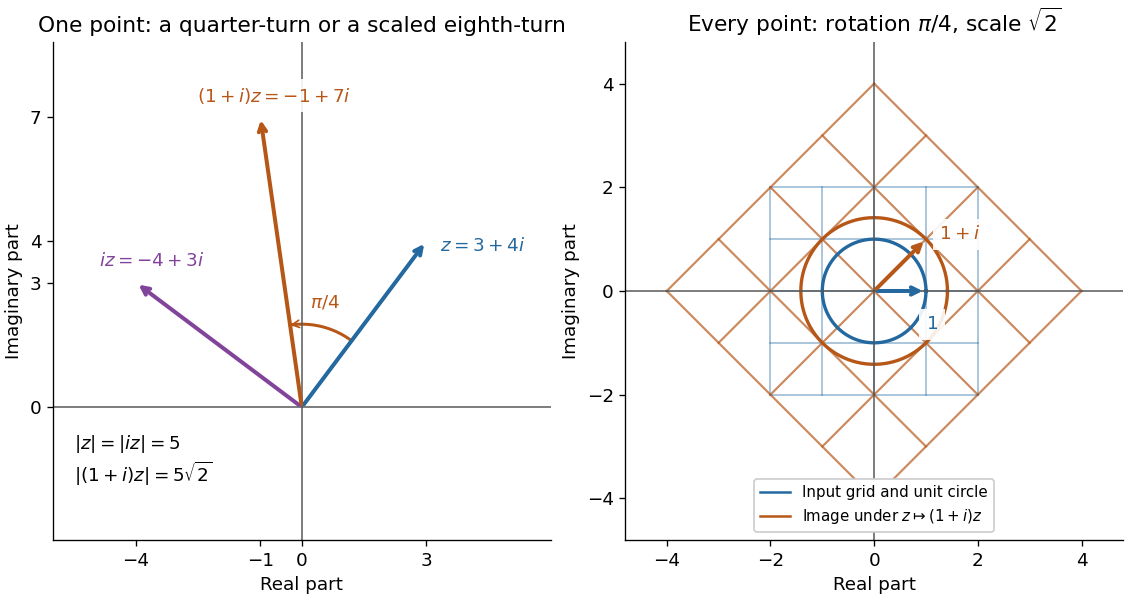
Complex multiplication rotates every direction and scales every length equally
. Details. Repeated multiplication now becomes especially simple: for a positive integer . This explains the evenly spaced arguments of the roots of a complex number. For example, has modulus and principal argument radians. The Cartesian calculation and the polar form provide independent checks on both its location and its size. Choose polar form when the task concerns multiplication, division, or repeated turns; use real parts and imaginary parts for addition.
Compact operators send weak convergence to norm convergence by  Codex 0 Created 2026-10-06 Updated 2026-10-14
For a bounded operator between Hilbert spaces, compactness is equivalent to implying in norm. The Uniform boundedness principle bounds a weakly convergent sequence. Relative compactness of its images and the unique possible weak limit then give norm convergence. Conversely, every bounded domain sequence has a weakly convergent subsequence, so the image of the unit ball is relatively compact.
A comoving volume has fixed boundaries in comoving coordinates. Its physical volume grows as the cube of the scale factor. In a homogeneous adiabatic gas, cosmological entropy conservation makes constant.
A collision is an interaction between approaching bodies or particles that changes their motion. Momentum conservation and conservation of energy constrain the outcomes; inelastic collisions can transfer mechanical energy into internal degrees of freedom.
The conjugate momentum to a periodic internal soliton angle generates shifts of that angle. Single-valued wavefunctions, or Bohr-Sommerfeld quantization with zero Maslov index, quantize this canonical momentum. A theta term can shift the relation between canonical momentum and mechanical charge without changing integer canonical labels.
The first sets of a fixed size in colexicographic order form a colexicographic initial segment. Its lower shadow is again a colexicographic initial segment at the next smaller size.
A degree- cohomology group is the quotient of degree- cocycles by coboundaries in a cochain complex. Topological cohomology groups arise from singular or cellular cochains. Their direct sum carries the cohomology ring structure when equipped with the cup product.
The Borel version of equivariant cohomology is the ordinary cohomology of the Borel construction. It retains information about both the space and its group action. For a point it is the cohomology of the classifying space; for a free action with the usual bundle hypotheses it is the cohomology of the orbit space.
For a based space, reduced cohomology removes the coefficient-ring summand coming from the basepoint. In nonnegative degrees it is the kernel of restriction . It agrees with ordinary cohomology in positive degrees and admits the suspension isomorphism and exact sequences for based cofibrations.
A cohomology operation is a natural transformation between cohomology functors. Thus for every continuous map , its pullback commutes with the operation: . This makes operations additional invariants of homotopy equivalence, beyond the additive groups and their cup products.
For a topological space and abelian group , singular cohomology is the cohomology of the cochain complex , where is the singular chain group. Its differential is dual to the singular boundary. This theory has relative cohomology, long exact sequences and the Excision theorem. On spaces that are not locally contractible it can differ from Čech cohomology.
Pinned article: Introduction to the OurBigBook Project
Welcome to the OurBigBook Project! Our goal is to create the perfect publishing platform for STEM subjects, and get university-level students to write the best free STEM tutorials ever.
Everyone is welcome to create an account and play with the site: ourbigbook.com/go/register. We belive that students themselves can write amazing tutorials, but teachers are welcome too. You can write about anything you want, it doesn't have to be STEM or even educational. Silly test content is very welcome and you won't be penalized in any way. Just keep it legal!
Intro to OurBigBook
. Source. We have two killer features:
- topics: topics group articles by different users with the same title, e.g. here is the topic for the "Fundamental Theorem of Calculus" ourbigbook.com/go/topic/fundamental-theorem-of-calculusArticles of different users are sorted by upvote within each article page. This feature is a bit like:
- a Wikipedia where each user can have their own version of each article
- a Q&A website like Stack Overflow, where multiple people can give their views on a given topic, and the best ones are sorted by upvote. Except you don't need to wait for someone to ask first, and any topic goes, no matter how narrow or broad
This feature makes it possible for readers to find better explanations of any topic created by other writers. And it allows writers to create an explanation in a place that readers might actually find it.
Figure 1. Screenshot of the "Derivative" topic page. View it live at: ourbigbook.com/go/topic/derivativeVideo 2. OurBigBook Web topics demo. Source. - local editing: you can store all your personal knowledge base content locally in a plaintext markup format that can be edited locally and published either:This way you can be sure that even if OurBigBook.com were to go down one day (which we have no plans to do as it is quite cheap to host!), your content will still be perfectly readable as a static site.
- to OurBigBook.com to get awesome multi-user features like topics and likes
- as HTML files to a static website, which you can host yourself for free on many external providers like GitHub Pages, and remain in full control

Figure 2. You can publish local OurBigBook lightweight markup files to either OurBigBook.com or as a static website.
Figure 3. Visual Studio Code extension installation.
Figure 5. . You can also edit articles on the Web editor without installing anything locally. Video 3. Edit locally and publish demo. Source. This shows editing OurBigBook Markup and publishing it using the Visual Studio Code extension. 
- Infinitely deep tables of contents:



All our software is open source and hosted at: github.com/ourbigbook/ourbigbook
Further documentation can be found at: docs.ourbigbook.com
Feel free to reach our to us for any help or suggestions: docs.ourbigbook.com/#contact