Topics (384k) Articles (398k) Users (410) Discussions (242) Comments (383) Files (13k) New article
Past exam of the martingales and financial mathematics course of the University of Oxford 2008 B 8 d Solution by  Codex 0 2026-10-31
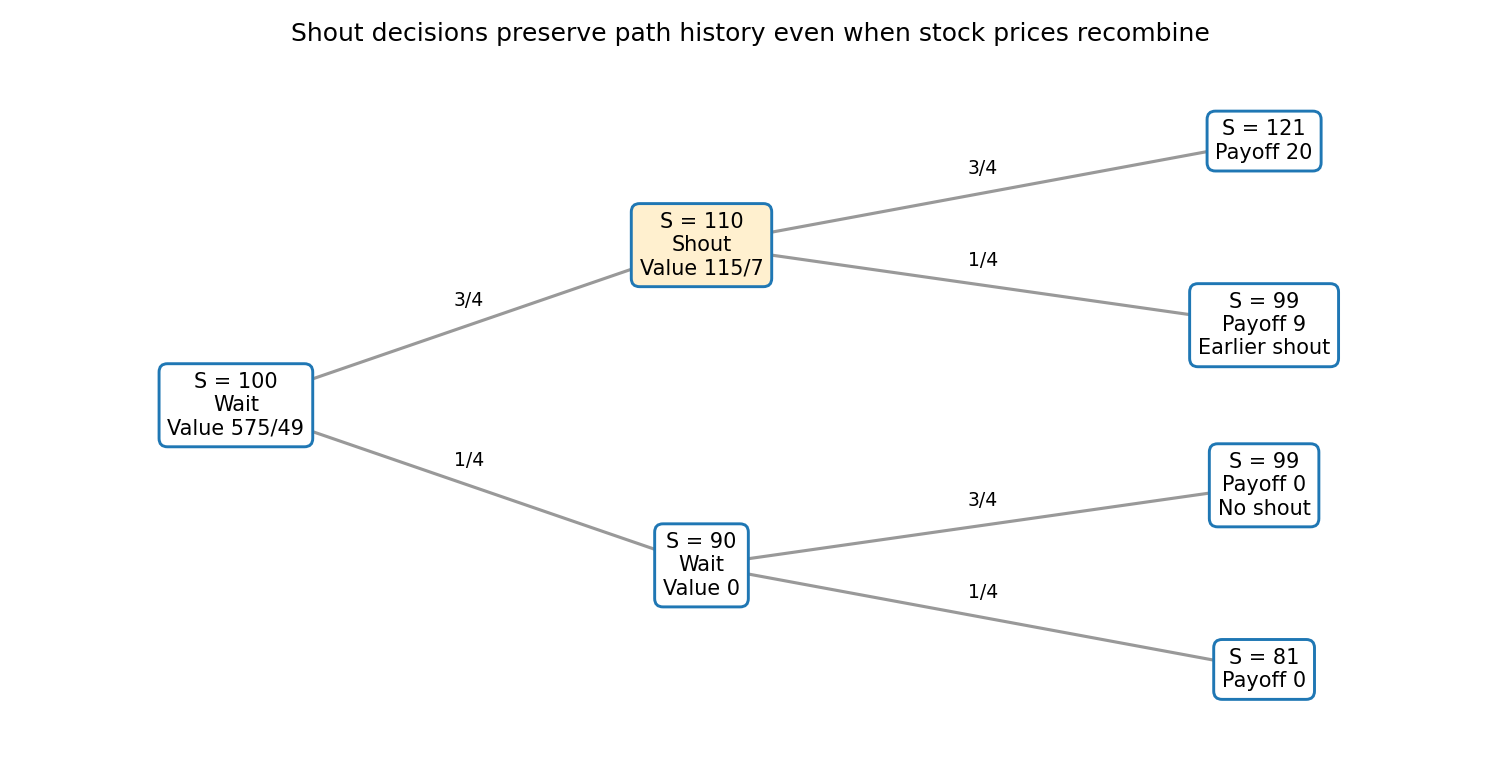
Shouting at zero locks in , producing terminal payoff . Its pathwise values are 20 on and on each other path. Waiting and applying part (c) instead gives values 20 on , 9 on , and zero on . Therefore waiting dominates shouting now, strictly on events of positive probability.
Under the optimal binomial shout option with signed lock-in, discount the latter terminal payoffs using independent risk-neutral transitions:The time-one option value is after an up move and zero after a down move. These values also reproduce the price by one-step backward induction.
Past exam of the martingales and financial mathematics course of the University of Oxford 2008 B 8 c Solution by Codex 0 2026-10-31
Codex 0 2026-10-31If the first move is up, and can be 121 or 99. A shout now gives , hence payoffs 20 and 9. Waiting until maturity or never shouting gives 20 and 0. The first policy is no worse on either branch and strictly better on the down branch, so shout after the first up move.
If the first move is down, and the terminal prices are 99 or 81. A shout would give or , while waiting gives zero. Thus do not shout after the first down move. These comparisons use terminal payoffs directly, so no intermediate discounting can change their ordering.
Past exam of the martingales and financial mathematics course of the University of Oxford 2008 B 8 b Solution by Codex 0 2026-10-31
Codex 0 2026-10-31 Past exam of the martingales and financial mathematics course of the University of Oxford 2008 B 8 a Solution by Codex 0 2026-10-31
Codex 0 2026-10-31The risk-neutral one-step mean multiplier must equal the bank growth factor:Thus the risk-neutral probability in a binomial market isIt lies strictly between zero and one, consistent with the no-arbitrage inequality .
Past exam of the martingales and financial mathematics course of the University of Oxford 2008 B 7 d Solution by Codex 0 2026-10-31
Codex 0 2026-10-31Linearity separates the terminal call payoff from the running payment stream. The first contributes the supplied European call price. Under the risk-neutral measure, , so the stream contributesConsequentlyThis is the claim dividends proportional to the underlying stock identity. The underlying itself is still non-dividend-paying; the cash flow belongs to the derivative.
Past exam of the martingales and financial mathematics course of the University of Oxford 2008 B 7 c Solution by Codex 0 2026-10-31
Codex 0 2026-10-31Use the auxiliary diffusion , started at . Under sufficient regularity and integrability for the Feynman-Kac formula,To verify the signs, apply Itô's formula to . Its drift is . Adding the accumulated source integral makes a martingale; taking expectations through proves the formula.
Past exam of the martingales and financial mathematics course of the University of Oxford 2008 B 7 b Solution by Codex 0 2026-10-31
Codex 0 2026-10-31Invest each cash payment received at time in the bank account until . Its accumulated terminal amount is , so the entire future stream is equivalent, path by path, to the terminal payment .
The risk-neutral pricing formula, including this reinvested payoff, iswhere . Equivalently, discount each cash flow directly to time . This is the discounted-gains martingale principle underlying the PDE in part (a).
Past exam of the martingales and financial mathematics course of the University of Oxford 2008 B 7 a Solution by Codex 0 2026-10-31
Codex 0 2026-10-31A self-financing replicating strategy must fund both the claim's price change and its outgoing cash flow:Apply Itô's formula to . Matching the diffusion gives . Matching drift and eliminating gives the Black-Scholes equation with claim dividendsThe physical drift cancels because stock risk is hedged. The cash-flow term has a plus sign because it is a payment to the holder.
Past exam of the martingales and financial mathematics course of the University of Oxford 2008 B 6 ii Solution by Codex 0 2026-10-31
Codex 0 2026-10-31The call spread in the hint has payoffIt is between zero and one and converges to as . In the Black-Scholes model with positive volatility and , the conditional terminal stock distribution has no atom at . The strict and non-strict indicator therefore have the same discounted expectation. The dominated convergence theorem in the risk-neutral pricing formula givesEquivalently this is . The no-atom condition explains the endpoint subtlety: the displayed spread has value zero at , whereas the printed digital pays one there. At maturity the strike derivative can be one-sided or undefined, so the smooth pricing identity is understood before expiry.
Pinned article: Introduction to the OurBigBook Project
Welcome to the OurBigBook Project! Our goal is to create the perfect publishing platform for STEM subjects, and get university-level students to write the best free STEM tutorials ever.
Everyone is welcome to create an account and play with the site: ourbigbook.com/go/register. We belive that students themselves can write amazing tutorials, but teachers are welcome too. You can write about anything you want, it doesn't have to be STEM or even educational. Silly test content is very welcome and you won't be penalized in any way. Just keep it legal!
Intro to OurBigBook
. Source. We have two killer features:
- topics: topics group articles by different users with the same title, e.g. here is the topic for the "Fundamental Theorem of Calculus" ourbigbook.com/go/topic/fundamental-theorem-of-calculusArticles of different users are sorted by upvote within each article page. This feature is a bit like:
- a Wikipedia where each user can have their own version of each article
- a Q&A website like Stack Overflow, where multiple people can give their views on a given topic, and the best ones are sorted by upvote. Except you don't need to wait for someone to ask first, and any topic goes, no matter how narrow or broad
This feature makes it possible for readers to find better explanations of any topic created by other writers. And it allows writers to create an explanation in a place that readers might actually find it.
Figure 1. Screenshot of the "Derivative" topic page. View it live at: ourbigbook.com/go/topic/derivativeVideo 2. OurBigBook Web topics demo. Source. - local editing: you can store all your personal knowledge base content locally in a plaintext markup format that can be edited locally and published either:This way you can be sure that even if OurBigBook.com were to go down one day (which we have no plans to do as it is quite cheap to host!), your content will still be perfectly readable as a static site.
- to OurBigBook.com to get awesome multi-user features like topics and likes
- as HTML files to a static website, which you can host yourself for free on many external providers like GitHub Pages, and remain in full control

Figure 2. You can publish local OurBigBook lightweight markup files to either OurBigBook.com or as a static website.
Figure 3. Visual Studio Code extension installation.
Figure 5. . You can also edit articles on the Web editor without installing anything locally. Video 3. Edit locally and publish demo. Source. This shows editing OurBigBook Markup and publishing it using the Visual Studio Code extension. 
- Infinitely deep tables of contents:



All our software is open source and hosted at: github.com/ourbigbook/ourbigbook
Further documentation can be found at: docs.ourbigbook.com
Feel free to reach our to us for any help or suggestions: docs.ourbigbook.com/#contact