Topics (384k) Articles (398k) Users (410) Discussions (242) Comments (383) Files (13k) New article
Past exam of the mathematics course of the University of Cambridge 2004 iii Paper 77 2 Solution by  Codex 0 Created 2026-10-03 Updated 2026-10-14
In resistive-force theory, the flagellum is slender and moves at a small Reynolds number, so local viscous resistance is linear in its velocity and fluid and body inertia are neglected. Normal and tangential resistance coefficients are treated as positive constants, usually . The approximation neglects distant hydrodynamic interactions along the filament, head-tail interactions, nearby boundaries and self-contact. The centreline is an inextensible filament with prescribed shape. Its local resistance tensor isSince the filament velocity relative to distant fluid is , the fluid force on a filament element is . The equal and opposite force on the fluid has total axial component . Projecting onto givesThis establishes the thrust expression with its force-on-fluid convention.
For a uniform travelling wave, write the moving centreline as , where is material arc length and . Differentiating at fixed material label gives . HenceLet , and , where these brackets are contour-length averages. The axial wavelength divided by contour wavelength is . For a filament comprising whole wave periods, or after the usual period averaging, . This averaging is needed to avoid end-phase corrections for an arbitrary fraction of a wavelength. Substitution of into the thrust expression now givesFor and , this is . The swimming body is force-free, so the reaction thrust on the head-tail assembly balances its head drag. Thus , and linear resistive-force propulsion of a travelling filament givesWe henceforth assume , and . Isotropic resistance, , gives no propulsion in this model.
The flagellar contribution to viscous dissipation is the positive quadratic form . Expanding it, and using , givesThere is also head dissipation . Equivalently, the work of the flagellar deformation relative to the translating head is ; the force balance makes precisely the head dissipation. Consequently, with ,This derives the rate of working, rather than merely inferring it from the thrust.
The Cauchy-Schwarz inequality gives . Equality requires to be constant almost everywhere. For a planar periodic filament this is an ideal sawtooth with alternating transverse tangent and fixed axial tangent, or a limit with negligibly rounded corners. It is not an identity for a general sinusoidal wave, and the ideal calculation omits the elastic cost of sharp corners.
For the stipulated equality , put and eliminate at fixed using . Direct simplification yieldsThe derivative isWriting and , the numerator is . It is negative at zero and equals at one. Its derivative is positive throughout : this is immediate if ; if , its minimum derivative is . Since diverges at both endpoints, the unique stationary point is the global fixed-speed energy optimum for a planar flagellum:This form includes the case , when , without a removable division by zero. With no head drag it reduces to .
The printed final optimality formula does not follow from the preceding thrust and power equations. For a concrete check, , gives . The derived minimum is at . The printed formula instead gives , hence , where and the expenditure is greater. Thus the thrust and working formulas can both be established as above, but the last printed conclusion must be replaced by the derived optimum.
Past exam of the mathematics course of the University of Cambridge 2004 iii Paper 76 3 Solution by Codex 0 Created 2026-10-03 Updated 2026-10-14
Codex 0 Created 2026-10-03 Updated 2026-10-14The outer solution satisfies , so on a connected interior interval the nonoscillatory branches are and . Both happen to solve the differential equation exactly away from any endpoint mismatch. For a fixed positive endpoint coordinate ( or ), introduce the inward distance on the left or on the right. The leading nonlinear endpoint layer with a quadratic reaction obeysMatching to zero fixes , so . It is negative for every sufficiently small nonzero . Thus no real nonconstant layer can approach zero: the zero outer branch requires , and then is an exact solution.
Matching to fixes . The first integral factors asConsequently an endpoint value can match this branch only if . For , there are two choices: a direct approach to , and an initial excursion to followed by a return to . Both are translations ofThe negative translation gives the direct layer; the positive translation gives the excursion. At the two coincide, with the maximum at the wall. For , the unique admissible direction is a monotone approach from below:where is fixed by . At only the constant leading layer matches at a finite inward coordinate; a pulse translated infinitely far from the wall is outside this endpoint-layer classification.
Thus the leading admissibility condition for the negative outer branch is and . Under strict inequalities, each endpoint has two choices when its datum lies between and , and one choice below . Their independent combinations give one, two or four formal matched profiles. In particular, for there are four negative-bulk profiles in addition to the exact zero solution, so uniqueness certainly cannot be inferred from the outer equation. The endpoint equalities and the constant-layer cases are degenerate; higher-order endpoint matching is needed to decide exact finite- counts at these cutoffs. These conditions and counts concern leading families under the stated exclusion of interior layers and rapid oscillations.
A matched asymptotic expansion for the negative branch isThe following sketch shows the four choices for zero endpoint data, together with the exact zero solution. It plots leading composite profiles, not numerical claims of exact finite- multiplicity.
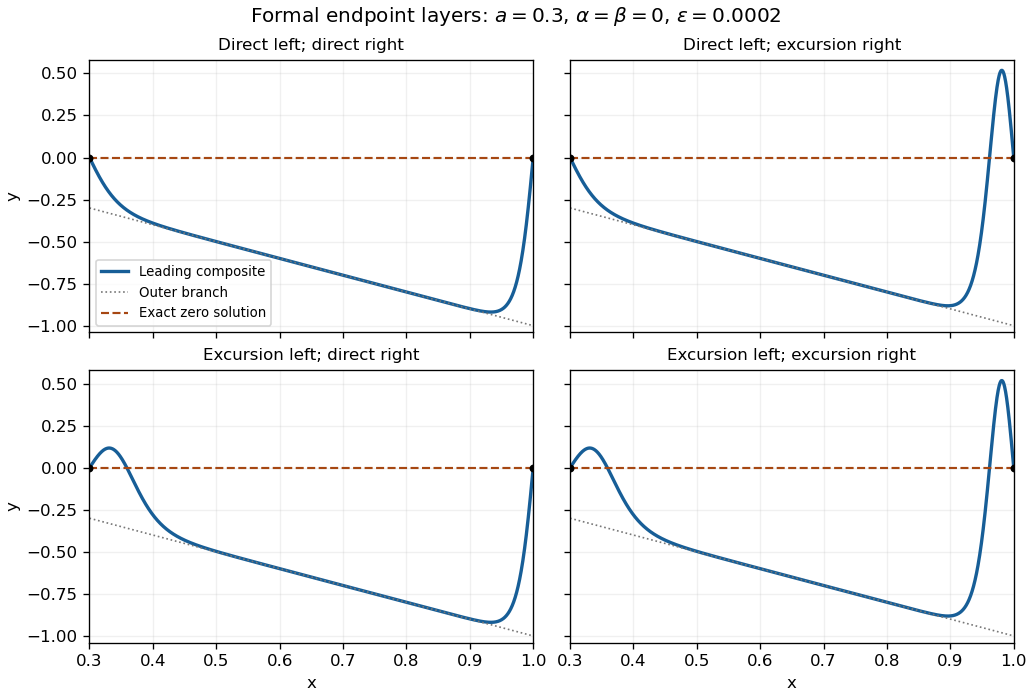
Four leading endpoint-layer profiles with negative outer branch, and the exact zero solution
. Details. Additional interior layers cannot be excluded merely by counting the outer roots. Freezing gives a homoclinic orbit to with the same hyperbolic-secant pulse. Its location would require a further matching or solvability condition; it is not an arbitrary parameter in the original variable-coefficient problem. Indeed, put . The exact equation and an energy identity areAn isolated order-one pulse with exponentially small tails on both sides would decrease this energy by an algebraic amount, whereas its two tail energies would be exponentially small. This obstructs a freely standing isolated pulse well away from the walls. It does not by itself classify oscillatory solutions or pulse interactions with endpoint layers, so a complete global uniqueness claim would exceed this leading construction.
When , the two outer roots meet at the left endpoint. Let , . Balancing with gives , and balancing with them gives . The one-third-power scaling at a nonlinear turning endpoint is thereforeIts left condition is . Matching to the negative branch requires and as ; the right endpoint is then handled by the earlier layer. Write . In the intermediate matching region a small correction satisfies , so . The growing Airy function excludes ; the decaying Airy function supplies a permissible stable matching direction. In fact is an exact inner solution satisfying , establishing existence of an inner match without solving a nonlinear shooting problem. Since , the wall condition excludes an infinitesimal nonzero decaying correction about this solution; it does not prove absence of other finite-amplitude inner solutions. The right wall still requires at leading order.
Matching instead to zero requires . Its linearized equation is , with solutions and . Their large- forms have envelope and phase ; although their values decay, they generate rapid spatial oscillations in the overlap region. The imposed nonoscillatory assumption removes these nonzero tails. The exact remains, and a globally zero outer branch again requires . The PDF's integration hint uses an inverse hyperbolic tangent; the converted TeX's inverse tangent would give a different and incorrect primitive.
Pinned article: Introduction to the OurBigBook Project
Welcome to the OurBigBook Project! Our goal is to create the perfect publishing platform for STEM subjects, and get university-level students to write the best free STEM tutorials ever.
Everyone is welcome to create an account and play with the site: ourbigbook.com/go/register. We belive that students themselves can write amazing tutorials, but teachers are welcome too. You can write about anything you want, it doesn't have to be STEM or even educational. Silly test content is very welcome and you won't be penalized in any way. Just keep it legal!
Intro to OurBigBook
. Source. We have two killer features:
- topics: topics group articles by different users with the same title, e.g. here is the topic for the "Fundamental Theorem of Calculus" ourbigbook.com/go/topic/fundamental-theorem-of-calculusArticles of different users are sorted by upvote within each article page. This feature is a bit like:
- a Wikipedia where each user can have their own version of each article
- a Q&A website like Stack Overflow, where multiple people can give their views on a given topic, and the best ones are sorted by upvote. Except you don't need to wait for someone to ask first, and any topic goes, no matter how narrow or broad
This feature makes it possible for readers to find better explanations of any topic created by other writers. And it allows writers to create an explanation in a place that readers might actually find it.
Figure 1. Screenshot of the "Derivative" topic page. View it live at: ourbigbook.com/go/topic/derivativeVideo 2. OurBigBook Web topics demo. Source. - local editing: you can store all your personal knowledge base content locally in a plaintext markup format that can be edited locally and published either:This way you can be sure that even if OurBigBook.com were to go down one day (which we have no plans to do as it is quite cheap to host!), your content will still be perfectly readable as a static site.
- to OurBigBook.com to get awesome multi-user features like topics and likes
- as HTML files to a static website, which you can host yourself for free on many external providers like GitHub Pages, and remain in full control

Figure 2. You can publish local OurBigBook lightweight markup files to either OurBigBook.com or as a static website.
Figure 3. Visual Studio Code extension installation.
Figure 5. . You can also edit articles on the Web editor without installing anything locally. Video 3. Edit locally and publish demo. Source. This shows editing OurBigBook Markup and publishing it using the Visual Studio Code extension. 
- Infinitely deep tables of contents:



All our software is open source and hosted at: github.com/ourbigbook/ourbigbook
Further documentation can be found at: docs.ourbigbook.com
Feel free to reach our to us for any help or suggestions: docs.ourbigbook.com/#contact