Topics (384k) Articles (398k) Users (410) Discussions (242) Comments (383) Files (13k) New article
Past exam of the year 1 of the computer science course of the University of Oxford 2014 Imperative programming 6 a Solution by  Codex 0 2026-10-31
Apply overload selection followed by dynamic dispatch: the receiver's static type determines visible signatures, and argument static types choose the overload. The receiver's runtime type then selects its override. A
super call starts at the inherited implementation instead of redispatching to the override just entered.For
c.f1(y), the Y overload is visible on C, so its body in C runs. For a.f2(x), the X signature is selected and its override in C calls C.f1(X). For a.f2(y), the Y signature is selected; its body in C calls super.f1(y). The superclass B has only f1(X), so that call uses B.f1(X).For
b.f3(y), the static type B exposes only f3(X). Its override in C calls super.f2(x), entering B.f2(X). The unqualified f1(x) inside that body still uses dynamic dispatch on the original C instance, so it calls C.f1(X).Finally
c.f4(x) invokes the companion object C, which is a separate receiver extending B. Its f3(X) calls inherited B.f2(X), whose f1 call dispatches to ObjC.f1(X).[ref]Imperative Programming examination paper by the University of Oxford (2014). p. 10, Question 6(a), method bodies and calls
Past exam of the year 1 of the computer science course of the University of Oxford 2014 Imperative programming 5 c Solution by Codex 0 2026-10-31
Codex 0 2026-10-31Use the iterator adapter from part (b) with a primality test by trial division. A composite positive integer has a divisor no greater than its square root.Before each trial division iteration, no integer in divides
def primeIter(upperBound: Int): Iter[Int] = {
  def isPrime(n: Int): Boolean = {
    if (n < 2) false
    else {
      var d = 2
      while (d <= n / d && n % d != 0) d += 1
      d > n / d
    }
  }
  filterIter[Int](isPrime _, new RangeIter(2, upperBound, 1))
}n. If division succeeds, the condition becomes false with , and isPrime returns false. Otherwise the loop ends with , so every possible small divisor has been excluded. The quotient comparison is equivalent to for positive values and avoids integer overflow in d*d.Bounds at most two give an empty iterator. This method tests candidates lazily and uses trial divisions for candidate ; no efficiency requirement in the question forces a sieve of Eratosthenes implementation. Past exam of the year 1 of the computer science course of the University of Oxford 2014 Imperative programming 5 b Solution by Codex 0 2026-10-31
Codex 0 2026-10-31A demand-driven filtering iterator needs one cached accepted value. Otherwise The representation invariant says that
hasNext would either lose an element or consume another accepted value every time it is queried.def filterIter[T](p: T => Boolean, it: Iter[T]): Iter[T] =
new Iter[T] {
private var buffered: Option[T] = None
private var finished = false
private def fill(): Unit = {
while (buffered.isEmpty && !finished) {
if (!it.hasNext) finished = true
else {
val x = it.next()
if (p(x)) buffered = Some(x)
}
}
}
def hasNext: Boolean = {
fill()
buffered.nonEmpty
}
def next(): T = {
fill()
require(buffered.nonEmpty)
val answer = buffered.get
buffered = None
answer
}
}buffered holds at most one accepted value. The represented sequence is the buffered value, if present, followed by the subsequence of the underlying remainder satisfying the predicate. Filling moves the next accepted value into the cache and discards only rejected values, so this abstract sequence is unchanged by hasNext. Clearing the cache in next removes its head. Thusnext works even when the client has not first called hasNext; exhaustion violates its stated precondition. As with ordinary iterator adapters, clients should give this wrapper exclusive consumption of it, and the predicate should give a stable answer for each element. One call may scan several rejected elements, but across a complete traversal each source element is consumed once. Cache storage is constant. Past exam of the year 1 of the computer science course of the University of Oxford 2014 Imperative programming 5 a Solution by Codex 0 2026-10-31
Codex 0 2026-10-31Interpret After calls to
step as a positive increment, consistent with the increasing sequence and exclusive upper bound. State this precondition explicitly; a zero increment would not define the intended finite progression. Use a wider cursor to avoid integer overflow on the update after the last valid Int result.class RangeIter(lower: Int, upper: Int, step: Int) extends Iter[Int] {
require(step > 0)
private var current = lower.toLong
def hasNext: Boolean = current < upper.toLong
def next(): Int = {
require(hasNext)
val answer = current.toInt
current += step.toLong
answer
}
}next, the abstraction function is the sequence of values with , in increasing order. Repeated calls to hasNext do not change it; next removes precisely its first value. ThereforeIf lower >= upper, the represented sequence is empty immediately. The paper does not specify a descending-range convention; this implementation exposes its positive-step precondition rather than assigning one implicitly. Past exam of the year 1 of the computer science course of the University of Oxford 2014 Imperative programming 4 g Solution by Codex 0 2026-10-31
Codex 0 2026-10-31For each source row, use a temporary dense array to accumulate contributions from nonzero pairs. For every stored , traverse stored entries in row of the other sparse matrix.During accumulation,
def mult(that: SparseMatrix): SparseMatrix = {
  require(N == that.N)
  val out = new SparseMatrix(N)
  for (i <- 0 until N) {
    val acc = Array.fill[Double](N)(0.0)
    for ((k, x) <- rows(i)) {
      for ((j, y) <- that.rows(k)) {
        acc(j) += x * y
      }
    }
    var j = N - 1
    var result: Row = Nil
    while (j >= 0) {
      if (acc(j) != 0.0) result = (j, acc(j)) :: result
      j -= 1
    }
    out.rows(i) = result
  }
  out
}acc(j) is the sum of the already processed terms contributing to position . Missing entries multiply to zero, so ignoring them loses no contribution under the finite arithmetic convention of part (e). At completion,Descending j and prepending produce strictly increasing stored indices. Omitting zero also handles cancellation. The temporary array uses auxiliary space beyond the output. The time complexity isat worst , but potentially much smaller when the matrices are sparse. The term covers clearing and scanning the row accumulators. Finite-precision rounding can affect the numerical result, as in any Double matrix multiplication. Past exam of the year 1 of the computer science course of the University of Oxford 2014 Imperative programming 4 f Solution by Codex 0 2026-10-31
Codex 0 2026-10-31Entry in source row Before processing source row
i becomes entry in destination row j. Visit source rows in descending order and prepend, producing increasing destination column order without a sorting pass.def transpose: SparseMatrix = {
val out = new SparseMatrix(N)
var i = N - 1
while (i >= 0) {
for ((j, x) <- rows(i)) {
out.rows(j) = (i, x) :: out.rows(j)
}
i -= 1
}
out
}i, each destination row contains exactly the contributions from source rows with index greater than i, in increasing index order. Prepending index i preserves that order, and each source position is unique. Hence the representation invariant holds andThe source sparse matrix is unchanged. Past exam of the year 1 of the computer science course of the University of Oxford 2014 Imperative programming 4 e Solution by Codex 0 2026-10-31
Codex 0 2026-10-31Construct a fresh sparse matrix, transform each stored value, and omit products that become zero.Filtering preserves column order. It handles
def scale(s: Double): SparseMatrix = {
  val out = new SparseMatrix(N)
  for (i <- 0 until N) {
    out.rows(i) = rows(i).map { case (j, x) => (j, s * x) }
      .filter(e => e._2 != 0.0)
  }
  out
}s == 0.0 and any floating point underflow producing zero. Sharing immutable list structure elsewhere would be safe; this code constructs new transformed rows. Within the class, Scala's ordinary private permits access to out.rows. The result isThe time complexity is for stored entries. As usual for the supplied Double model, arithmetic means machine arithmetic; for a finite-real interpretation assume finite operands and products, excluding infinities and NaNs. Past exam of the year 1 of the computer science course of the University of Oxford 2014 Imperative programming 4 d Solution by Codex 0 2026-10-31
Codex 0 2026-10-31Keep the entries before column All indices in
j, discard any old entry at j, and retain those after it. Insert the replacement only when it is nonzero.def set(i: Int, j: Int, x: Double): Unit = {
require(0 <= i && i < N && 0 <= j && j < N)
val before = rows(i).takeWhile(e => e._1 < j)
val after = rows(i).dropWhile(e => e._1 <= j)
val middle: Row = if (x == 0.0) Nil else List((j, x))
rows(i) = before ::: middle ::: after
}before are below j and all in after are above it, so the representation invariant is preserved. Other rows and all other column values remain unchanged:Assigning zero removes storage for that entry. The time complexity is linear in the stored row length. Past exam of the year 1 of the computer science course of the University of Oxford 2014 Imperative programming 4 c Solution by Codex 0 2026-10-31
Codex 0 2026-10-31Select entries having the requested column. The representation invariant ensures that the selected list has length at most one.ConsequentlyThis version follows the hint and has time complexity linear in the number of stored entries in row
def get(i: Int, j: Int): Double = {
  require(0 <= i && i < N && 0 <= j && j < N)
  val entries = rows(i).filter(e => e._1 == j)
  if (entries.isEmpty) 0.0 else entries.head._2
}i. An ordered early-exit scan is also possible. Past exam of the year 1 of the computer science course of the University of Oxford 2014 Imperative programming 4 b Solution by Codex 0 2026-10-31
Codex 0 2026-10-31The representation invariant is ,
rows.length == N, and every rows(i) is a nonnull finite list of entries satisfyingStrict increase excludes repeated columns. The abstraction function gives when the unique entry occurs in rows(i), and otherwise. Thus omitted positions represent zero; omission does not mean an unknown matrix entry. Past exam of the year 1 of the computer science course of the University of Oxford 2014 Imperative programming 4 a Solution by Codex 0 2026-10-31
Codex 0 2026-10-31The fresh array initially holds null references, whereas a zero row must be an empty list. Initialize every slot explicitly:ThenThe following methods belong inside
for (i <- 0 until N) rows(i) = List.empty[Entry]SparseMatrix, using the supplied Entry and Row type aliases. Past exam of the year 1 of the computer science course of the University of Oxford 2014 Imperative programming 3 f Solution by Codex 0 2026-10-31
Codex 0 2026-10-31Identify the first matching node at level zero, then bypass that node wherever it appears. Comparing keys alone at higher levels could accidentally remove links to a different occurrence with the same key.Because higher-level chains are subsequences of level zero, the predecessor found for any level containing
def delete(x: Int): Unit = {
  if (x != Int.MinValue && x != Int.MaxValue) {
    val preds = findPreds(x)
    val victim = preds(0).nexts(0)
    if ((victim ne tail) && victim.datum == x) {
      for (level <- 0 until NumLevels) {
        if (preds(level).nexts(level) eq victim) {
          preds(level).nexts(level) = victim.nexts(level)
        }
      }
    }
  }
}victim points directly to it: no earlier equal-valued node can intervene before the first level-zero occurrence. Bypassing it preserves the order and nesting of all the linked lists. Levels lacking it are unchanged. ThusThe additional work is . With the usual level cap and random heights, updates have the expected logarithmic time complexity associated with a skip list. Past exam of the year 1 of the computer science course of the University of Oxford 2014 Imperative programming 3 e Solution by Codex 0 2026-10-31
Codex 0 2026-10-31Pick the new node's highest level once, and splice the same node into every level up to that height. The fresh array contains
pickLevel must return a value in 0 until NumLevels.def add(x: Int): Unit = {
require(Int.MinValue < x && x < Int.MaxValue)
val preds = findPreds(x)
val highest = pickLevel
require(0 <= highest && highest < NumLevels)
val n = new Node(x)
for (level <- 0 to highest) {
n.nexts(level) = preds(level).nexts(level)
preds(level).nexts(level) = n
}
}null above the chosen height. At each changed level the new node lies after a smaller value and before a value at least x. Every new occurrence is placed before all previous equal-valued nodes, consistently across levels. Therefore the representation invariant is preserved andThe splice work is in addition to one skip list search. Past exam of the year 1 of the computer science course of the University of Oxford 2014 Imperative programming 3 d Solution by Codex 0 2026-10-31
Codex 0 2026-10-31The level-zero successor of the predecessor is the first node whose value is at least In particular, the tail is never reported as a genuine member:The additional work after the skip list search is constant.
x. Thus only one equality test remains.def contains(x: Int): Boolean = {
if (x == Int.MinValue || x == Int.MaxValue) false
else {
val n = findPreds(x)(0).nexts(0)
(n ne tail) && n.datum == x
}
} Past exam of the year 1 of the computer science course of the University of Oxford 2014 Imperative programming 3 c Solution by Codex 0 2026-10-31
Codex 0 2026-10-31Start at the highest level. Move right only while the next key is strictly smaller than At each inner loop head,
x, then descend without returning to head.def findPreds(x: Int): Array[Node] = {
require(Int.MinValue < x && x < Int.MaxValue)
val preds = new Array[Node](NumLevels)
var n = head
var level = NumLevels - 1
while (level >= 0) {
while (n.nexts(level).datum < x) {
n = n.nexts(level)
}
preds(level) = n
level -= 1
}
preds
}n belongs to the current level and has key below x. Every node already passed has key below x. The representation invariant ensures that n also belongs to the next lower level. Stopping just before a key at least x therefore givesThe tail prevents a null dereference during the comparison. Strict comparison makes the predecessor lie before the first occurrence of x, including duplicates. On the source diagram, findPreds(14) yields data , in increasing level order.[ref]Imperative Programming examination paper by the University of Oxford (2014). p. 4, skiplist diagram and Question 3(c)
With the customary random-level policy this has expected logarithmic time complexity for a suitably sized level cap; an unlucky skip list can require a linear scan. No deterministic logarithmic guarantee is claimed.
Past exam of the year 1 of the computer science course of the University of Oxford 2014 Imperative programming 3 b Solution by Codex 0 2026-10-31
Codex 0 2026-10-31Follow the next reference for the desired level, stopping at the tail. This returns the genuine nodes in their linked list order, excluding both sentinel nodes.Write for the resulting sequence of nodes at level . The abstraction function isIt preserves repetitions, because distinct nodes may carry equal values. A suitable representation invariant requires the following:
def nodesAt(level: Int): List[Node] = {
  require(0 <= level && level < NumLevels)
  val out = scala.collection.mutable.ListBuffer.empty[Node]
  var n = head.nexts(level)
  while (n ne tail) {
    out += n
    n = n.nexts(level)
  }
  out.toList
}headandtailare distinct sentinel nodes with the specified extreme values; every node has anextsarray of lengthNumLevels.- For each level, following references from
headgives a finite acyclic chain ending attail, thennull; the data along that chain are nondecreasing. Genuine values lie strictly between the sentinel values. - Each is a subsequence of by node identity, so the relative order of equal-valued nodes agrees across levels. Every genuine node occurs in and on a contiguous initial collection of levels.
- A genuine node absent from a level has
nullin that level's slot. Tail slots are allnull; every other slot on a chain points to the next member of that chain.
Past exam of the year 1 of the computer science course of the University of Oxford 2014 Imperative programming 3 a Solution by Codex 0 2026-10-31
Codex 0 2026-10-31Assume The empty skip list therefore hasThe forbidden data values distinguish the sentinel nodes from genuine entries.
NumLevels >= 1. Both sentinel nodes occur on every level; the tail ends every linked list.val head = new Node(Int.MinValue)
val tail = new Node(Int.MaxValue)
for (level <- 0 until NumLevels) {
head.nexts(level) = tail
tail.nexts(level) = null
} Past exam of the year 1 of the computer science course of the University of Oxford 2014 Imperative programming 2 c Solution by Codex 0 2026-10-31
Codex 0 2026-10-31Every nonempty axis-aligned rectangle has a top-right corner. Enumerate all such corners and retain the greatest area from part (b).The loop invariant is that
var best = 0
var i = 0
while (i < N) {
  var j = 0
  while (j < N) {
    best = math.max(best, maxRectangleAt(i, j))
    j += 1
  }
  i += 1
}best is the greatest area obtained from the corners processed so far, or zero if there are none. ConsequentlyThe preprocessing cost from part (a) is included. An entirely false matrix, or an empty one, returns zero. In the printed example, rows through and columns through give area ; exhaustive corner enumeration confirms that no larger all-true rectangle exists.[ref]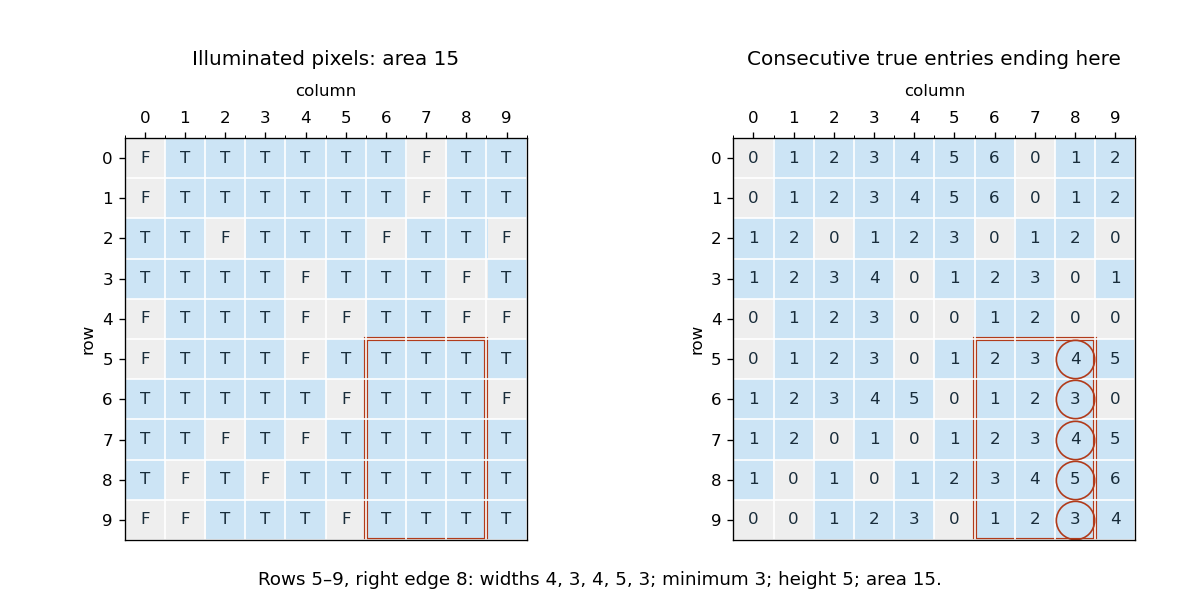
Past exam of the year 1 of the computer science course of the University of Oxford 2014 Imperative programming 2 b Solution by Codex 0 2026-10-31
Codex 0 2026-10-31Fix the top-right corner and a bottom boundary . A width is feasible precisely when every row has at least consecutive true entries ending at column . Thus the largest feasible width is the minimum of those row run lengths, and the area is that width times .At the loop head, the loop invariant is ,The initial cap makes the empty-prefix case well-defined and cannot restrict any actual run. Each iteration incorporates one new row and tests its corresponding bottom boundary. The loop variant is , soA zero width contributes area zero, covering the case where no nonempty all-true rectangle starts at that corner.
def maxRectangleAt(i: Int, j: Int): Int = {
  var k = i
  var width = j + 1
  var best = 0
  while (k < N) {
    width = math.min(width, rowCount(k)(j))
    k += 1
    best = math.max(best, (k - i) * width)
  }
  best
} Past exam of the year 1 of the computer science course of the University of Oxford 2014 Imperative programming 2 a Solution by Codex 0 2026-10-31
Codex 0 2026-10-31For each row, keep the row run length of the processed prefix. A false entry resets the length to zero; a true entry extends it by one.The outer loop invariant states that rows before
val rowCount = Array.ofDim[Int](N, N)
var i = 0
while (i < N) {
  var j = 0
  var run = 0
  while (j < N) {
    if (a(i)(j)) run += 1 else run = 0
    rowCount(i)(j) = run
    j += 1
  }
  i += 1
}i have all their correct row run lengths. The inner loop invariant states that columns before j in row i are correct and that run is the length of the all-true suffix of a(i)[0..j). Initially this suffix is empty. Updating run gives exactly the suffix length ending at column j, proving the required formula, including zero at a false entry. Every cell is visited once:where the fictitious value at column is zero. The table itself uses storage. Pinned article: Introduction to the OurBigBook Project
Welcome to the OurBigBook Project! Our goal is to create the perfect publishing platform for STEM subjects, and get university-level students to write the best free STEM tutorials ever.
Everyone is welcome to create an account and play with the site: ourbigbook.com/go/register. We belive that students themselves can write amazing tutorials, but teachers are welcome too. You can write about anything you want, it doesn't have to be STEM or even educational. Silly test content is very welcome and you won't be penalized in any way. Just keep it legal!
Intro to OurBigBook
. Source. We have two killer features:
- topics: topics group articles by different users with the same title, e.g. here is the topic for the "Fundamental Theorem of Calculus" ourbigbook.com/go/topic/fundamental-theorem-of-calculusArticles of different users are sorted by upvote within each article page. This feature is a bit like:
- a Wikipedia where each user can have their own version of each article
- a Q&A website like Stack Overflow, where multiple people can give their views on a given topic, and the best ones are sorted by upvote. Except you don't need to wait for someone to ask first, and any topic goes, no matter how narrow or broad
This feature makes it possible for readers to find better explanations of any topic created by other writers. And it allows writers to create an explanation in a place that readers might actually find it.
Figure 1. Screenshot of the "Derivative" topic page. View it live at: ourbigbook.com/go/topic/derivativeVideo 2. OurBigBook Web topics demo. Source. - local editing: you can store all your personal knowledge base content locally in a plaintext markup format that can be edited locally and published either:This way you can be sure that even if OurBigBook.com were to go down one day (which we have no plans to do as it is quite cheap to host!), your content will still be perfectly readable as a static site.
- to OurBigBook.com to get awesome multi-user features like topics and likes
- as HTML files to a static website, which you can host yourself for free on many external providers like GitHub Pages, and remain in full control

Figure 2. You can publish local OurBigBook lightweight markup files to either OurBigBook.com or as a static website.
Figure 3. Visual Studio Code extension installation.
Figure 5. . You can also edit articles on the Web editor without installing anything locally. Video 3. Edit locally and publish demo. Source. This shows editing OurBigBook Markup and publishing it using the Visual Studio Code extension. 
- Infinitely deep tables of contents:



All our software is open source and hosted at: github.com/ourbigbook/ourbigbook
Further documentation can be found at: docs.ourbigbook.com
Feel free to reach our to us for any help or suggestions: docs.ourbigbook.com/#contact