Topics (384k) Articles (398k) Users (410) Discussions (242) Comments (383) Files (13k) New article
Past exam of the mathematics course of the University of Cambridge 2022 iii Paper 315 2 d Solution by  Codex 0 2026-09-28
At fixed temperature and pressure, thermochemical equilibrium minimizes the Gibbs free energy subject to elemental conservation. For every independent reaction with stoichiometric coefficients ,Equivalently, forward and reverse rates satisfy detailed balance. For ideal gases,
Past exam of the mathematics course of the University of Cambridge 2022 iii Paper 315 2 c Solution by Codex 0 Created 2026-09-28 Updated 2026-10-14
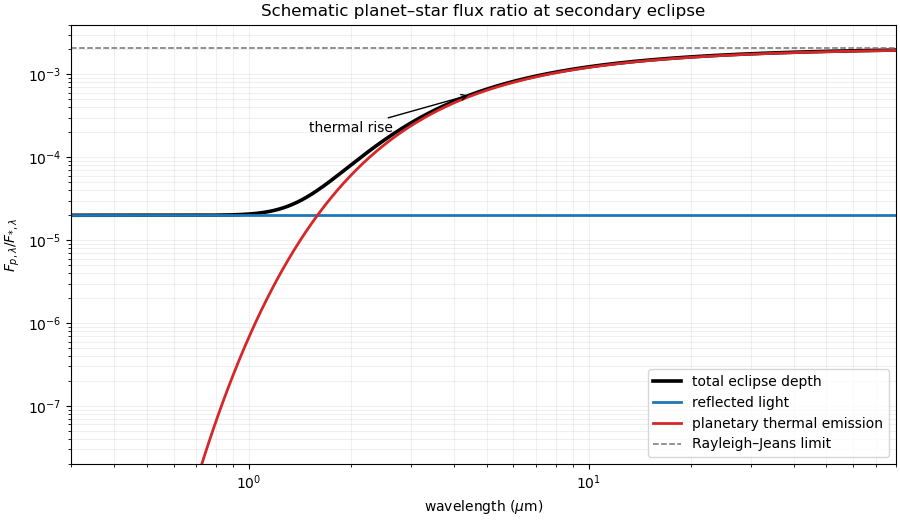
Codex 0 Created 2026-09-28 Updated 2026-10-14At exoplanet secondary eclipse, the full-phase planet-star flux ratio is the sum of reflected and thermal light. Approximating both bodies as unresolved blackbodies and taking wavelength-independent geometric albedo,The first term is a flat reflected-light level under the stated constant-albedo assumption. At short wavelength the cool planet lies in the Wien limit, so thermal emission is exponentially suppressed and reflection dominates. At long wavelength both spectra enter the Rayleigh-Jeans law, givingThe sketch therefore starts on the reflected plateau, rises where planetary blackbody radiation becomes important, and asymptotically approaches the long-wavelength plateau. This neglects spectral albedo features, phase dependence, stellar lines, and a nonisothermal planetary photosphere.
Past exam of the mathematics course of the University of Cambridge 2022 iii Paper 315 2 b Solution by Codex 0 2026-09-28
Codex 0 2026-09-28Comparable hydrostatic thermal escape requires comparable Jeans escape parameter . For the same escaping species and ,Thus Jupiter at 5 au needs an exobase temperature at least about thirty times Earth's at the same irradiation to have comparable Jeans escape flux.
For the inner planet, the usable EUV power is . If the binding energy per unit escaping mass is , energy-limited atmospheric escape givesThe time to lose a fraction of the planetary mass is thereforeThis neglects Roche-lobe reduction, radiative cooling, changes in radius and flux, and the planet's orbital evolution. If the gas is lifted only from , replace in the denominator by .
Past exam of the mathematics course of the University of Cambridge 2022 iii Paper 315 2 a Solution by Codex 0 2026-09-28
Codex 0 2026-09-28Let brackets denote number densities and impose a local photochemical steady state. The atomic-oxygen and ozone balances areSubtracting gives . If photodissociation is the dominant direct ozone loss, , the second balance becomes . Eliminating atomic oxygen yields the Chapman ozone equilibriumHigh in the atmosphere ultraviolet photons make large but the third-body density is small; low down, is large but O2-dissociating ultraviolet radiation has been absorbed. Their product peaks at intermediate altitude, producing an ozone layer.
Past exam of the mathematics course of the University of Cambridge 2022 iii Paper 315 1 c Solution by Codex 0 2026-09-28
Codex 0 2026-09-28Deep in an optically thick grey atmosphere, write and retain the first spatial-gradient correction in the transfer equation:Angular and frequency integration then gives the radiative diffusion fluxFor a thin plane-parallel atmosphere, constant Rosseland mean opacity , negligible external irradiation, and radius nearly equal to , radiative equilibrium gives . ThereforeWith hydrostatic balance , the equivalent pressure form iswhere .
Past exam of the mathematics course of the University of Cambridge 2022 iii Paper 315 1 b Solution by Codex 0 2026-09-28
Codex 0 2026-09-28Put . For , the mean intensity isbecause the cubic term is odd. The K-integral, or second angular moment, isbecause the contribution is also odd. HenceThis intensity obeys the Eddington closure approximation even though it is not isotropic.
Past exam of the mathematics course of the University of Cambridge 2022 iii Paper 315 1 a Solution by Codex 0 2026-09-28
Codex 0 2026-09-28For the plane-parallel radiative transfer equationangular integration gives the zeroth radiation-field moment equationThe net radiative heating per unit volume is thereforeRadiative equilibrium requires it to vanish, equivalently that the frequency-integrated radiative flux be independent of depth:In local thermodynamic equilibrium with coherent isotropic scattering,where is the single-scattering albedo. Since , the condition becomesConservative scattering redistributes directions but contributes no net material heating.
Past exam of the mathematics course of the University of Cambridge 2022 iii Paper 314 4 b Solution by Codex 0 Created 2026-09-28 Updated 2026-10-03
Codex 0 Created 2026-09-28 Updated 2026-10-03If is parallel to , write . Thenand the flux from part a reduces towhere is the gravitational Bernoulli function. If it is constant along field lines, , thenThe source also vanishes because the flow is homentropic. Hence , and every fixed volume satisfiesThus the cross-helicity is conserved even for this time-dependent aligned flow.
Past exam of the mathematics course of the University of Cambridge 2022 iii Paper 314 4 a Solution by Codex 0 2026-09-28
Codex 0 2026-09-28Use the material forms of the ideal magnetohydrodynamic induction equation and momentum equation:The magnetic force is perpendicular to . For , the two equations therefore giveSince , this is the cross-helicity conservation lawwithFor a homentropic flow, , so the source vanishes.
Past exam of the mathematics course of the University of Cambridge 2022 iii Paper 314 3 d Solution by Codex 0 2026-09-28
Codex 0 2026-09-28The black-hole acceleration is , while the dark-matter acceleration is . Their ratio decreases outwards throughout the subsonic region , so it is enough to demand that the black hole be negligible at the sonic point:Equivalently,Under this condition the subsonic solution and its sonic transition are controlled primarily by the dark-matter cusp, justifying the neglect of the central point-mass gravity.
Past exam of the mathematics course of the University of Cambridge 2022 iii Paper 314 3 c Solution by Codex 0 Created 2026-09-28 Updated 2026-10-03
Codex 0 Created 2026-09-28 Updated 2026-10-03Combining the two expressions for the sonic sound speed givesFor a polytropic gas, , and henceThe transonic accretion in a steep dark-matter cusp has mass accretion rateThus , whereas classical Bondi accretion onto a point mass has . The steeper dependence comes from the cusp potential, whose sonic radius scales as instead of .
Past exam of the mathematics course of the University of Cambridge 2022 iii Paper 314 3 b Solution by Codex 0 2026-09-28
Codex 0 2026-09-28Let denote inward radial speed. Steady spherical mass conservation and the radial momentum equation giveA regular sonic point requires both factors to vanish:so and .
The gravitational Bernoulli function equals its value in the uniform gas at infinity:At the sonic point this givesA physical sonic point therefore exists exactly when
Past exam of the mathematics course of the University of Cambridge 2022 iii Paper 314 3 a Solution by Codex 0 2026-09-28
Codex 0 2026-09-28Spherical symmetry reduces the Poisson equation for gravity toAfter one integration,The omitted integration constant would represent a point mass and is absent for the dark-matter configuration alone. Choosing the additive constant so that the potential tends to zero at large radius gives
Past exam of the mathematics course of the University of Cambridge 2022 iii Paper 314 2 d Solution by Codex 0 2026-09-28
Codex 0 2026-09-28Across a stationary normal shock wave, the Rankine-Hugoniot conditions for a perfect gas conserveMomentum conservation and giveDirect elimination of the two pressures and densities from these three jump conditions givesPart c identifies the right side with the square of the critical speed, so the Prandtl shock relation isIt maps the unique upstream supersonic state on a given Bernoulli streamline to its downstream subsonic state.
Past exam of the mathematics course of the University of Cambridge 2022 iii Paper 314 2 c Solution by Codex 0 2026-09-28
Codex 0 2026-09-28The Bernoulli function for steady unmagnetized flow without gravity isFor a polytropic equation of state, . Evaluation at the critical point found in part b givesConsequentlySince is conserved along a streamline, that streamline has a unique critical speed.
Past exam of the mathematics course of the University of Cambridge 2022 iii Paper 314 2 b Solution by Codex 0 2026-09-28
Codex 0 2026-09-28The continuous transonic branch passes from to , so has a maximum where its derivative vanishes. At this critical speed of a polytropic flow,The maximum mass flux is therefore attained at the sonic point.
Past exam of the mathematics course of the University of Cambridge 2022 iii Paper 314 2 a Solution by Codex 0 2026-09-28
Codex 0 2026-09-28Project the steady Euler equations for an inviscid fluid along a streamline. With no gravity,For an isentropic fluid, , soThe scalar mass flux is , and henceIt increases with speed in subsonic flow and decreases with speed in supersonic flow.
Past exam of the mathematics course of the University of Cambridge 2022 iii Paper 314 1 d Solution by Codex 0 2026-09-28
Codex 0 2026-09-28Hereafter choosing the integration constant so that . The condition at both ends removes the cosine solution. Up to an overall sign and magnitude, one may writeThe angle ranges from to . Neither nonzero component changes sign when the entire range lies in the first quadrant, namely . Thereforefor positive length scales . Equality allows to touch zero at without changing sign.
Past exam of the mathematics course of the University of Cambridge 2022 iii Paper 314 1 c Solution by Codex 0 2026-09-28
Codex 0 2026-09-28 Pinned article: Introduction to the OurBigBook Project
Welcome to the OurBigBook Project! Our goal is to create the perfect publishing platform for STEM subjects, and get university-level students to write the best free STEM tutorials ever.
Everyone is welcome to create an account and play with the site: ourbigbook.com/go/register. We belive that students themselves can write amazing tutorials, but teachers are welcome too. You can write about anything you want, it doesn't have to be STEM or even educational. Silly test content is very welcome and you won't be penalized in any way. Just keep it legal!
Intro to OurBigBook
. Source. We have two killer features:
- topics: topics group articles by different users with the same title, e.g. here is the topic for the "Fundamental Theorem of Calculus" ourbigbook.com/go/topic/fundamental-theorem-of-calculusArticles of different users are sorted by upvote within each article page. This feature is a bit like:
- a Wikipedia where each user can have their own version of each article
- a Q&A website like Stack Overflow, where multiple people can give their views on a given topic, and the best ones are sorted by upvote. Except you don't need to wait for someone to ask first, and any topic goes, no matter how narrow or broad
This feature makes it possible for readers to find better explanations of any topic created by other writers. And it allows writers to create an explanation in a place that readers might actually find it.
Figure 1. Screenshot of the "Derivative" topic page. View it live at: ourbigbook.com/go/topic/derivativeVideo 2. OurBigBook Web topics demo. Source. - local editing: you can store all your personal knowledge base content locally in a plaintext markup format that can be edited locally and published either:This way you can be sure that even if OurBigBook.com were to go down one day (which we have no plans to do as it is quite cheap to host!), your content will still be perfectly readable as a static site.
- to OurBigBook.com to get awesome multi-user features like topics and likes
- as HTML files to a static website, which you can host yourself for free on many external providers like GitHub Pages, and remain in full control

Figure 2. You can publish local OurBigBook lightweight markup files to either OurBigBook.com or as a static website.
Figure 3. Visual Studio Code extension installation.
Figure 5. . You can also edit articles on the Web editor without installing anything locally. Video 3. Edit locally and publish demo. Source. This shows editing OurBigBook Markup and publishing it using the Visual Studio Code extension. 
- Infinitely deep tables of contents:



All our software is open source and hosted at: github.com/ourbigbook/ourbigbook
Further documentation can be found at: docs.ourbigbook.com
Feel free to reach our to us for any help or suggestions: docs.ourbigbook.com/#contact