Radiative flux is the first angular moment of specific intensity and measures net radiant power crossing unit area. Integrating over frequency gives bolometric radiative flux. The receiving surface's orientation matters through ; observed radiative flux from a compact distant source conventionally refers to an area perpendicular to its line of sight.
For a steady point-like astronomical source with isotropy of emission, in transparent space with negligible relativistic or cosmological effects, conservation of energy spreads its luminosity over a sphere of surface area . Its bolometric observed radiative flux isThis inverse-square law reflects geometric dilution: the same emitted power crosses increasingly large spheres. It does not require light to lose energy on the journey. For a fixed luminosity, doubling Euclidean distance quarters the observed radiative flux. [ref].
With and parsecs, the result is . At parsecs, the same source gives . An ideal collecting area of at parsecs intercepts approximately , before detector losses.
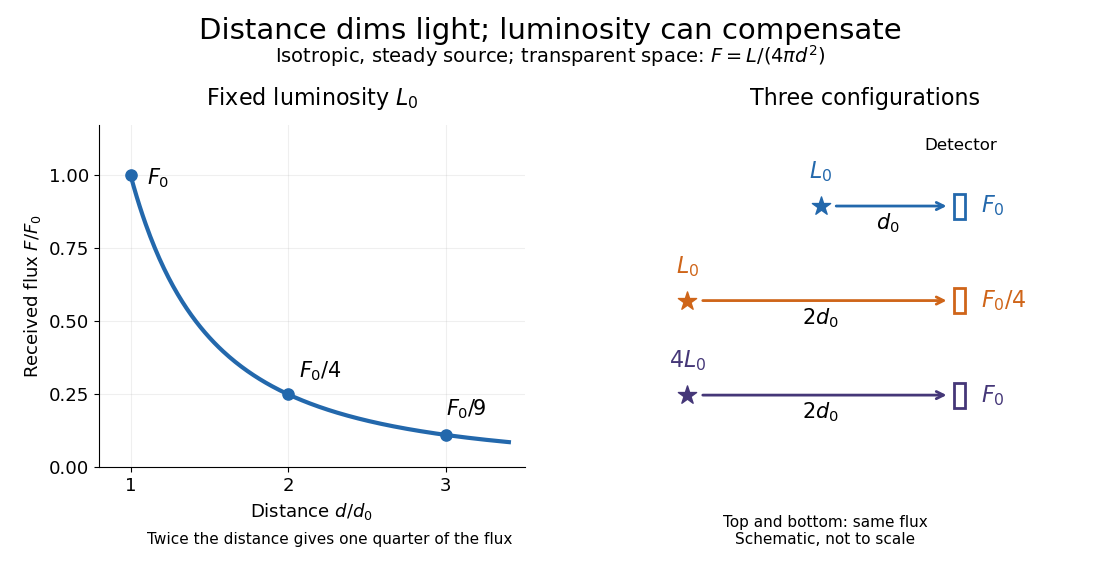
Fixed luminosity gives inverse-square dimming; different luminosities can give equal observed flux; configuration diagram schematic, not to scale
. Details. 
One observed radiative flux cannot determine both luminosity and Euclidean distance: for every , replacing by leaves unchanged. In particular, at parsecs produces the same observed radiative flux as at parsecs. This is a concrete failure of identifiability in an inverse problem.
An independent stellar parallax fixes the distance and breaks this degeneracy; alternatively, a calibrated standard candle supplies the luminosity. Interstellar extinction can further reduce the observed radiative flux, and a photometric passband measures only a selected spectral range. At cosmological distances, use luminosity distance in the bolometric relation. Each inference must specify which radiative flux was measured and what propagation assumptions connect it to luminosity.
For a uniformly emitting spherical body of radius at Euclidean distance , integration of its specific intensity over the apparent solid angle gives . For a blackbody, and the bolometric result is . A grey emissivity factor multiplies this expression; isothermality alone does not imply blackbody emission.
Spectral flux density is radiant power received per unit area and per unit wavelength or frequency. The two conventions satisfy under , hence when the arguments refer to the same photons. Integrating over a photometric passband gives its measured flux.
The Eddington closure approximation sets the second angular moment to one third of the zeroth, so the radiation pressure and mean intensity satisfy .
For the affine angular ansatz , the radiative flux is . Setting the inward hemispheric flux to zero gives , but then the formal intensity at is negative when . Exact no-incoming radiation and nonnegative intensity cannot both be represented by a nonzero affine polynomial on all directions. The Eddington surface boundary condition therefore specifies approximate moments, rather than an exact emergent angular radiation field.
Articles by others on the same topic
There are currently no matching articles.