Topics (203k) Articles (205k) Users (298) Discussions (237) Comments (383) Files (715) New article

14 million images with more than 20k categories, typically denoting prominent objects in the image, either common daily objects, or a wild range of animals. About 1 million of them also have bounding boxes for the objects. The images have different sizes, they are not all standardized to a single size like MNIST[ref].
Each image appears to have a single label associated to it. Care must have been taken somehow with categories, since some images contain severl possible objects, e.g. a person and some object.
Official project page: www.image-net.org/
The data license is restrictive and forbids commercial usage: www.image-net.org/download.php. Also as a result you have to login to download the dataset. Super annoying.
How to visualize: datascience.stackexchange.com/questions/111756/where-can-i-view-the-imagenet-classes-as-a-hierarchy-on-wordnet
TODO where to find it: www.kaggle.com/general/50987


70,000 28x28 grayscale (1 byte per pixel) images of hand-written digits 0-9, i.e. 10 categories. 60k are considered training data, 10k are considered for test data.
This is THE "OG" computer vision dataset.
Playing with it is the de-facto computer vision hello world.
It was on this dataset that Yann LeCun made great progress with the LeNet model. Running LeNet on MNIST has to be the most classic computer vision thing ever. See e.g. activatedgeek/LeNet-5 for a minimal and modern PyTorch educational implementation.
But it is important to note that as of the 2010's, the benchmark had become too easy for many applications. It is perhaps fair to say that the next big dataset revolution of the same importance was with ImageNet.
The dataset could be downloaded from yann.lecun.com/exdb/mnist/ but as of March 2025 it was down and seems to have broken from time to time randomly, so Wayback Machine to the rescue:but doing so is kind of pointless as both files use some crazy single-file custom binary format to store all images and labels. OMG!
wget \
 https://web.archive.org/web/20120828222752/http://yann.lecun.com/exdb/mnist/train-images-idx3-ubyte.gz \
 https://web.archive.org/web/20120828182504/http://yann.lecun.com/exdb/mnist/train-labels-idx1-ubyte.gz \
 https://web.archive.org/web/20240323235739/http://yann.lecun.com/exdb/mnist/t10k-images-idx3-ubyte.gz \
 https://web.archive.org/web/20240328174015/http://yann.lecun.com/exdb/mnist/t10k-labels-idx1-ubyte.gz
OK-ish data explorer: knowyourdata-tfds.withgoogle.com/#tab=STATS&dataset=mnist


The cool thing about this notation is that is showed to Ciro Santilli that there is more state to a chess game than just the board itself! Notably:plus some other boring draw rules counters.
- whose move it is next
- castling availability
- en passant availability
To be fair, this is one of the least worse ones.
Advanced. Not beginner friendly, very clunky.
Both chess engine and a CLI chess UI. As an engine it is likely irrelevant compared to Stockfish as of 2020. TODO: does the UI support Universal Chess Interface?
Cool project history though. Started before the GNU Project itself, and became one of the first packages.
The user friendly Chess UI! Exactly what you would expect from a GNOME Project package. But also packs some punch via the Universal Chess Interface, e.g. Stockfish just works.
CLI program implementing Universal Chess Interface: www.reddit.com/r/ComputerChess/comments/b6rdez/commandline_options_for_stockfish/
How to actually play against it: chess.stackexchange.com/questions/4353/how-to-install-stockfish-on-ubuntu So hard!
This article is about covert agent communication channel websites used by the CIA in many countries from the mid 2000s until the early 2010s, when they were uncovered by counter intelligence of some of the targeted countries, notably Iran and China, circa 2010-2013.
This article uses publicly available information to publicly disclose for the first time a few hundred of what we feel are extremely likely candidate sites of the network. The starting point for this research was the September 2022 Reuters article "America’s Throwaway Spies" which for the first time gave nine example websites, and their analyst from Citizenlabs claims to have found 885 websites in total, but did not publicly disclose them. Starting from only the nine disclosed websites, we were then able to find a few hundred websites that share so many similarities with them, i.e. a common fingerprint, that we believe makes them beyond reasonable doubt part of the same network.
If you enjoy this article, consider dropping some Monero at: 4A1KK4uyLQX7EBgN7uFgUeGt6PPksi91e87xobNq7bT2j4V6LqZHKnkGJTUuCC7TjDNnKpxDd8b9DeNBpSxim8wpSczQvzf so I can waste it on my foolish attempts to improve higher education. Other sponsorship methods: Section "Sponsor Ciro Santilli's work on OurBigBook.com".
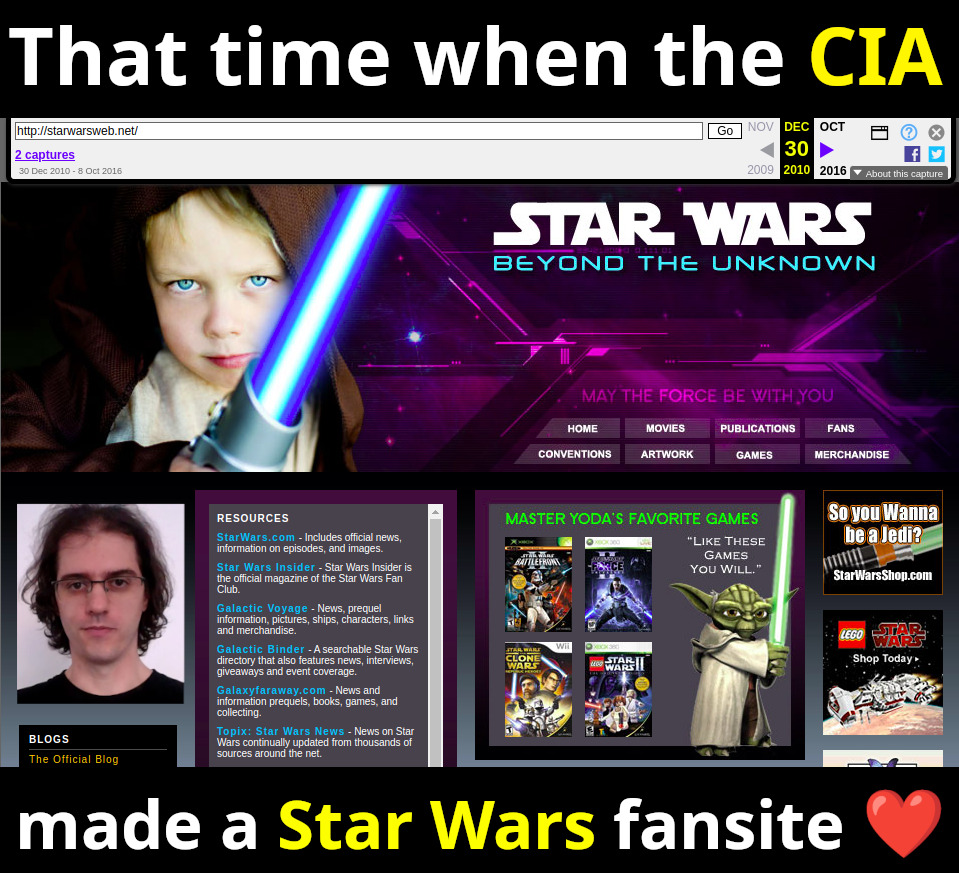
The discovery of these websites by Iranian and Chinese counterintelligence led to the imprisonment and execution of several assets in those countries, and subsequent shutdown of the channel by the CIA when they noticed that things had gone wrong. This is likely a Wikipedia page that talks about the disastrous outcome of the websites being found out: 2010–2012 killing of CIA sources in China, although it contained no mention of websites before Ciro Santilli edited it in.
Of particular interest is that based on their language and content, certain of the websites seem to have targeted other democracies such as Germany, France, Spain and Brazil.
If anyone can find others websites, or has better techniques feel free to contact Ciro Santilli at: Section "How to contact Ciro Santilli". Contributions will be clearly attributed if desired. Some of the techniques used so far have been very heuristic, and that added to the limited amount of data makes it almost certain that some websites have been missed. Broadly speaking, there are two types of contributions that would be possible:
- finding new IP ranges: harder and more exiting, and potentially requires more intelligence
- better IP to domain name databases to fill in known gaps in existing IP ranges
The fact that citizenlabs reported exactly 885 websites being found makes it feel like they might have found find a better fingerprint which we have not managed to find yet. We have not yet had to pay for our data. If someone wants to donate to the research, some ideas include:
- dump $400 on WhoisXMLAPI to dump whois history of all known hits and search for other matches. Small discoveries were made like this in the past and we'd expect a few more to be left. We don't expect huge breakthroughs from this, but at only $400 it is not so bad
- dump a lot more ($15k+? needs confirmation as opaque pricing) on DomainTools. We are not certain that they have any superior data since there is no free trial of any kind, but it would be interesting to test the quality of the data they acquired from Farsight DNSDB if you are really loaded
Disclaimers:
- the network fell in 2013, followed by fully public disclosures in 2018 and 2022, so we believe that the benefit of giving the public this broader historic understanding outweighs the risks that agents could be found so many years later by sloppy secret services
- Ciro Santilli's political bias is strongly pro-democracy and anti-dictatorship, but with a good pinch of skepticism about the morality US foreign policy in the last century
It's like the bootloader stage of biology! It's weird and magic and important: Section "Molecular biology feels like systems programming".
Likely implies whole brain emulation and therefore AGI.
Ciro Santilli invented this term, derived from "hardware in the loop" to refer to simulations in which both the brain and the body and physical world of organism models are modelled.
E.g. just imagine running:
Pinned article: Introduction to the OurBigBook Project
Welcome to the OurBigBook Project! Our goal is to create the perfect publishing platform for STEM subjects, and get university-level students to write the best free STEM tutorials ever.
Everyone is welcome to create an account and play with the site: ourbigbook.com/go/register. We belive that students themselves can write amazing tutorials, but teachers are welcome too. You can write about anything you want, it doesn't have to be STEM or even educational. Silly test content is very welcome and you won't be penalized in any way. Just keep it legal!
Intro to OurBigBook
. Source. We have two killer features:
- topics: topics group articles by different users with the same title, e.g. here is the topic for the "Fundamental Theorem of Calculus" ourbigbook.com/go/topic/fundamental-theorem-of-calculusArticles of different users are sorted by upvote within each article page. This feature is a bit like:
- a Wikipedia where each user can have their own version of each article
- a Q&A website like Stack Overflow, where multiple people can give their views on a given topic, and the best ones are sorted by upvote. Except you don't need to wait for someone to ask first, and any topic goes, no matter how narrow or broad
This feature makes it possible for readers to find better explanations of any topic created by other writers. And it allows writers to create an explanation in a place that readers might actually find it.
Figure 1. Screenshot of the "Derivative" topic page. View it live at: ourbigbook.com/go/topic/derivativeVideo 2. OurBigBook Web topics demo. Source. - local editing: you can store all your personal knowledge base content locally in a plaintext markup format that can be edited locally and published either:This way you can be sure that even if OurBigBook.com were to go down one day (which we have no plans to do as it is quite cheap to host!), your content will still be perfectly readable as a static site.
- to OurBigBook.com to get awesome multi-user features like topics and likes
- as HTML files to a static website, which you can host yourself for free on many external providers like GitHub Pages, and remain in full control

Figure 2. You can publish local OurBigBook lightweight markup files to either OurBigBook.com or as a static website.
Figure 3. Visual Studio Code extension installation.
Figure 5. . You can also edit articles on the Web editor without installing anything locally. Video 3. Edit locally and publish demo. Source. This shows editing OurBigBook Markup and publishing it using the Visual Studio Code extension. 
- Infinitely deep tables of contents:


All our software is open source and hosted at: github.com/ourbigbook/ourbigbook
Further documentation can be found at: docs.ourbigbook.com
Feel free to reach our to us for any help or suggestions: docs.ourbigbook.com/#contact