Topics (203k) Articles (205k) Users (298) Discussions (237) Comments (383) Files (715) New article

Some criticisms:
The key takeaway is that setting an explicit value function to an AGI entity is a good way to destroy the world due to poor AI alignment. We are more likely to not destroy by creating an AI whose goals is to "do want humans what it to do", but in a way that it does not know before hand what it is that humans want, and it has to learn from them. This approach appears to be known as reward modeling.
Some other cool ideas:
- a big thing that is missing for AGI in the 2010's is some kind of more hierarchical representation of the continuous input data of the world, e.g.:
- game theory can be seen as part of artificial intelligence that deals with scenarios where multiple intelligent agents are involved
- probability plays a crucial role in our everyday living, even though we don't think too much about it every explicitly. He gives a very good example of the cost/risk tradeoffs of planning to the airport to catch a plane. E.g.:
- economy, and notably the study of the utility, is intrinsically linked to AI alignment
Some examples by Ciro Santilli follow.
Of the tutorial-subjectivity type:
- This edit perfectly summarizes how Ciro feels about Wikipedia (no particular hate towards that user, he was a teacher at the prestigious Pierre and Marie Curie University and actually as a wiki page about him):which removed the only diagram that was actually understandable to non-Mathematicians, which Ciro Santilli had created, and received many upvotes at: math.stackexchange.com/questions/776039/intuition-behind-normal-subgroups/3732426#3732426. The removal does not generate any notifications to you unless you follow the page which would lead to infinite noise, and is extremely difficult to find out how to contact the other person. The removal justification is even somewhat ad hominem: how does he know Ciro Santilli is also not a professional Mathematician? :-) Maybe it is obvious because Ciro explains in a way that is understandable. Also removal makes no effort to contact original author. Of course, this is caused by the fact that there must also have been a bunch of useless edits not done by Ciro, and there is no reputation system to see if you should ignore a person or not immediately, so removal author has no patience anymore. This is what makes it impossible to contribute to Wikipedia: your stuff gets deleted at any time, and you don't know how to appeal it. Ciro is going to regret having written this rant after Daniel replies and shows the diagram is crap. But that would be better than not getting a reply and not learning that the diagram is crap.
rm a cryptic diagram (not understandable by a professional mathematician, without further explanations
- en.wikipedia.org/w/index.php?title=Finite_field&type=revision&diff=1044934168&oldid=1044905041 on finite fields with edit comment "Obviously: X ≡ α". Discussion at en.wikipedia.org/wiki/Talk:Finite_field#Concrete_simple_worked_out_example Some people simply don't know how to explain things to beginners, or don't think Wikipedia is where it should be done. One simply can't waste time fighting off those people, writing good tutorials is hard enough in itself without that fight.
- en.wikipedia.org/w/index.php?title=Discrete_Fourier_transform&diff=1193622235&oldid=1193529573 by user Bob K. removed Ciro Santilli's awesome simple image of the Discrete Fourier transform as seen at en.wikipedia.org/w/index.php?title=Discrete_Fourier_transform&oldid=1176616763:with message:
Hello. I am a retired electrical engineer, living near Washington,DC. Most of my contributions are in the area of DSP, where I have about 40 years of experience in applications on many different processors and architectures.
Thank you so much!!remove non-helpful image
Maybe it is a common thread that these old "experts" keep removing anything that is actually intelligible by beginners? Section "There is value in tutorials written by beginners"Also ranted at: x.com/cirosantilli/status/1808862417566290252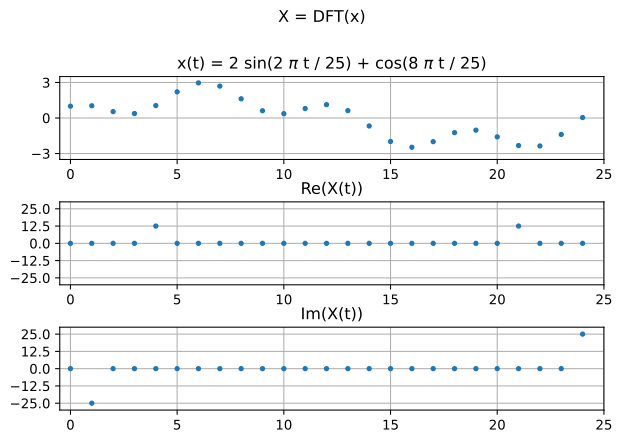
Figure 1. Source at: numpy/fft_plot.py. - when Ciro Santilli created Scott Hassan's page, he originally included mentions of his saucy divorce: en.wikipedia.org/w/index.php?title=Scott_Hassan&oldid=1091706391 These were reverted by Scott's puppets three times, and Ciro and two other editors fought back. Finally, Ciro understood that Hassan's puppets were likely right about the removal because you can't talk about private matters of someone who is low profile:even if it is published in well known and reliable publications like the bloody New York Times. In this case, it is clear that most people wanted to see this information summarized on Wikipedia since others fought back Hassan's puppet. This is therefore a failure of Wikipedia to show what the people actually want to read about.This case is similar to the PsiQuantum one. Something is extremely well known in an important niche, and many people want to read about it. But because the average person does not know about this important subject, and you are limited about what you can write about it or not, thus hurting the people who want to know about it.
Notability constraints, which are are way too strict:There are even a Wikis that were created to remove notability constraints: Wiki without notability requirements.
- even information about important companies can be disputed. E.g. once Ciro Santilli tried to create a page for PsiQuantum, a startup with $650m in funding, and there was a deletion proposal because it did not contain verifiable sources not linked directly to information provided by the company itself: en.wikipedia.org/wiki/Wikipedia:Articles_for_deletion/PsiQuantum Although this argument is correct, it is also true about 90% of everything that is on Wikipedia about any company. Where else can you get any information about a B2B company? Their clients are not going to say anything. Lawsuits and scandals are kind of the only possible source... In that case, the page was deleted with 2 votes against vs 3 votes for deletion.is very similar to Stack Exchange's own Stack Overflow content deletion issues. Ain't Nobody Got Time For That. "Ain't Nobody Got Time for That" actually has a Wiki page: en.wikipedia.org/wiki/Ain%27t_Nobody_Got_Time_for_That. That's notable. Unlike a $600M+ company of course.
should we delete this extremely likely useful/correct content or not according to this extremely complex system of guidelines"
In December 2023 the page was re-created, and seemed to stick: en.wikipedia.org/wiki/Talk:PsiQuantum#Secondary_sources It's just a random going back and forth. Author Ctjk has an interesting background:I am a legal official at a major government antitrust agency. The only plausible connection is we regulate tech firms
For these reasons reason why Ciro basically only contributes images to Wikipedia: because they are either all in or all out, and you can determine which one of them it is. And this allows images to be more attributable, so people can actually see that it was Ciro that created a given amazing image, thus overcoming Wikipedia's lack of reputation system a little bit as well.
Wikipedia is perfect for things like biographies, geography, or history, which have a much more defined and subjective expository order. But when it comes to "tutorials of how to actually do stuff", which is what mathematics and physics are basically about, Wikipedia has a very hard time to go beyond dry definitions which are only useful for people who already half know the stuff. But to learn from zero, newbies need tutorials with intuition and examples.
Bibliography:
- gwern.net/inclusionism from gwern.net:
Iron Law of Bureaucracy: the downwards deletionism spiral discourages contribution and is how Wikipedia will die.
- Quote "Golden wiki vs Deletionism on Wikipedia"
Not going to lie, this is some cool shit, robot simulation and 3D visualization in the browser.
In your normal 2020 broken educational system, it is the first time at which students get an official chance to learn something advanced, and possibly prepare to go venture into the PhD desert.
As of 2020s and much earlier, Ciro Santilli believes that undergrad studies were fundamentally broken (considering the Information Age which completely changed what would be possible) because university had only two goals, with the exception of a few enlightened professors:As a result, most students, who would not go on to do a PhD essentially do a simple trade: all their time, and possibly some money, in exchange for imbuing themselves with the incredible name of a respected institution so they can get better jobs later on.
- rank students from worse to best so they can get into PhD programs.For regular jobs grades didn't even matter as much compared the prestige of your university (and therefore, university entry exam grades) and your ability to stand the stress of exams to get minimal passing grade.In particular, being able to rank requires setting the difficulty level at a point where you can see a normal distribution in grades, and not have everyone at either 0 nor 100%.
- get money from the students. Of course, in countries where university is "free", this means reporting how many students you had to some government office so they can give you a corresponding budget. But you still have an incentive to enroll as many as possible.
You just have to spend a few minutes with students until they complain about the courses or teachers. And you just have to spend a few hours with teachers until they complain about the students or broader system.
University is broken, and everyone knows it. The only question now is finding a viable, "political cash flow positive" path, into something better.
Bibliography:
- academeblog.org/2022/10/05/american-universities-are-going-to-implode/ American Universities Are Going to Implode (2022) by www.linkedin.com/in/jsgabin/
- theimaginativeconservative.org/2020/04/higher-education-implode-alexander-zubatov.html Higher Education Is About to Implode by Alexander Zubatov (2020)
- 2024-05-28 www.theguardian.com/education/article/2024/may/28/i-see-little-point-uk-university-students-on-why-attendance-has-plummeted ‘I see little point’: UK university students on why attendance has plummetedGive it to me, baby. OurBigBook incoming.
"There’s a bit of a feeling that there is just box-ticking going on [among students], and getting a degree at the end of it."
Pinned article: Introduction to the OurBigBook Project
Welcome to the OurBigBook Project! Our goal is to create the perfect publishing platform for STEM subjects, and get university-level students to write the best free STEM tutorials ever.
Everyone is welcome to create an account and play with the site: ourbigbook.com/go/register. We belive that students themselves can write amazing tutorials, but teachers are welcome too. You can write about anything you want, it doesn't have to be STEM or even educational. Silly test content is very welcome and you won't be penalized in any way. Just keep it legal!
Intro to OurBigBook
. Source. We have two killer features:
- topics: topics group articles by different users with the same title, e.g. here is the topic for the "Fundamental Theorem of Calculus" ourbigbook.com/go/topic/fundamental-theorem-of-calculusArticles of different users are sorted by upvote within each article page. This feature is a bit like:
- a Wikipedia where each user can have their own version of each article
- a Q&A website like Stack Overflow, where multiple people can give their views on a given topic, and the best ones are sorted by upvote. Except you don't need to wait for someone to ask first, and any topic goes, no matter how narrow or broad
This feature makes it possible for readers to find better explanations of any topic created by other writers. And it allows writers to create an explanation in a place that readers might actually find it.
Figure 1. Screenshot of the "Derivative" topic page. View it live at: ourbigbook.com/go/topic/derivativeVideo 2. OurBigBook Web topics demo. Source. - local editing: you can store all your personal knowledge base content locally in a plaintext markup format that can be edited locally and published either:This way you can be sure that even if OurBigBook.com were to go down one day (which we have no plans to do as it is quite cheap to host!), your content will still be perfectly readable as a static site.
- to OurBigBook.com to get awesome multi-user features like topics and likes
- as HTML files to a static website, which you can host yourself for free on many external providers like GitHub Pages, and remain in full control

Figure 2. You can publish local OurBigBook lightweight markup files to either OurBigBook.com or as a static website.
Figure 3. Visual Studio Code extension installation.
Figure 5. . You can also edit articles on the Web editor without installing anything locally. Video 3. Edit locally and publish demo. Source. This shows editing OurBigBook Markup and publishing it using the Visual Studio Code extension. 
- Infinitely deep tables of contents:


All our software is open source and hosted at: github.com/ourbigbook/ourbigbook
Further documentation can be found at: docs.ourbigbook.com
Feel free to reach our to us for any help or suggestions: docs.ourbigbook.com/#contact