A cubic root from existence to a quantitative bracket
ID: a-cubic-root-from-existence-to-a-quantitative-bracket

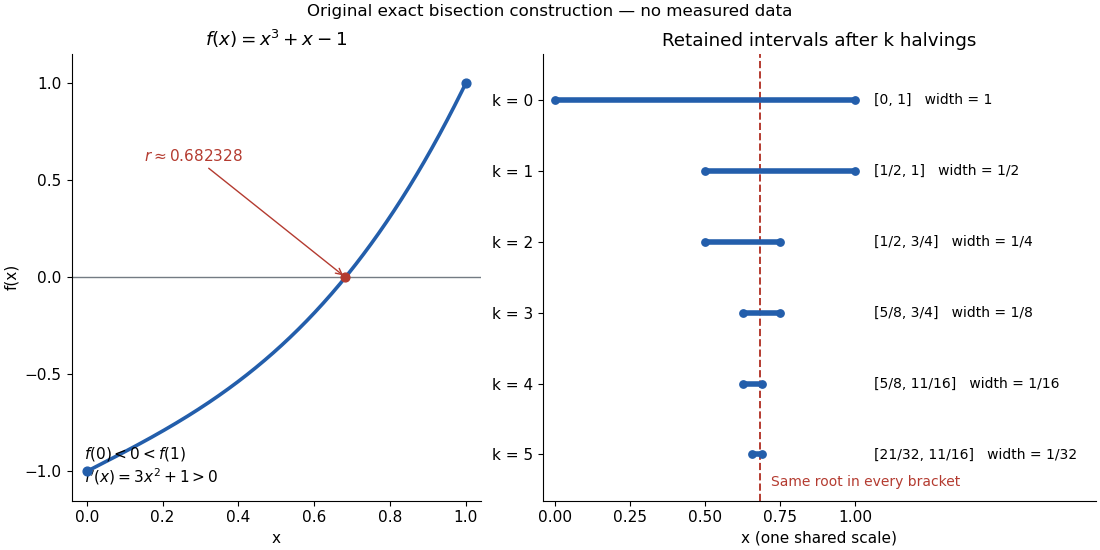
Consider the original worked example on . First, existence: a polynomial function is a continuous function, and . The intermediate value theorem therefore supplies a zero of a function , even before its value has been calculated.
Second, uniqueness is a separate argument. The derivative is . The derivative criterion for monotonicity, obtained from the mean value theorem, makes a strictly increasing function. Two distinct zeros of a function would contradict that strict increase. Thus this root bracket contains exactly one zero of a function; indeed the same derivative argument proves uniqueness on the entire real line.
Third, localization uses the existing bisection method. Set ; after completed halvings, retain with opposite endpoint signs. Each update tests the old midpoint . The first five exact updates areEvery retained root bracket contains by the intermediate value theorem. After ten halvings, exact arithmetic givesHence . The new midpoint and its bisection error bound areThis midpoint is the estimate after the tenth update; the last tested point was . In general the retained width is , so the bisection error bound is . Nine halvings already suffice for an error at most , since . This guarantee comes from the width of the root bracket, independently of any displayed decimal approximation to the unknown zero of a function. Endpoint signs must be established reliably if evaluations use floating-point arithmetic.

New to topics? Read the docs here!