Let be a real interval, and let be differentiable in its interior and continuous at any endpoints belonging to . If the derivative satisfies throughout the interior, then is a nondecreasing function on . For in , the mean value theorem supplies withChanging to , , or gives a nonincreasing function, strictly increasing function, or strictly decreasing function, respectively. The endpoint continuity assumption lets the mean value theorem apply even when or is an endpoint. [ref].
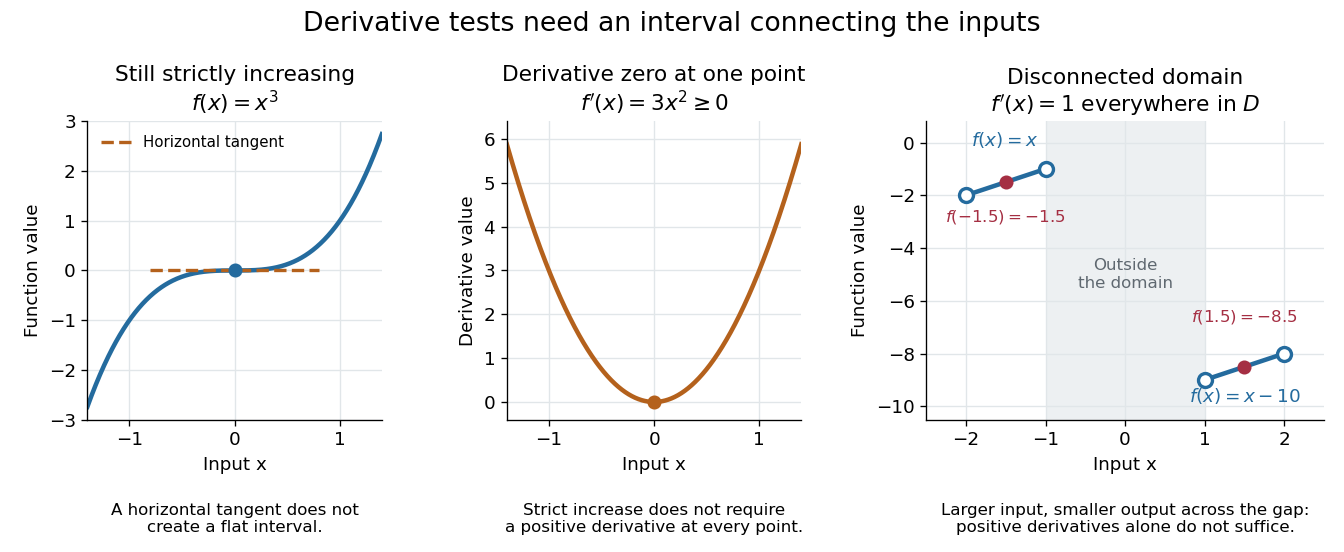
Conversely, if a nondecreasing function on a real interval is differentiable at an interior point , then : the difference quotient is nonnegative for either sign of . A differentiable nonincreasing function has derivative . Strict monotonicity still only forces these weak signs: the strictly increasing function has derivative zero at zero. The sign of the derivative helps locate intervals of monotonicity when sketching a graph. [ref].
The real interval hypothesis matters because a connected subset of the real line contains every point between its inputs. On a disconnected domain of a function, positive derivatives need not give a nondecreasing function. For example, takeHere everywhere in , but while . Each component has a strictly increasing function, yet their outputs are ordered the wrong way across the gap. This function is neither a nondecreasing function nor a nonincreasing function on all of ; the mean value theorem cannot cross the missing interval.

A continuous function on an open interval with positive symmetric derivative everywhere is strictly increasing. One proof takes an antiderivative using the fundamental theorem of calculus. For small positive , the identityfollows from . If exceeded a chord, its difference from the chord would attain a positive interior maximum, contradicting this symmetric difference inequality. Thus is a convex function, and its derivative is nondecreasing. Equality at two different points would make constant between them and force an interior symmetric derivative to vanish, proving strict monotonicity.
Articles by others on the same topic
There are currently no matching articles.