
For a finite, time-homogeneous Discrete-time Markov chain with row-stochastic transition matrix , a state is absorbing exactly when . Nonnegativity and the row sum then force for : once entered, is never left. Equivalently, is a closed communicating class. A larger closed communicating class may keep moving internally; closure means confinement to a set, whereas absorption at a state means remaining at one point.
An absorbing state is useful for recording a terminal outcome: after a toy routine finishes, keep its outcome in the state space so that the same transition matrix still describes subsequent steps. Calling a finite Markov chain absorbing usually also requires that some absorbing state be accessible from every state. Merely containing an absorbing state is insufficient: another closed communicating class could prevent absorption. See Grinstead and Snell, Introduction to Probability, section 11.2 for this convention.
Consider a constructed routine with unfinished modes and terminal outcomes . All the following transition probabilities are chosen for illustration, not estimated from observations. In state order , takeThe communicating class is open, while and are closed communicating classes consisting of absorbing states. Both terminal outcomes are accessible from both unfinished modes, sometimes by an indirect path.
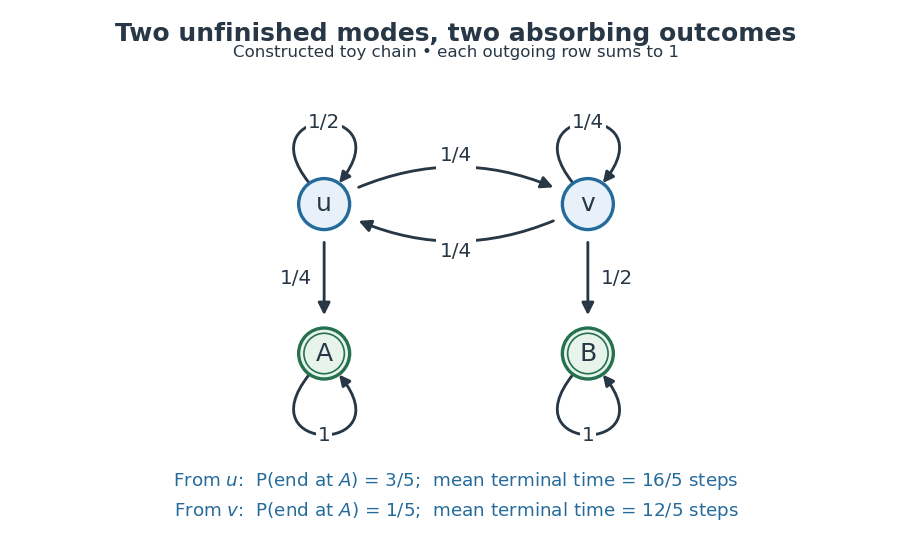
A constructed four-state routine: arrows give transition probabilities, and the two absorbing outcomes have different eventual probabilities and waiting times.
Details. 
Let be the terminal hitting time. Write for the absorption probability and for the expected hitting time, with the subscript denoting the starting state. First-step analysis givesHere , , and . Solving these two pairs of linear equations yieldsStarting at therefore ends at with probability and takes steps on average to reach either terminal state. The terminal hitting time counts the transition into the outcome, but no later self-transitions. Outcome and duration answer different questions: from , outcome is less likely, yet termination is faster on average.
The matrix power gives the probability distribution after two steps from asThus , and the probability of having already reached is , still below its eventual absorption probability . From either unfinished mode, each next step has terminal probability at least . Consequently , proving termination almost surely and finite expected hitting time directly. The Fundamental matrix of a finite absorbing Markov chain packages both calculations and counts visits to unfinished modes.
New to topics? Read the docs here!