
For a finite measurable partition with positive probabilities, and an event of positive probability,Its beauty is that a model predicting observations from a hidden state can also describe uncertainty about the state after an observation. Each numerator is a joint probability; the denominator, supplied by the law of total probability, makes the answers sum to one. This is a direct consequence of conditional probability, rather than an extra axiom.
Select the coin from law of total probability once, then toss that same coin repeatedly, with conditionally independent tosses given its identity. Let denote the -head coin, initially of prior probability . After one head , its posterior probability isThe likelihood of a head is larger under , but remains less likely than the other coin because its prior probability was smaller. A large likelihood for an observation does not itself imply a large posterior probability for the hypothesis.
After an ordered sequence containing heads and tails, its likelihood ratio between the two coins is . Bayes' theorem therefore gives posterior oddsEach head multiplies the odds by and each tail by . Three heads give posterior probability , still below one half; four give , above one half. The finite-model update and the distinction between prior probability, likelihood and posterior probability are set out in MIT 18.05, Reading 11: Bayesian Updating with Discrete Priors.
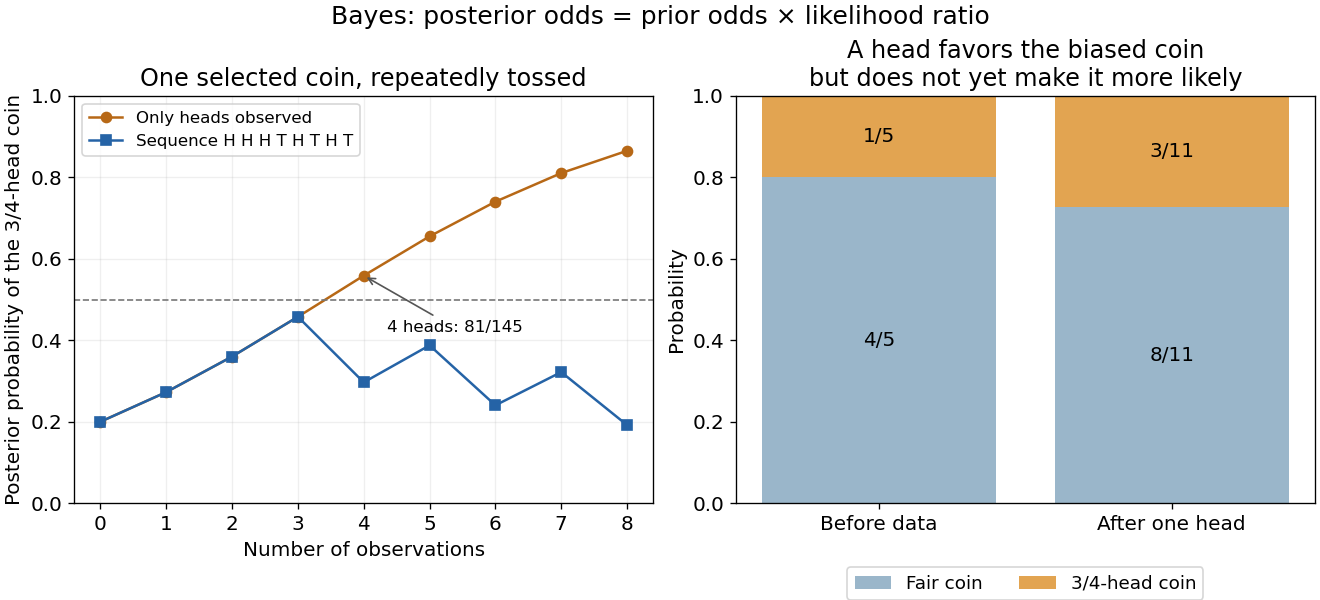
Updating uncertainty about one selected coin after repeated observations
. Details. The hidden selection also creates dependence. Each toss has marginal head probability , but two heads have joint probability , greater than . Their indicator covariance is . Seeing a head makes the head-favoring coin more likely, so it also raises the chance of a future head. This is covariance induced by a shared latent variable, despite conditional independence of the tosses given the coin.
Historically, Thomas Bayes's essay on an unknown success probability appeared in 1763 after his death, communicated by Richard Price. Its opening problem asks how observed successes and failures constrain that unknown probability; Price's introductory letter explains the connection to reasoning from experience. That is a more substantial inference problem than simply rearranging today's elementary identity. [ref]
https://www.gtfp.cs.rhul.ac.uk/pulskamp/Bayes/bayesessay-rjp.pdf. Bayes, An Essay towards solving a Problem in the Doctrine of Chances, 1763; original text transcribed, introductory letter and statement of the problem



Bayes' theorem is a fundamental theorem in probability and statistics that describes how to update the probability of a hypothesis as more evidence or information becomes available. It allows us to calculate the conditional probability of an event based on prior knowledge of conditions related to the event.
New to topics? Read the docs here!