Bell correlations versus a classical mixture
ID: bell-correlations-versus-a-classical-mixture

Give Alice the first qubit and Bob the second . Compare the Bell state with a preparation that tosses a fair classical bit and gives both parties its value. Their density operators, written in the computational basis ordered , areThey have identical diagonal quantum state populations. The off-diagonal entries of the Bell state retain quantum coherence between and ; the classical mixture has none in this basis.
If both parties perform a Pauli measurement of , the Born rule gives and for both preparations. Perfect agreement here therefore cannot establish entanglement: an ordinary shared random bit already explains it.
Now both measure , whose normalized eigenstates are and . Changing basis givesThe Bell state again has matching outcomes, each with probability . For either product state or , each of the four outcome pairs has probability , so their classical mixture does too. Equivalently, the Pauli correlator is one for the Bell state and zero for this mixture, while is one for both.
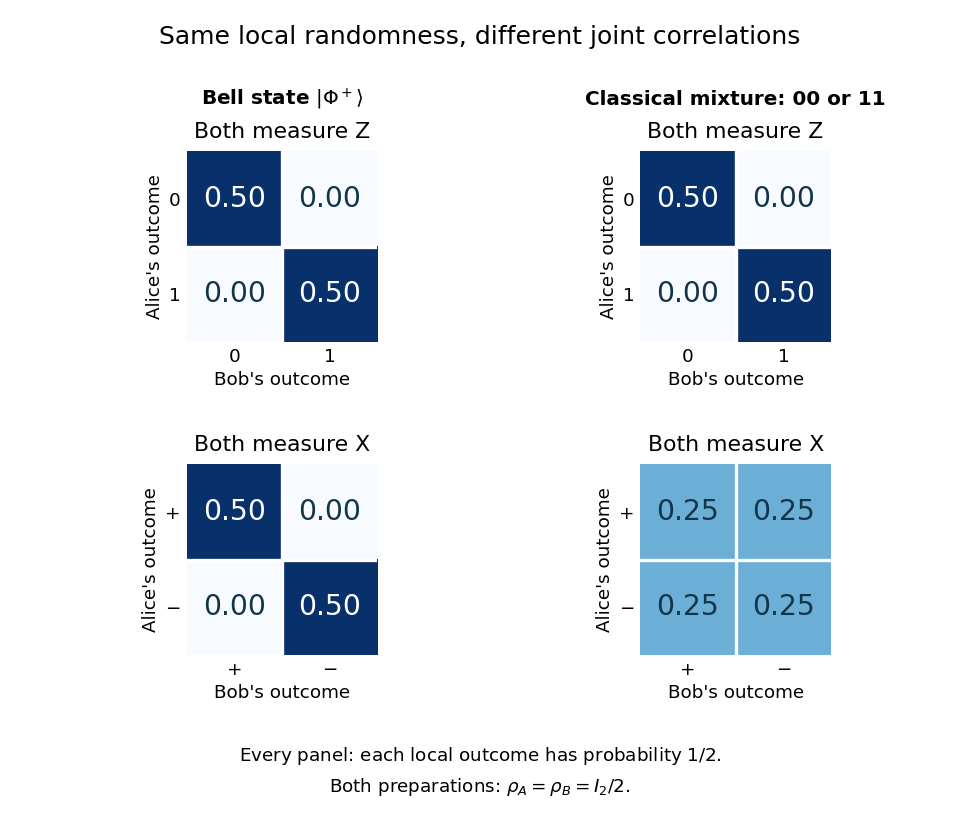
Joint measurement probabilities distinguish a Bell state from a classical mixture while every local outcome remains uniformly random
. Details. 
Taking a partial trace gives for both preparations. Thus every measurement confined to Alice's system has the same statistics in the two cases, and so does every measurement confined to Bob's. They reveal the difference by comparing records through classical communication. Conditional on Alice's result, Bob can predict a matching result for the Bell state; without that result, his outcomes remain evenly split. An uncommunicated local quantum channel, including a measurement with its outcome discarded, leaves his reduced density matrix unchanged. This is quantum no-signalling, even when conditional states change. [ref]
https://jhwatrous.github.io/TQI.2.pdf. Watrous, Basic notions of quantum information, sections 2.1.3 and 2.2.1, on reductions and channels
The Von Neumann entropy makes the joint-versus-local distinction numerical. With base-two logarithms, the Bell state has eigenvalues , giving , whereas the mixture has , giving . Both have . Their quantum mutual information is consequently two and one bits, respectively. The value two is not two readable classical bits in either local qubit: the matching records have ordinary mutual information one bit in both cases. Random records can come from a globally pure state. [ref]
https://jhwatrous.github.io/TQI.5.pdf. Watrous, Quantum entropy and source coding, on Von Neumann entropy and quantum mutual information
These two matching-axis measurements distinguish the specified preparations; they alone are not a test of a Bell inequality. A local hidden-variable theory could assign shared random answers separately to these two axes. Bell theorem concerns incompatible correlations across a suitable larger collection of measurement settings. Bell's 1964 paper established the obstruction for local hidden-variable descriptions of the predicted correlations. [ref]
https://journals.aps.org/ppf/pdf/10.1103/PhysicsPhysiqueFizika.1.195. Bell, On the Einstein Podolsky Rosen paradox, 1964
New to topics? Read the docs here!