
A burette delivers an adjustable measured volume of a chemical solution; the change in its reading gives the delivered volume in an acid-base titration.
Its downward-increasing scale measures a change in reading, not the initial liquid inventory. For initial reading and final reading without refilling, the nominal delivered volume is . An illustrative to reading therefore represents . There is no requirement to start at zero. An air bubble disappearing from the tip uses part of the apparent delivery to fill the tip, and a hanging drop has not yet entered the sample; both break the intended volume account.
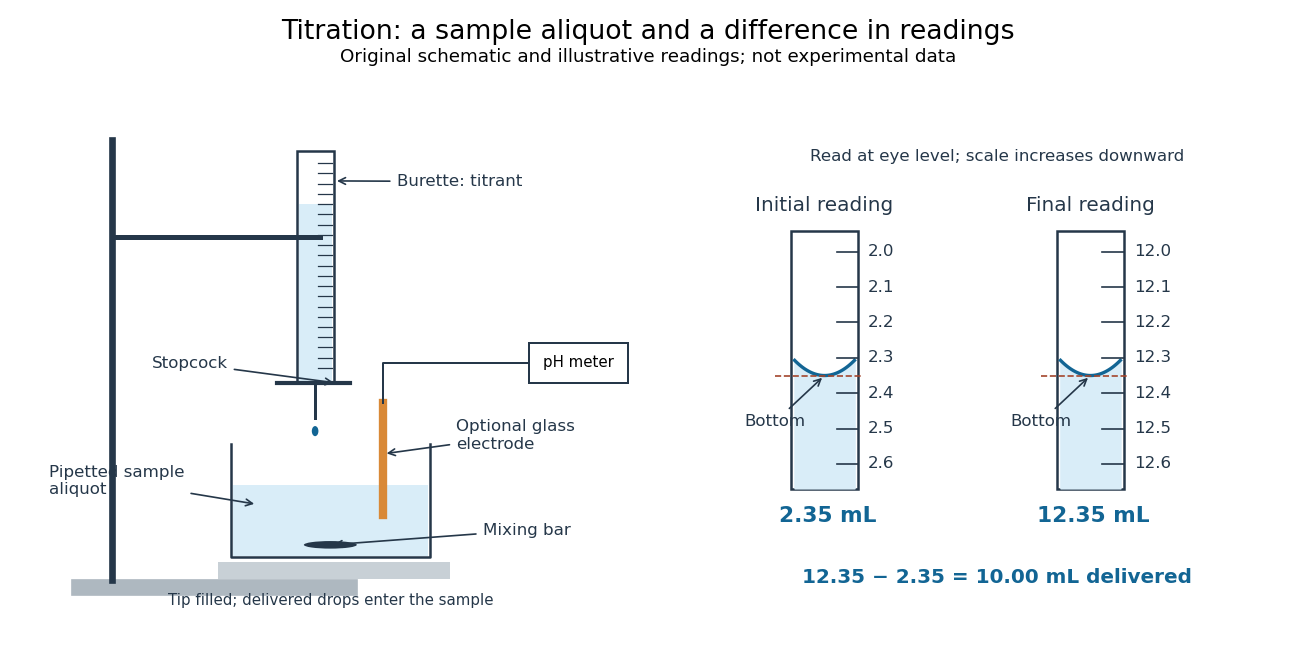

For transparent aqueous samples, read the bottom of the liquid meniscus at eye level; viewing from above or below shifts its apparent alignment. The mark is a comparison between a curved liquid surface and a scale, not a direct measure of amount of substance. Eye-level reading and the distinction between contained and delivered volumes are part of solution preparation and volumetric calibration.[ref]
Calibration of Volumetric Glassware (Buffalo State laboratory handout). Laboratory Experiment 1. Calibration of Volumetric Glassware, p. 1, eye-level bottom-of-meniscus reading
Both readings contribute measurement uncertainty. If each has independent standard deviation , their difference has standard deviation ; a common additive reading offset cancels, while a scale-factor error remains. For the inventory , uncertainty in titrant concentration remains even with perfect readings. This is why repeat delivery, independent volume calibration, and titrant standardization answer different questions.
New to topics? Read the docs here!