Cavendish torsion balance
ID: cavendish-torsion-balance

A Cavendish torsion balance is a torsion balance arranged to measure gravitational torque from nearby source masses. Its suspended horizontal rod rotates about a vertical fiber. In the linear elastic regime, a twist angle , measured from the fiber's untwisted orientation, gives a restoring torque , where is the torsion constant. The minus sign is essential: the fiber resists the twist. Under an approximately constant gravitational torque, the rotational equation using moment of inertia and angular acceleration isAt equilibrium, the two torques balance. The angle is a displacement from the fiber's reference orientation, not the largest excursion during an oscillation. [ref]
https://www.phys.uconn.edu/~hamilton/phys258/N/cav.pdf. University of Connecticut, The Cavendish Experiment, pp. 2–3: restoring torque and equilibrium deflection
For the toy parameters in the Cavendish experiment, the predicted equilibrium twist isHere , consistent with using a small geometric displacement in the toy model, but not an estimate of its total measurement error. Reversing the source positions ideally takes the equilibrium angle from to : the magnitude of the change is . A stable zero offset then cancels in the difference. A real reading may track a reflected light spot; the law of reflection doubles a mirror's rotation in the outgoing beam, so the spot's angular change must not be confused with the rod's angle. [ref]
https://sciencedemonstrations.fas.harvard.edu/presentations/cavendish-experiment. Harvard Natural Sciences Lecture Demonstrations, Cavendish Experiment: mirror readout and source reversal
How can the fiber's torsion constant be found without already knowing the gravitational force? Measure the oscillation period and calculate the moment of inertia. For the same toy rod, neglecting its mass and treating both test masses as point masses, . With the source torque absent or treated as constant, let be a small departure from equilibrium. Neglect damping and any change of gravitational torque with angle. The rotational equation becomes simple harmonic motion:Here is the angular amplitude, specifies the initial phase, and is the angular frequency. A softer fiber gives a larger equilibrium twist but also a longer oscillation period: greater sensitivity costs observation time. An undamped oscillation does not settle at equilibrium; damping is needed for settling. [ref]
https://www.phys.uconn.edu/~hamilton/phys258/N/cav.pdf. University of Connecticut, The Cavendish Experiment, p. 3, equation (7): period calibration neglecting damping
The toy moment of inertia and undamped oscillation period areTiming this oscillation period would recover the assumed torsion constant. The units check explains the result: torque divided by torsion constant is an angle in radians, and has units of time squared when radians are treated as dimensionless in SI.
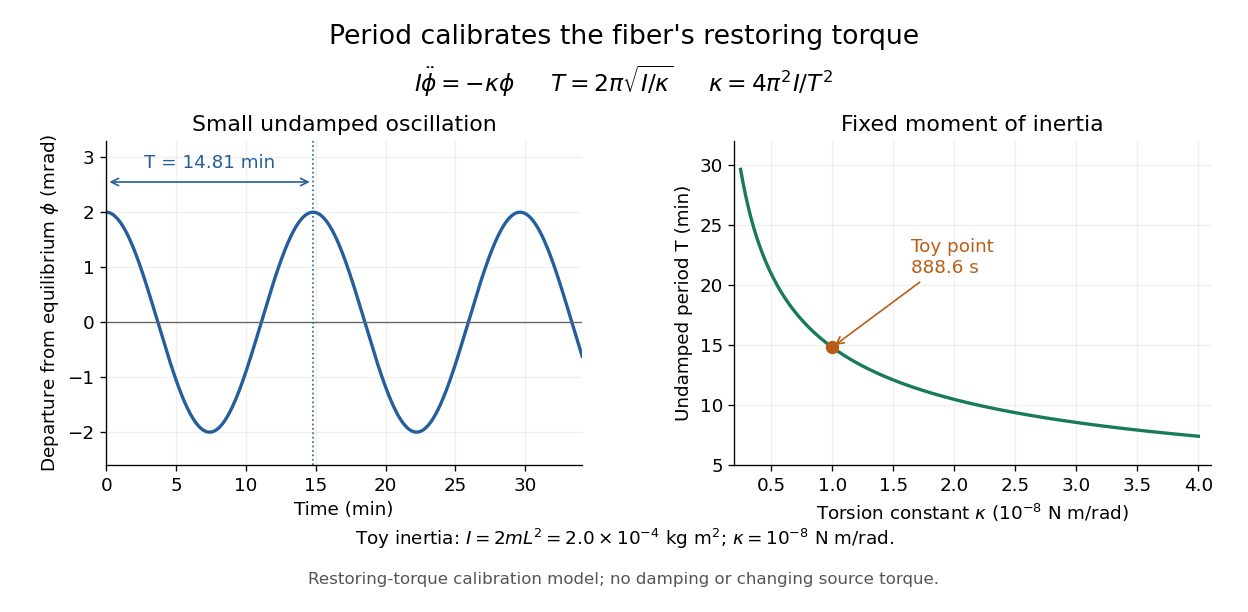
Undamped small torsional oscillations calibrate the restoring torque: a softer fiber has a longer period
. Details. 
Combining the equilibrium twist with the period calibration, the two-near-pair model would infer the gravitational constant asThe test mass cancels in the second expression because it enters both the gravitational torque and the toy moment of inertia. If the measured quantity is the magnitude of the change between opposite source positions, use . Substituting the toy twist and oscillation period returns the input ; it is a consistency check, not independent experimental evidence.
The sensitivity of a Cavendish torsion balance also explains its practical difficulty. Air motion can exert unwanted torque; unequal temperatures can drive that motion. Cavendish discusses this effect on p. 471 and describes observing from outside a closed room to avoid disturbing the instrument. [ref]
https://www.infinitoteatrodelcosmo.it/wp-content/uploads/2021/07/cavendish-1997-xxi-experiments-to-determine-the-density-of-the-earth.pdf. Cavendish (1798), original paper, p. 471: temperature-driven air currents and remote observation
Mechanical vibrations can excite the same slow oscillations used to calibrate the torsion constant, while changes in the fiber or source separations alter the inferred force. Precision therefore depends on resolving the equilibrium angle, calibrating the full suspended moment of inertia and torsion constant, and modeling the actual source geometry. The two-near-pair model omits opposite-source attraction, rod contributions, finite-size effects, damping, and the variation of gravitational torque as the rod turns. [ref]https://sciencedemonstrations.fas.harvard.edu/presentations/cavendish-experiment. Harvard Cavendish demonstration: sensitivity, settling, and separation-dependent measurement
New to topics? Read the docs here!