The Cavendish experiment makes the attraction predicted by Newton's law of universal gravitation measurable between laboratory masses. Two small test masses hang at the ends of a horizontal rod in a Cavendish torsion balance; nearby larger source masses exert a tiny torque. A thin suspension fiber supplies an opposing torque as it twists. Measuring its twist and calibrating its torsion constant lets an experimenter infer the gravitational force and, in a modern analysis, the gravitational constant. [ref]
https://www.phys.uconn.edu/~hamilton/phys258/N/cav.pdf. University of Connecticut, Physics 258/259, The Cavendish Experiment: apparatus and equations of motion, pp. 1–3
The beautiful feature is that the two horizontal forces can cancel as vectors while their torques add. The instrument converts weak attraction into a rotation, with sensitivity set by the fiber's torsion constant. Earth's much larger downward gravitational weight is supported by the suspension rather than supplying the intended torque about its vertical axis. A laboratory measurement can therefore probe the same Newtonian gravitational field that governs the two-body problem.
Henry Cavendish's original paper was Experiments to determine the Density of the Earth, published in Philosophical Transactions, volume 88 (1798), pp. 469–526, and read on 21 June 1798. On p. 469 he credits John Michell with the apparatus idea and explains that Michell died before using it; the instrument reached Cavendish through Francis John Hyde Wollaston. Cavendish's stated aim was Earth's mean mass density. Calling the experiment a determination of the gravitational constant is a modern interpretation, not Cavendish's own formulation of his result. [ref]
https://www.famaf.unc.edu.ar/~wolf/FisicaI/Phil.%20Trans.%20R.%20Soc.%20Lond.-1798-Cavendish-rstl.1798.0022.pdf. Cavendish (1798), original paper, opening p. 469; DOI 10.1098/rstl.1798.0022
The connection between Earth's mean mass density and the gravitational constant follows in a spherical, nonrotating model of Earth. With Earth mass , radius , and surface gravitational acceleration , the spherical shell theorem and Newton's law of universal gravitation giveThus a local comparison of gravitational attractions, together with knowledge of Earth's size and surface gravitational acceleration, reaches a property of the entire planet. These are modern equations explaining the connection, not equations quoted from Cavendish's paper.
For a worked example, use an explicitly simplified two-near-pair model. Each test point mass is , each source point mass is , and each lever arm is , so the rod's full length is . Neglect the rod's mass. At zero twist put the test masses at and , and the sources at and . Here is the near-pair center separation. Ignore each source's attraction on the test mass at the opposite end. Evaluate the two near-pair forces at zero twist and treat their torque as constant for a small twist, requiring . This is a teaching model, not a precision model of Cavendish's actual apparatus.
By Newton's law of universal gravitation, each retained force has magnitude . The left force points down and the right force points up. Using torque about the suspension axis, both contributions are counterclockwise when viewed from above:The net retained horizontal force is zero, yet the net torque is positive. Moving the sources to and reverses both forces and hence the torque. In a real apparatus, the opposite source also attracts each test mass; that correction is explicitly included in the university derivation. [ref]
https://www.phys.uconn.edu/~hamilton/phys258/N/cav.pdf. University of Connecticut, The Cavendish Experiment, p. 2, equation (1): opposite-source correction
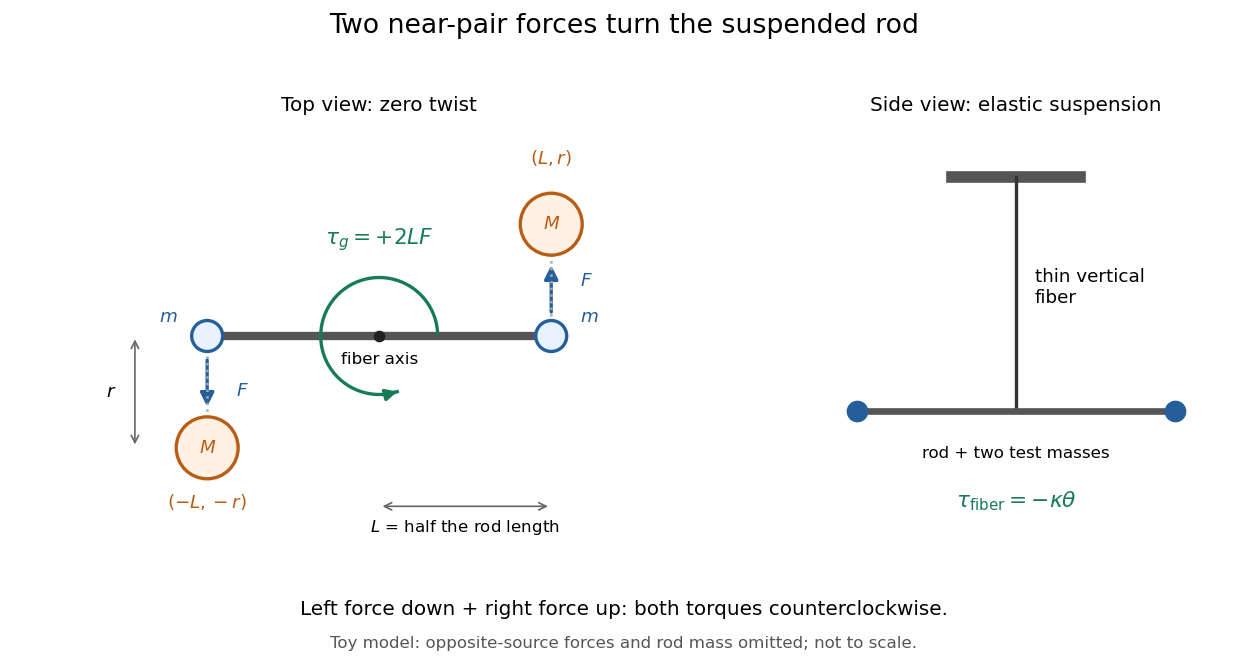
For illustrative parameters, take , , , , and torsion constant . Use , the central value in NIST's 2022 CODATA table; that table gives standard uncertainty . This is an input for the example, not a measurement made with these assumed parameters. [ref]This sub-nanonewton force produces a measurable twist in the Cavendish torsion balance. The displayed digits make the toy calculation reproducible; they do not describe experimental precision.
A Cavendish torsion balance is a torsion balance arranged to measure gravitational torque from nearby source masses. Its suspended horizontal rod rotates about a vertical fiber. In the linear elastic regime, a twist angle , measured from the fiber's untwisted orientation, gives a restoring torque , where is the torsion constant. The minus sign is essential: the fiber resists the twist. Under an approximately constant gravitational torque, the rotational equation using moment of inertia and angular acceleration isAt equilibrium, the two torques balance. The angle is a displacement from the fiber's reference orientation, not the largest excursion during an oscillation. [ref]
https://www.phys.uconn.edu/~hamilton/phys258/N/cav.pdf. University of Connecticut, The Cavendish Experiment, pp. 2–3: restoring torque and equilibrium deflection
For the toy parameters in the Cavendish experiment, the predicted equilibrium twist isHere , consistent with using a small geometric displacement in the toy model, but not an estimate of its total measurement error. Reversing the source positions ideally takes the equilibrium angle from to : the magnitude of the change is . A stable zero offset then cancels in the difference. A real reading may track a reflected light spot; the law of reflection doubles a mirror's rotation in the outgoing beam, so the spot's angular change must not be confused with the rod's angle. [ref]
https://sciencedemonstrations.fas.harvard.edu/presentations/cavendish-experiment. Harvard Natural Sciences Lecture Demonstrations, Cavendish Experiment: mirror readout and source reversal
How can the fiber's torsion constant be found without already knowing the gravitational force? Measure the oscillation period and calculate the moment of inertia. For the same toy rod, neglecting its mass and treating both test masses as point masses, . With the source torque absent or treated as constant, let be a small departure from equilibrium. Neglect damping and any change of gravitational torque with angle. The rotational equation becomes simple harmonic motion:Here is the angular amplitude, specifies the initial phase, and is the angular frequency. A softer fiber gives a larger equilibrium twist but also a longer oscillation period: greater sensitivity costs observation time. An undamped oscillation does not settle at equilibrium; damping is needed for settling. [ref]
https://www.phys.uconn.edu/~hamilton/phys258/N/cav.pdf. University of Connecticut, The Cavendish Experiment, p. 3, equation (7): period calibration neglecting damping
The toy moment of inertia and undamped oscillation period areTiming this oscillation period would recover the assumed torsion constant. The units check explains the result: torque divided by torsion constant is an angle in radians, and has units of time squared when radians are treated as dimensionless in SI.
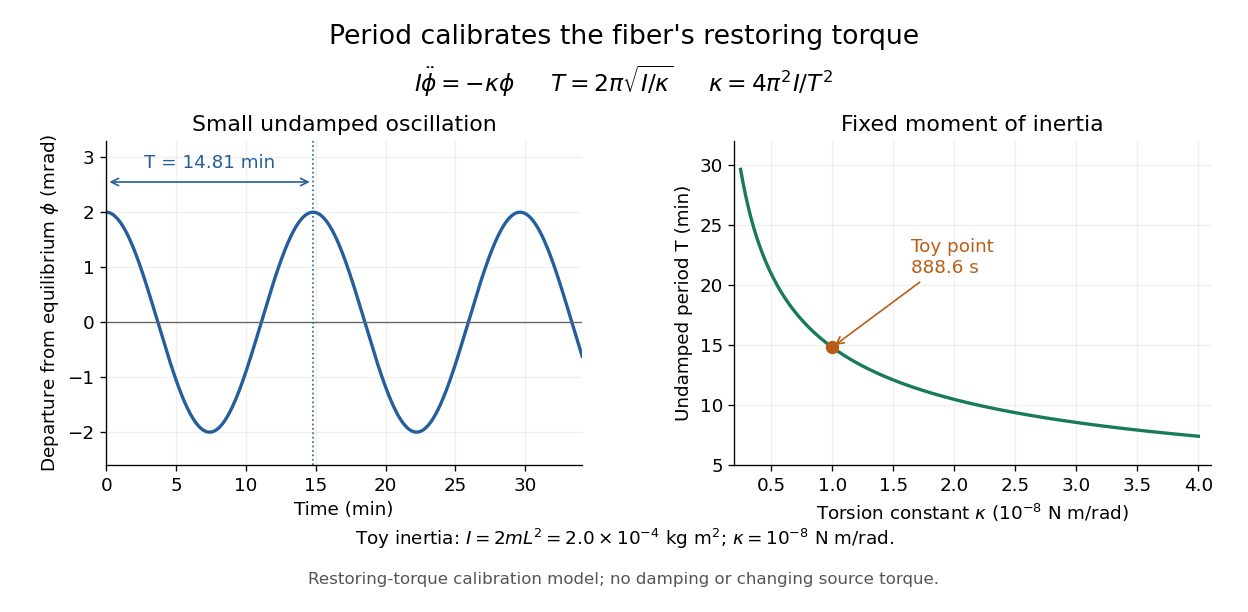
Undamped small torsional oscillations calibrate the restoring torque: a softer fiber has a longer period
. Details. Combining the equilibrium twist with the period calibration, the two-near-pair model would infer the gravitational constant asThe test mass cancels in the second expression because it enters both the gravitational torque and the toy moment of inertia. If the measured quantity is the magnitude of the change between opposite source positions, use . Substituting the toy twist and oscillation period returns the input ; it is a consistency check, not independent experimental evidence.
The sensitivity of a Cavendish torsion balance also explains its practical difficulty. Air motion can exert unwanted torque; unequal temperatures can drive that motion. Cavendish discusses this effect on p. 471 and describes observing from outside a closed room to avoid disturbing the instrument. [ref]
https://www.infinitoteatrodelcosmo.it/wp-content/uploads/2021/07/cavendish-1997-xxi-experiments-to-determine-the-density-of-the-earth.pdf. Cavendish (1798), original paper, p. 471: temperature-driven air currents and remote observation
Mechanical vibrations can excite the same slow oscillations used to calibrate the torsion constant, while changes in the fiber or source separations alter the inferred force. Precision therefore depends on resolving the equilibrium angle, calibrating the full suspended moment of inertia and torsion constant, and modeling the actual source geometry. The two-near-pair model omits opposite-source attraction, rod contributions, finite-size effects, damping, and the variation of gravitational torque as the rod turns. [ref]https://sciencedemonstrations.fas.harvard.edu/presentations/cavendish-experiment. Harvard Cavendish demonstration: sensitivity, settling, and separation-dependent measurement
Articles by others on the same topic

The Cavendish experiment, conducted by British scientist Henry Cavendish in 1797-1798, was a groundbreaking experiment that measured the force of gravitational attraction between masses. The primary aim of the experiment was to determine the density of the Earth, but it also yielded the first accurate measurement of the gravitational constant (G), which is fundamental to our understanding of gravitational interactions.


