
The convex conjugate records a function using slopes rather than input positions. Let be a proper extended-real function: it is finite somewhere and never takes . Its convex conjugate iswhere is the dot product and is the effective domain. An infinite value of excludes that input from the supremum. The value can be , but cannot be because an input with finite supplies a finite lower bound.
The convex conjugate is automatically a convex function, even when is not convex: each fixed input gives an affine function , and their supremum is convex. It is also lower semicontinuous. It need not be proper: for on , is unbounded above for every . The definition and the automatic convexity are discussed in Boyd and Vandenberghe, Convex Optimization (2004), §3.3.1.
The best lower bound with a prescribed slope. Whenever is finite, the affine functionis an affine minorant of . Indeed, an affine function lies below everywhere exactly when . Thus is the largest possible intercept at slope . The convex conjugate trades positions for slopes: specifies where to inspect , whereas specifies which global affine minorant to use. Taking the supremum over all these affine minorants produces the biconjugate; the Fenchel-Moreau theorem says this recovers a proper convex function when it is lower semicontinuous.
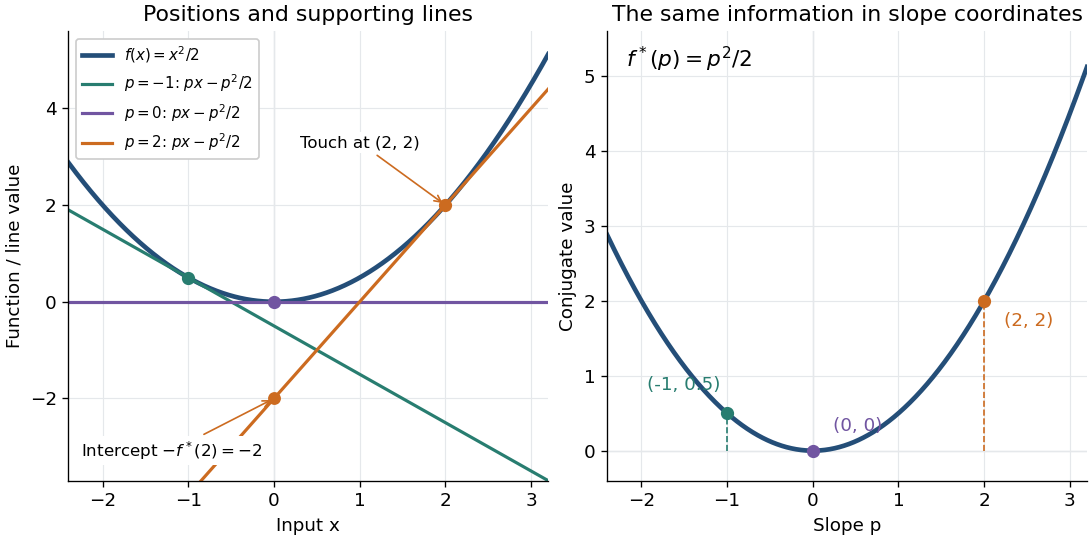
A quadratic, computed by completing the square. For the convex quadratic function ,Consequently , and the unique maximizing input is . The affine minorant is the tangent line at : its slope is and its intercept is . For example, gives and the tangent line , touching at . This is the same curve described either by its point values or by the intercepts of its tangent lines.
A corner turns into a constraint on slopes. For the absolute value , if then , with value zero at . If , taking makes ; if , taking does the same. Therefore its convex conjugate is zero on and outside: it is the indicator functional of a constraint set for this interval. For the unique maximizing input is zero; for every maximizes, and for every maximizes. The corner's many supporting slopes are exactly the subdifferential .
A supremum need not be attained. For a differentiable convex function finite on all of , an input maximizes exactly when . If is strictly convex, there is at most one such input; existence is a separate issue. For the exponential function , the derivative is positive. At , solving gives and . At , the supremum of is zero as , with no maximizing input. At , as . Thus a strictly convex differentiable function can have both unattained finite conjugate values and infinite conjugate values.


The convex conjugate, also known as the Legendre-Fenchel transform, is a concept in convex analysis and optimization that is used to transform a convex function into another function.
New to topics? Read the docs here!