
A function on a convex set is a convex function if, for every and ,Geometrically, a line segment joining two points of its graph of a function lies on or above that graph of a function. The convex set condition ensures that the intermediate input stays in the domain of a function. An affine function satisfies the defining inequality with equality.
For the quadratic function , the inputs and have equally weighted arithmetic mean . Evaluating at the arithmetic mean gives , whereas averaging the outputs gives . Averaging first saves one unit in this example. More generally, direct expansion givesThis identity proves convexity and also shows exactly when its defining inequality is strict.
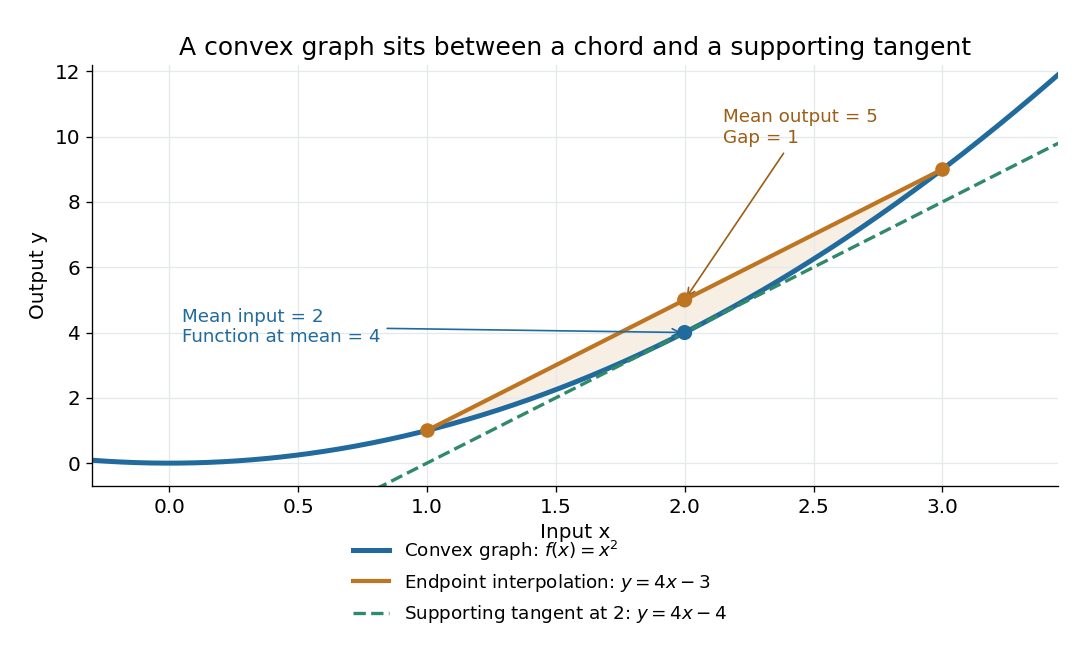
The graph of a convex quadratic lies below its endpoint interpolation and above its supporting tangent
. For , the line segment through and has height at , while the graph of a function has height . The tangent line is an affine minorant: everywhere. Details.For a differentiable convex function, the tangent line in one dimension, or the corresponding supporting affine function in several dimensions, lies below the entire graph of a function. This is the subgradient inequality. The equivalent geometric statement is that the epigraph, consisting of points on or above the graph of a function, is a convex set. These characterizations are developed in Boyd and Vandenberghe's convex-function slides, sections 3.1–3.4.
Convexity does not require differentiability: the absolute value function is a convex function with a corner at . When a function is twice continuously differentiable on an open interval, it is a convex function exactly when its second derivative is nonnegative throughout that interval. In several dimensions, the corresponding criterion on an open convex set is that its Hessian matrix is positive semidefinite everywhere. The domain of a function matters: is a convex function on , but not on all of . A strictly positive second derivative is sufficient for strict convexity, but is not necessary: is a strictly convex function although its second derivative vanishes at .
The usefulness of convexity is that local information can certify a global conclusion. Every local minimum of a convex function on a convex set is a global minimum: if a lower value existed elsewhere, the defining inequality would produce lower values arbitrarily close to the proposed local minimum. For a differentiable convex function on an open convex set, a zero gradient therefore certifies a global minimum. Strict convexity gives uniqueness when a global minimum exists; it does not supply existence by itself. These facts explain the role of convex functions in convex optimization.


New to topics? Read the docs here!