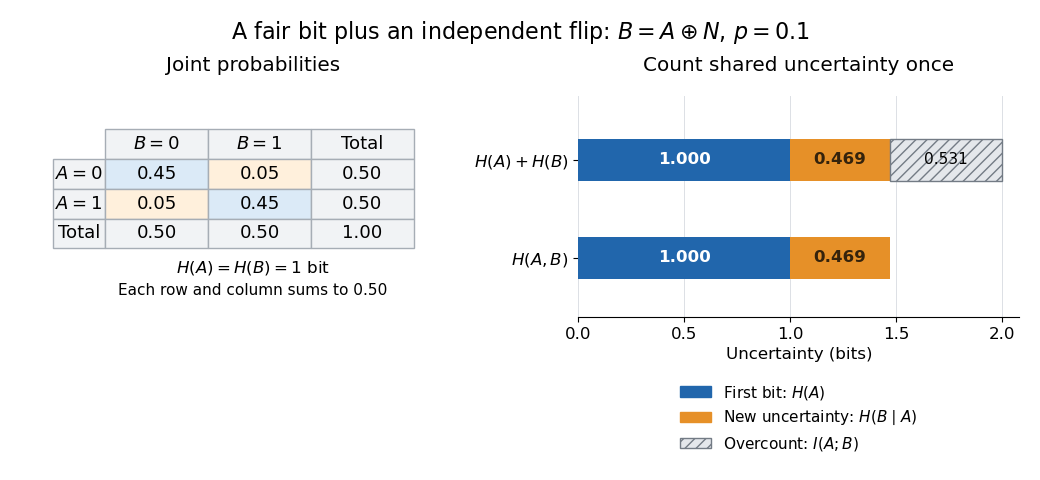
Adding H(A)+H(B)=2 would overcount by exactly I(A;B). These are averageuncertainties under the stipulated probability distribution; the four possible pairs are still represented by four distinct outcomes.
There is another way to see the decomposition: (A,B)↦(A,A⊕B)=(A,N) is a bijection. It merely relabels the four outcomes, so it preserves joint entropy. The independence of A and N then gives H(A,B)=H(A,N)=H(A)+H(N)=1+h2(p). Describing the initial bit and the flip decision separates shared uncertainty from new uncertainty.
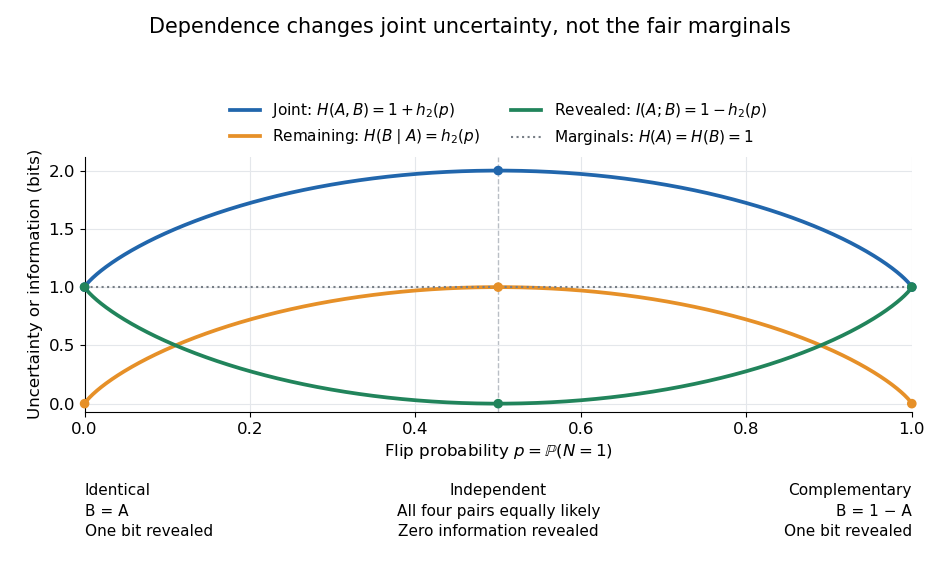
At p=0, the bits are identical: B=A, so H(B∣A)=0 and I(A;B)=1. At p=1, they are complementary: B=1−A, with exactly the same conditional entropy and mutual information. In either case, observing one determines the other. At p=1/2, all four joint probabilities are 1/4; the bits are independent, H(A,B)=2, and I(A;B)=0. Perfect disagreement is therefore just as informative as perfect agreement.