Correlated threshold and amplitude errors in RC timing

ID: correlated-threshold-and-amplitude-errors-in-rc-timing

Correlated threshold and amplitude errors in RC timing must be propagated together. An input level and a comparator threshold can share a reference, so treating their measurement uncertainties as independent can overestimate or underestimate the uncertainty of the RC threshold-crossing time. The correct cancellation depends on which levels share an error, including the initial baseline.
First hold the time constant fixed and take a known zero initial output. Write for the step's high level and for the threshold. The RC threshold-crossing time and its two sensitivity coefficients are
The first-order law of propagation of uncertainty retains the covariance term. If the two input standard uncertainties are , and their correlation coefficient is , then
The negative cross term follows from the opposite signs of the two sensitivities: raising the threshold delays a crossing, whereas raising the input makes it earlier. Setting covariance to zero is an assumption about the measurement process.[ref]
For an original example, let , , , and . The nominal crossing is , and
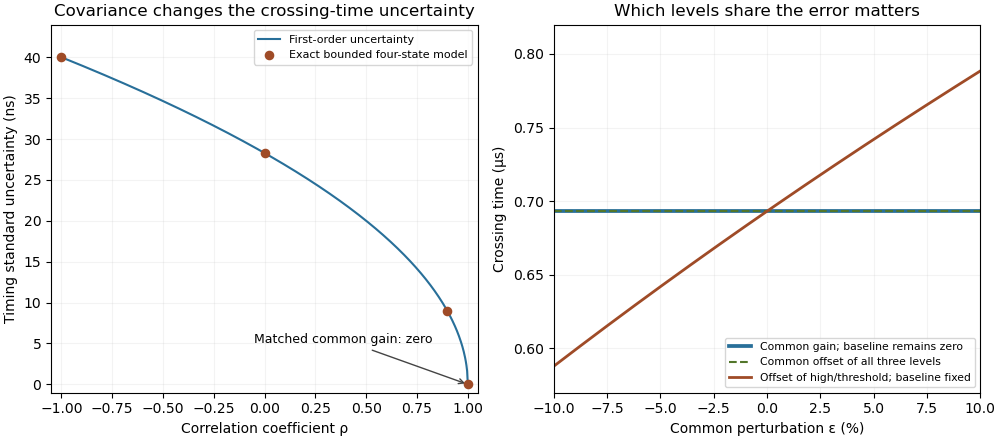
If the two errors are independent random variables, the result is ; gives ; perfect anticorrelation gives . These are standard uncertainties from a local approximation, not automatically coverage intervals.
There is an exact cancellation under a more specific model. With zero baseline, if and with the same positive gain , the ratio is fixed and
This ratiometric cancellation of RC timing gain errors is a ratiometric measurement principle. With , the zero at reflects exact common scaling, rather than a claim that every source of timing uncertainty has vanished. Uncertainty in , for example, still gives .
A common offset in RC timing needs the baseline to be specified. If the initial output remains fixed at zero while only and receive the same offset , then
In the numerical example, a small shared offset with standard uncertainty gives about of timing uncertainty. Perfect positive correlation between these two levels alone does not ensure cancellation.
If the baseline shares the offset too, it must be included. The nonzero-baseline model from residual baseline in RC pulse-width discrimination is
Adding to all three levels leaves both differences, and hence the time, unchanged. This is a change of common zero reference. Holding the baseline fixed while shifting only the two other levels is a different experiment. The extra sensitivity is ; at , the three voltage sensitivities sum to zero, as required by the exact common-offset invariance.
Figure 1.
Covariance changes RC timing uncertainty, while gain and offset cancellation depend on the full measurement model
. Original calculation for a 1 V high level, 0.5 V threshold and 1 µs time constant. Exact four-state bounded-error checks are compared with first-order propagation. The right panel distinguishes common gain, a two-level offset with fixed baseline, and a common offset of all three levels. Its common perturbation sets gain or offset . No measured uncertainty data are used. Details.
An exact numerical check can use bounded errors with prescribed correlation. Take two independent random variables with the Rademacher distribution and set
The four equally likely states have the specified variances and covariance. At the chosen error scales, all states retain , so the exact logarithmic crossing exists in every state. Evaluating those four times checks the local approximation without silently assigning a crossing to an invalid input pair. Near a threshold or pulse-duration boundary, missing crossings and nonlinear effects require separate treatment.
For a full measurement uncertainty calculation, include the baseline and time constant when their uncertainties matter. With input vector , Jacobian matrix and covariance matrix , the first-order result is . The measurement model must represent significant corrections and uncertainty sources, rather than only a physical law.[ref] A bench check can vary a common amplitude reference and then an independent threshold offset while recording actual levels and crossings on an oscilloscope; the baseline should be recorded in both tests.

New to topics? Read the docs here!