
Crashworthiness is the ability of a structure to manage a collision through controlled deformation and energy dissipation while limiting transmitted loads and intrusion into the space it protects. A crushable member can use plastic deformation to spread the loss of kinetic energy over a useful stopping distance. High static strength alone does not specify this response: the complete force-displacement curve and the available deformation stroke matter.
For an original one-dimensional model, a carriage approaches a stationary crush member at . Neglect rebound, friction elsewhere and external work during crushing. The member must absorbA constant resisting force over is ; over it is . A triangular force-displacement curve rising from zero over the shorter stroke needs a peak of to absorb the same energy. Thus equal absorbed energy does not imply equal peak load. Doubling the approach speed quadruples the required energy. The long-stroke design is useful only if that stroke is physically available without unacceptable intrusion.
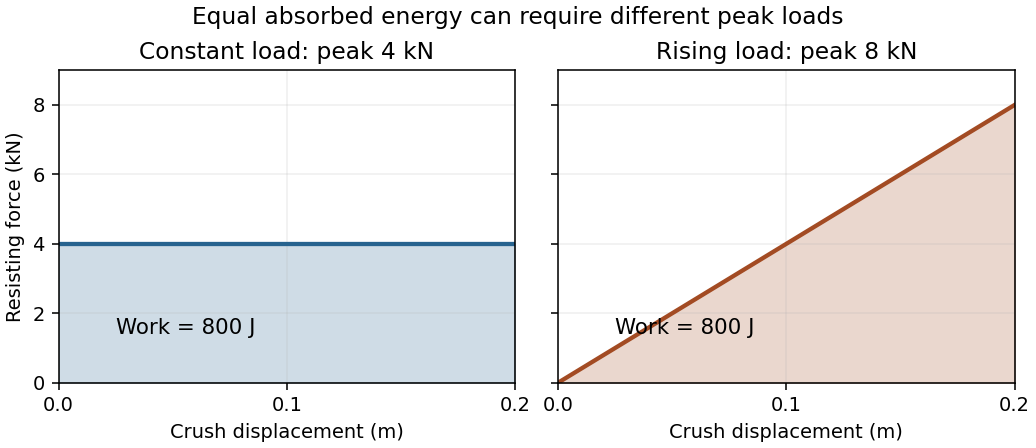
Original ideal crush-force curves: both absorb 800 J over 0.20 m, but their peak loads differ by a factor of two
. Details. A physical test must record the load history as well as the final crushed shape. One primary example used two vertical drop tests at with an energy-absorbing aircraft-seat prototype, a test dummy and acceleration measurements, using crash pulses informed by twelve light-aircraft crash tests. This tests a dynamic load path rather than merely a material's static strength.[ref]
Determination of crash test pulses and their application to aircraft seat analysis by E. Alfaro-Bou and others. NASA NTRS record 19810058363, author abstract; SAE paper 810611 (1981)
The carriage calculation above is an idealized energy budget, not a reconstruction of those tests.

Crashworthiness refers to the ability of a vehicle to protect its occupants during an impact. It encompasses the design, engineering, and material choices that contribute to how well a vehicle can withstand a crash and minimize injuries to passengers. Key aspects of crashworthiness include: 1. **Structural Integrity**: The vehicle's frame and body should be designed to absorb and dissipate energy during a collision, thereby protecting the occupants.
New to topics? Read the docs here!