
The damping ratio is the dimensionless ratio . Substituting the exponential function into the viscous damping model gives the characteristic equation and its characteristic roots:For , underdamping gives a pair of complex conjugate roots with negative real part. For , critical damping gives the repeated negative real root. For , overdamping gives two distinct negative real roots. At the roots are purely imaginary and the harmonic oscillator is undamped; this boundary case has no energy loss. With , negative would inject energy and lies outside the dissipative model.
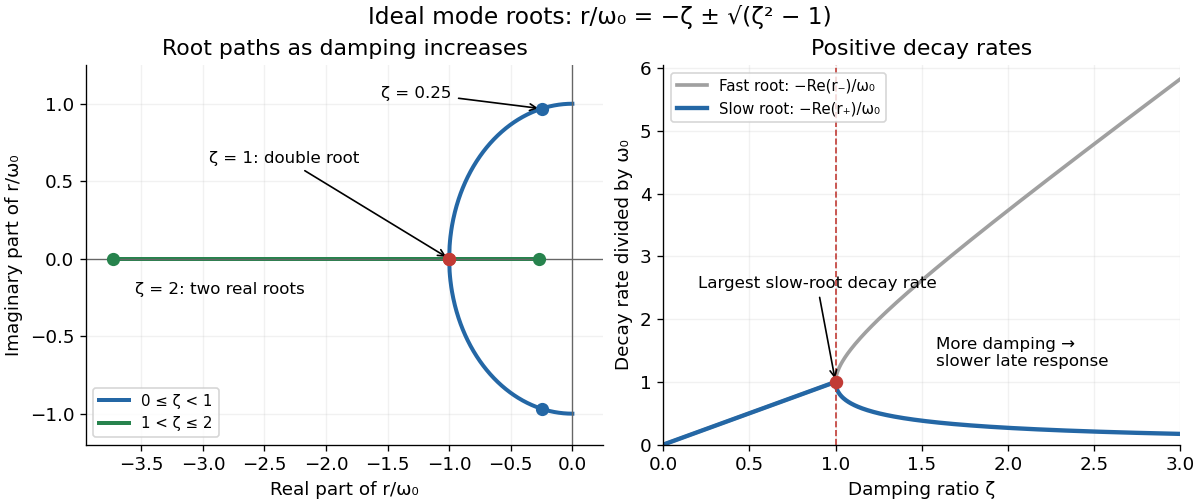
Characteristic roots of an ideal viscous oscillator and their dimensionless decay rates as the damping ratio varies
. Details. 
The left panel locates in the complex plane; the imaginary part gives the damped angular frequency, while the negative real part gives the exponential decay rate. The right panel shows the positive rates . Beyond critical damping, one root moves toward zero, explaining slow late motion for generic initial conditions. The repeated-root solution also has a polynomial prefactor, so these rates alone do not describe its complete response.
New to topics? Read the docs here!