The damping ratio is the dimensionless ratio . Substituting the exponential function into the viscous damping model gives the characteristic equation and its characteristic roots:For , underdamping gives a pair of complex conjugate roots with negative real part. For , critical damping gives the repeated negative real root. For , overdamping gives two distinct negative real roots. At the roots are purely imaginary and the harmonic oscillator is undamped; this boundary case has no energy loss. With , negative would inject energy and lies outside the dissipative model.
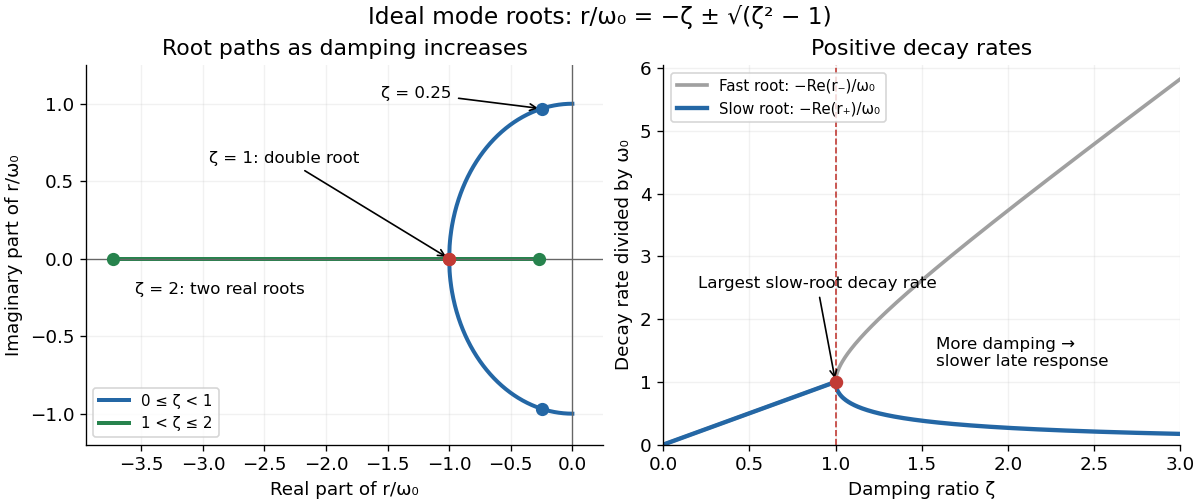
Characteristic roots of an ideal viscous oscillator and their dimensionless decay rates as the damping ratio varies
. Details. 
The left panel locates in the complex plane; the imaginary part gives the damped angular frequency, while the negative real part gives the exponential decay rate. The right panel shows the positive rates . Beyond critical damping, one root moves toward zero, explaining slow late motion for generic initial conditions. The repeated-root solution also has a polynomial prefactor, so these rates alone do not describe its complete response.
For a constant-force-amplitude displacement response, the frequency-domain magnitude has a nonzero-frequency peak only for damping ratio . The free time-domain motion remains underdamped for all . Thus an oscillator can have complex characteristic roots but no nonzero-frequency displacement resonance peak. The distinction depends on the measured response and drive convention, not merely on the existence of damping.
Articles by others on the same topic
There are currently no matching articles.