Viscous damping means a force proportional to, and opposite to, velocity: with . Its coefficient has units , equivalently . The name describes a force law; eddy-current damping can approximate the same law without a viscous fluid. Constant , and produce a linear ordinary differential equation, allowing superposition of responses. Kinetic friction with approximately constant magnitude and quadratic drag obey different laws, so their decay need not have the exponential decay or critical threshold derived here.
The damping ratio is the dimensionless ratio . Substituting the exponential function into the viscous damping model gives the characteristic equation and its characteristic roots:For , underdamping gives a pair of complex conjugate roots with negative real part. For , critical damping gives the repeated negative real root. For , overdamping gives two distinct negative real roots. At the roots are purely imaginary and the harmonic oscillator is undamped; this boundary case has no energy loss. With , negative would inject energy and lies outside the dissipative model.
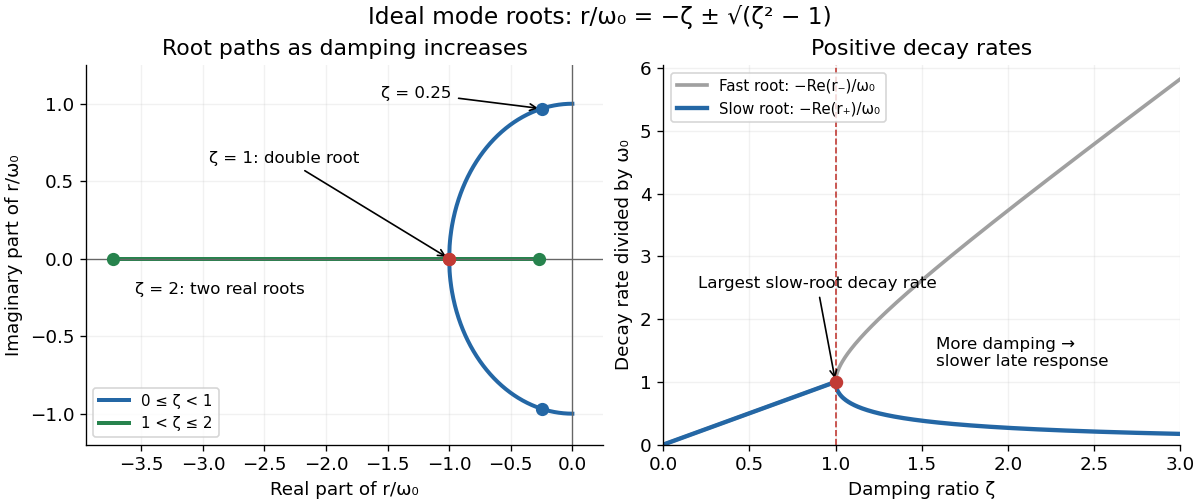
Characteristic roots of an ideal viscous oscillator and their dimensionless decay rates as the damping ratio varies
. Details. The left panel locates in the complex plane; the imaginary part gives the damped angular frequency, while the negative real part gives the exponential decay rate. The right panel shows the positive rates . Beyond critical damping, one root moves toward zero, explaining slow late motion for generic initial conditions. The repeated-root solution also has a polynomial prefactor, so these rates alone do not describe its complete response.
For a constant-force-amplitude displacement response, the frequency-domain magnitude has a nonzero-frequency peak only for damping ratio . The free time-domain motion remains underdamped for all . Thus an oscillator can have complex characteristic roots but no nonzero-frequency displacement resonance peak. The distinction depends on the measured response and drive convention, not merely on the existence of damping.
For the damped harmonic oscillator, the mechanical energy is the sum of kinetic energy and spring potential energy:Thus is the power transferred out of the oscillator's mechanical energy. For , the rate vanishes instantaneously at a turning point, despite nonzero stored potential energy; it is not a constant loss per unit time. In eddy-current damping the loss becomes Joule heating. [ref]
For an underdamped response, advancing one oscillation period multiplies both displacement and velocity by , so . This exact cycle relation does not imply that instantaneous energy is a pure exponential function throughout each cycle.
Articles by others on the same topic


Viscous damping refers to a type of damping that is proportional to the velocity of an object moving through a fluid or a material. This phenomenon is commonly observed in mechanical systems, particularly in oscillating or vibrating systems, where energy is dissipated as heat due to the resistance of the fluid or medium. In the context of mechanical vibrations, viscous damping can be described using a damping force that is proportional to the velocity (\(v\)) of the object.