Degenerate-electron pressure crossover
ID: degenerate-electron-pressure-crossover

Consider an ideal degenerate electron gas at zero temperature. Counting two spin states per phase space cell gives number density . The isotropic momentum flux gives pressureHere is Electron mass, is the speed of light, with Planck constant , and special relativity gives . The factor averages the directional momentum flux, and the spin factor is already included. This normalization makes a pressure, not an energy per Electron.
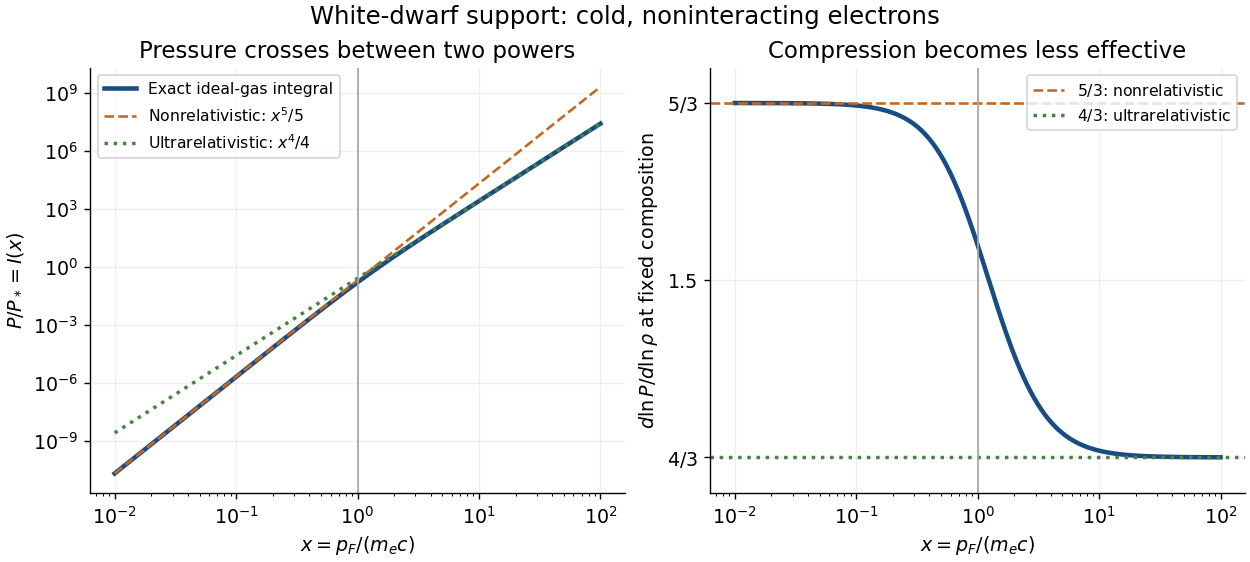
For , expand the denominator: and . For , the integrand approaches : and . At fixed composition, mass density is , with the mean molecular weight per electron and the unified atomic mass unit. Since , the logarithmic stiffness isPressure keeps rising; its fractional gain per fractional compression becomes smaller. Relativistic Electrons approach a speed ceiling while their momenta keep increasing. Thus the high-density equation of state loses the extra compression leverage of a nonrelativistic white dwarf. The Chandrasekhar mass from central polytropic constants supplies the corresponding global mass calculation.
For a calculated local example with , gives , and . Its stiffness is , intermediate between the two limits. These are ideal equation of state values at one point, not a measured central mass density or a whole white dwarf model. Finite temperature and interactions are excluded.

New to topics? Read the docs here!