Derivative criterion for monotonicity
ID: derivative-criterion-for-monotonicity

Let be a real interval, and let be differentiable in its interior and continuous at any endpoints belonging to . If the derivative satisfies throughout the interior, then is a nondecreasing function on . For in , the mean value theorem supplies withChanging to , , or gives a nonincreasing function, strictly increasing function, or strictly decreasing function, respectively. The endpoint continuity assumption lets the mean value theorem apply even when or is an endpoint. [ref].
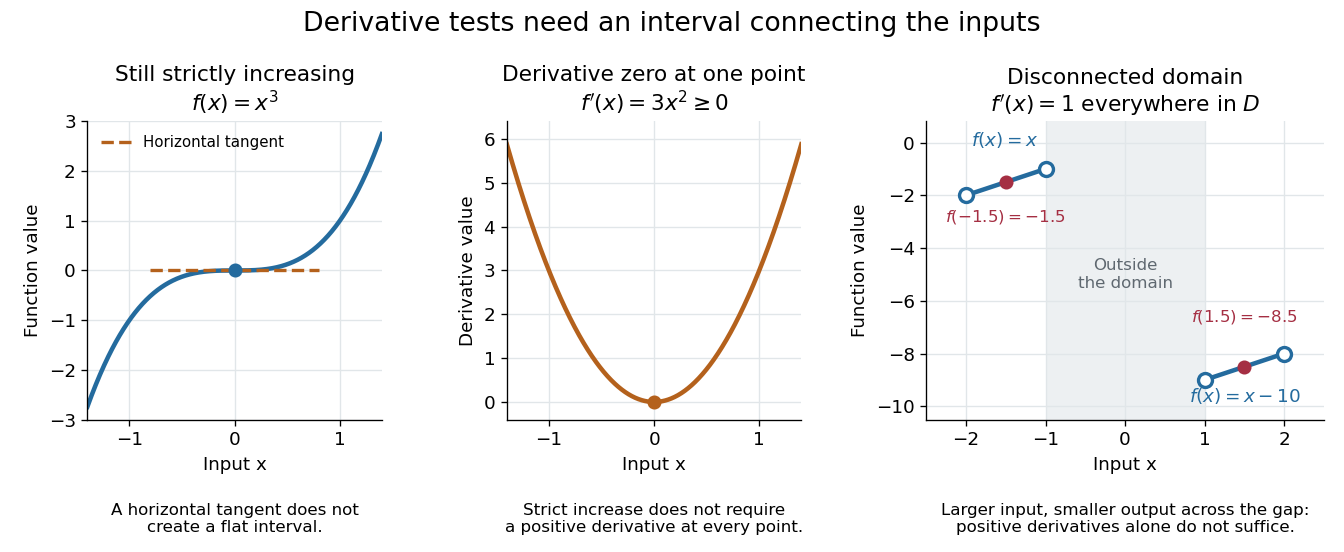
Conversely, if a nondecreasing function on a real interval is differentiable at an interior point , then : the difference quotient is nonnegative for either sign of . A differentiable nonincreasing function has derivative . Strict monotonicity still only forces these weak signs: the strictly increasing function has derivative zero at zero. The sign of the derivative helps locate intervals of monotonicity when sketching a graph. [ref].
The real interval hypothesis matters because a connected subset of the real line contains every point between its inputs. On a disconnected domain of a function, positive derivatives need not give a nondecreasing function. For example, takeHere everywhere in , but while . Each component has a strictly increasing function, yet their outputs are ordered the wrong way across the gap. This function is neither a nondecreasing function nor a nonincreasing function on all of ; the mean value theorem cannot cross the missing interval.

New to topics? Read the docs here!