
On a measurable space , the Dirac measure at assigns unit mass according to whether a measurable set contains that point:Here is the indicator function. This is a probability measure, since . For pairwise disjoint measurable sets , at most one contains , so : countable additivity reduces to a membership test. The definition works even when the singleton is not a measurable set. [ref]
To assert that its support of a measure is exactly , assume that is a metric space and is its Borel sigma-algebra. The singleton is then a closed set and a Borel set, with . Every open neighbourhood of has mass one; every other point has an open ball of radius less than its distance from , with mass zero. Thus . An abstract measurable space has no specified topology, so this topological conclusion is not part of the bare definition. Indeed, on the sigma-algebra , all Dirac measures coincide: the available measurable sets cannot distinguish points.
The Lebesgue integral against a Dirac measure is evaluation:This holds for every nonnegative measurable function, allowing an infinite value, and for real or complex measurable functions satisfying , which are precisely the integrable functions for . For a nonnegative simple function, only the cell containing contributes to its integral; increasing simple functions and the monotone convergence theorem extend the identity. Splitting into positive and negative parts, and then real and imaginary parts, gives the remaining cases. This is why a Dirac measure turns integration into a point query.
For a measurable function , its pushforward measure satisfiesConsequently for nonnegative or integrable measurable functions . For example, on the real numbers with their Borel sigma-algebra, sends to , so integrating against that pushforward measure gives . [ref]
https://terrytao.wordpress.com/2009/01/01/245b-notes-0-a-quick-review-of-measure-and-integration-theory/. Terence Tao, 245B notes 0, Example 10 and Theorem 2(8): pushforward and change of variables
Finite weighted sums of Dirac measures give useful measures with finitely many point masses. For finite nonnegative weights ,for nonnegative measurable functions , or whenever , with zero-weight terms omitted. Repeated locations have their weights added. On the real numbers, this is the finite version of the measure underlying the left-continuous cumulative function of an atomic measure; a positive-weight singleton is an atom of a measure. Unit weights at the distinct points of a finite set recover counting measure on that set. [ref]
https://terrytao.wordpress.com/2010/09/25/245a-notes-3-integration-on-abstract-measure-spaces-and-the-convergence-theorems/. Terence Tao, 245A notes 3, Exercises 21 and 25: representation by weighted Dirac measures
The same function can have sharply different integrals for different measures. On with its Borel sigma-algebra, defineHere is Lebesgue measure and is counting measure. The singleton is a Lebesgue null set, so its changed value leaves the Lebesgue integral equal to . For counting measure on the whole interval, on an infinite set, forcing an infinite integral. On the smaller measure space with its power set and counting measure, the restricted function instead has integral .
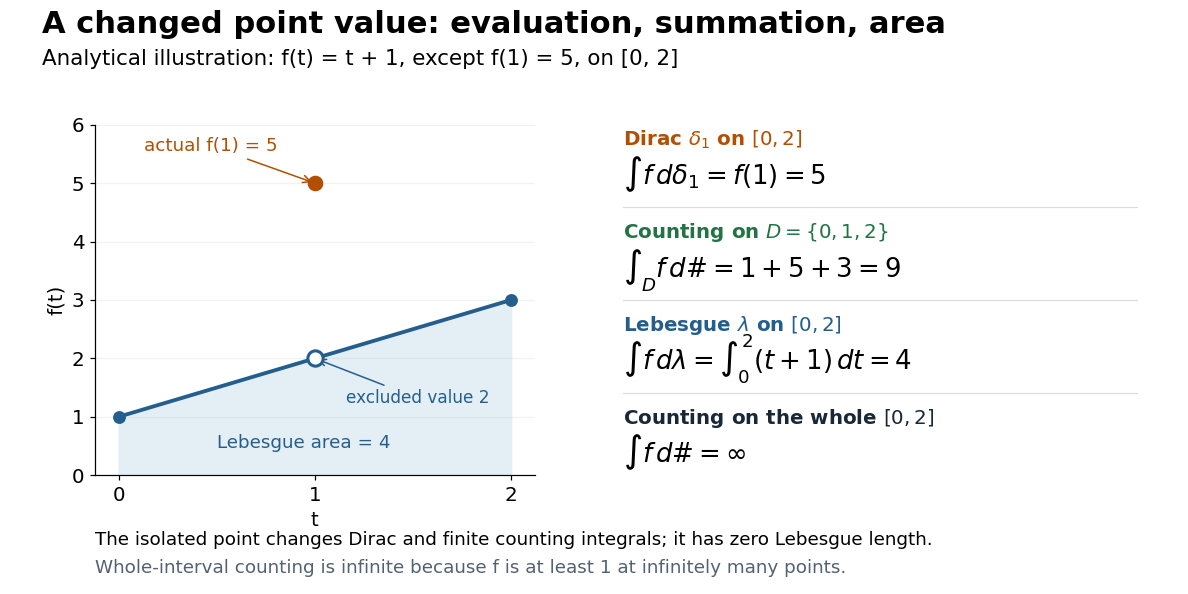

This also explains the almost everywhere convention in Lp spaces: equality almost everywhere for requires equality at , whereas equality almost everywhere for Lebesgue measure allows different values at that singleton. A point value therefore cannot be read unambiguously from an equivalence class in an Lp space formed using Lebesgue measure.
On the real numbers, a Dirac measure gives the Dirac delta distribution by for every test function. The name Dirac delta function does not mean an ordinary function that is zero away from and infinitely high at . Such a nonnegative measurable function still has Lebesgue integral zero, because its nonzero values occur on a Lebesgue null set. More generally, no nonnegative density with respect to Lebesgue measure can represent : it would give , contradicting unit mass. The measure and its associated distribution act on different kinds of inputs, namely measurable sets and test functions, but express the same point evaluation. [ref]
https://terrytao.wordpress.com/2009/04/19/245c-notes-3-distributions/. Terence Tao, 245C notes 3: Radon measures, test functions, and the Dirac delta distribution
New to topics? Read the docs here!