The power set is the set of all subsets of , including the empty set and itself. It is useful whenever an object is a selection rather than an individual member: a possible collection of active vertices in a graph, for example, belongs to the power set of the vertex set.
For , the power set has eight members:Each of the three set elements is either included or excluded. More generally, if , these independent binary choices give . This is a bijection between subsets and binary strings of length , not a probabilistic independence assumption.
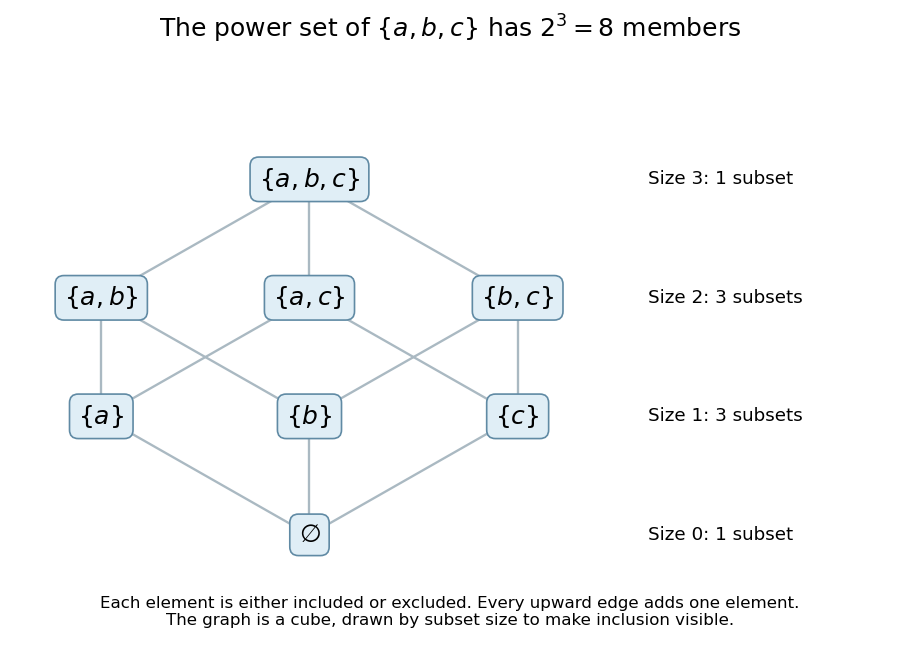

Ordering the subsets by inclusion gives a Boolean lattice. In the picture an upward edge adds one member. Complementation reverses inclusion, and union and intersection combine selections. The empty-input case is worth checking: has one member, not zero, consistently with .
There is no surjection from a set onto its power set . Consequently has strictly greater cardinality than .
For any candidate function , form . This is a subset of by set comprehension. If , then holds exactly when , a contradiction. Thus is missing from the image of . On the other hand, is an injection from into its power set, establishing the strict comparison of cardinalities. For , the omitted selection is the subset version of Cantor's diagonal argument.
Articles by others on the same topic
There are currently no matching articles.