Discontinuity of a function
ID: discontinuity-of-a-function

A function is discontinuous at a point in its domain of a function when it fails the epsilon-delta definition of continuity there. Two basic failures are an incorrect assigned value and unequal one-sided limits. They demand different repairs.
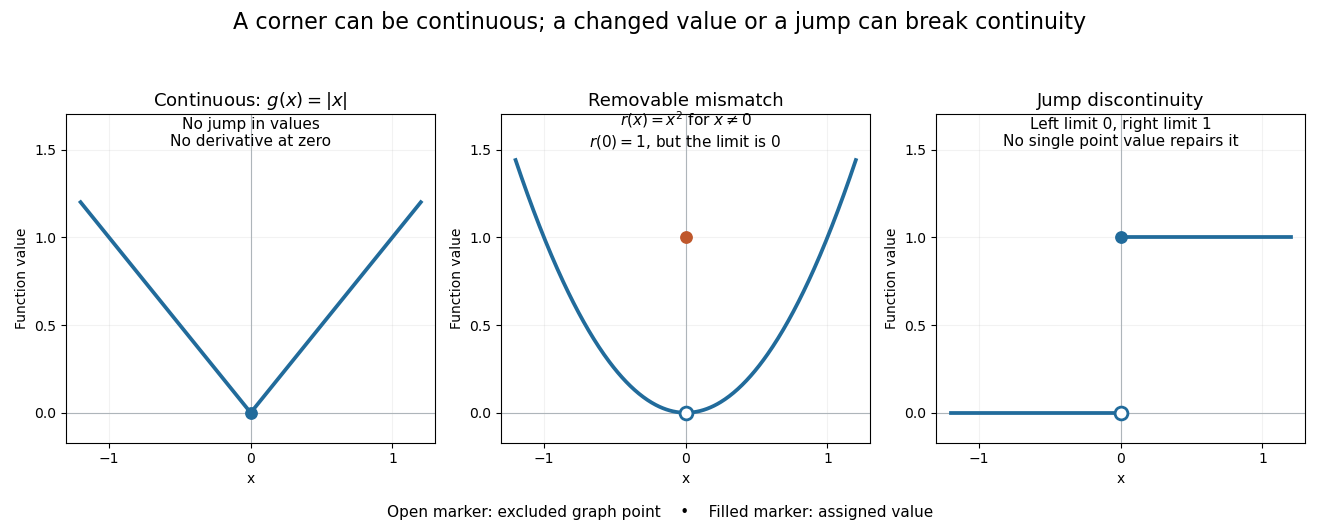
For a removable discontinuity, considerThe limit at zero is , but . Replacing that one value by gives the continuous square function. The sequence makes the mismatch visible: . A removable discontinuity can also describe an expression with a missing value, in which case the question is whether a continuous extension to the missing input exists.
For a jump discontinuity, take for and for . The left and right one-sided limits at zero are and . No assignment to can equal both, so changing only the point value cannot make the function continuous there. Contrast both examples with the corner of : that function is continuous at zero even though its derivative is absent.

New to topics? Read the docs here!