Equality slice of a feasible triangle
ID: equality-slice-of-a-feasible-triangle

Keep the feasible triangle with a squared-distance objective, but add the equation . An equality requires an exact relation, whereas an inequality allows a range. Here the equality selects a line, and intersecting that line with the original feasible region leaves just the line segment from to :The lower bound comes from ; the upper bound comes from . This is a nonempty closed set even though it has empty interior in the plane. An equality can reduce the dimension of the allowed decisions without making the feasible region empty.
The old optimum violates the added equality. On the surviving line segment, the objective function isThe derivative shows that the unique global minimum is at , giving and value . The nearest point on the entire equality line would be , at with value , but it violates . Both the equality and the original inequalities must hold simultaneously.
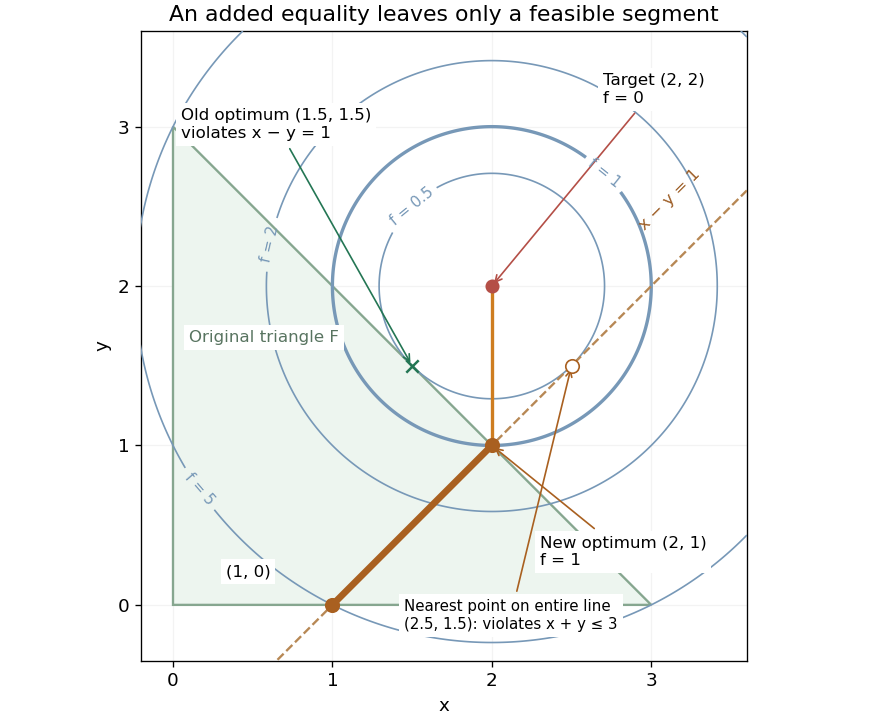
Equality slice of a feasible triangle: the allowed line segment ends at the optimum (2,1), while the nearest point on the entire line is infeasible
. Details. 
Use and to fix the multiplier sign convention in the optimization Lagrangian ; the Lagrange multipliers of and are again zero. At , Karush-Kuhn-Tucker conditions hold with and :The Lagrange multiplier of an equality has no nonnegativity restriction. For an independent global certificate, completing the square gives . On the feasible set, and , so , with equality exactly at .
New to topics? Read the docs here!