Take the decision domain and minimize the objective functionEach inequality permits a closed half-space; their intersection is the filled triangle with vertices , and , including its edges. The feasible region is a compact set and a convex set. The point is a feasible point, but its objective function value will not be best. Without the optimization constraints, the unique global minimum is at with value . That point is infeasible because .
The objective function is the squared Euclidean distance from . Its positive level sets are circles centered there. Expanding a circle from that center, the first contact with the feasible region is at , with objective function value . Thus the optimum is the Euclidean projection onto a convex set of the target . Squaring a nonnegative Euclidean distance preserves which point is nearest.[ref]
Convex Optimization by Stephen Boyd and Lieven Vandenberghe. §8.1.1, printed p. 398: squared Euclidean projection onto a polyhedron and half-space projection formula
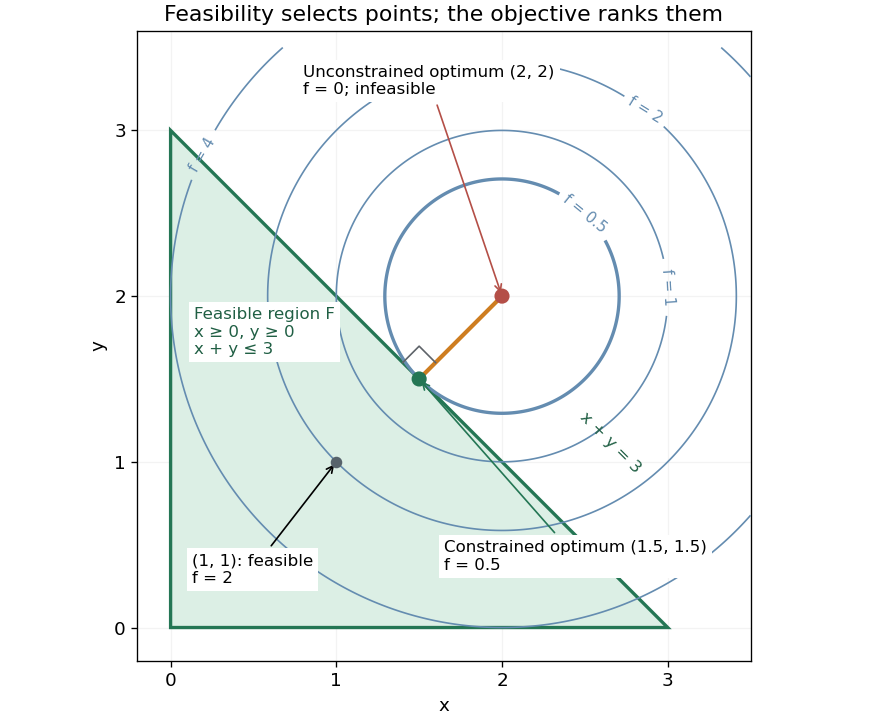
Feasible triangle with a squared-distance objective: the first attainable level set has value 0.5 at (1.5,1.5)
. Details. 
Here is a direct certificate, without relying on the picture. Put and . The objective function becomesEquality requires and , so the unique optimum is . At this point is an active constraint, while and are strict. An active constraint identifies a tight restriction at a specified point; it alone does not establish optimality. For example, has the same tight sum restriction but objective function value .
For a check using the Karush-Kuhn-Tucker conditions, write the inequalities as , , . Their Lagrange multipliers at the optimum are . The gradient equation isFeasibility, nonnegative Lagrange multipliers and complementary slackness also hold. With this strictly convex function and affine optimization constraints, the Karush-Kuhn-Tucker conditions certify the unique global minimum.[ref]
Convex Optimization by Stephen Boyd and Lieven Vandenberghe. §5.5.3, printed pp. 243–244, equation (5.49) and sufficiency for convex problems
Articles by others on the same topic
There are currently no matching articles.