Error-function diffusion front
ID: error-function-diffusion-front

Consider the one-dimensional diffusion equation on the whole real line,with initial value one for and zero for . This is an idealized Heaviside step function profile, not a measured material or an apparatus specification. The heat kernel gives a convolution with the initial profile:The change of variables turns the convolution into a Gaussian integral tail. The resulting similarity variable shows that the transition width grows like : multiplying elapsed time by four doubles every fixed-profile distance from the original interface.
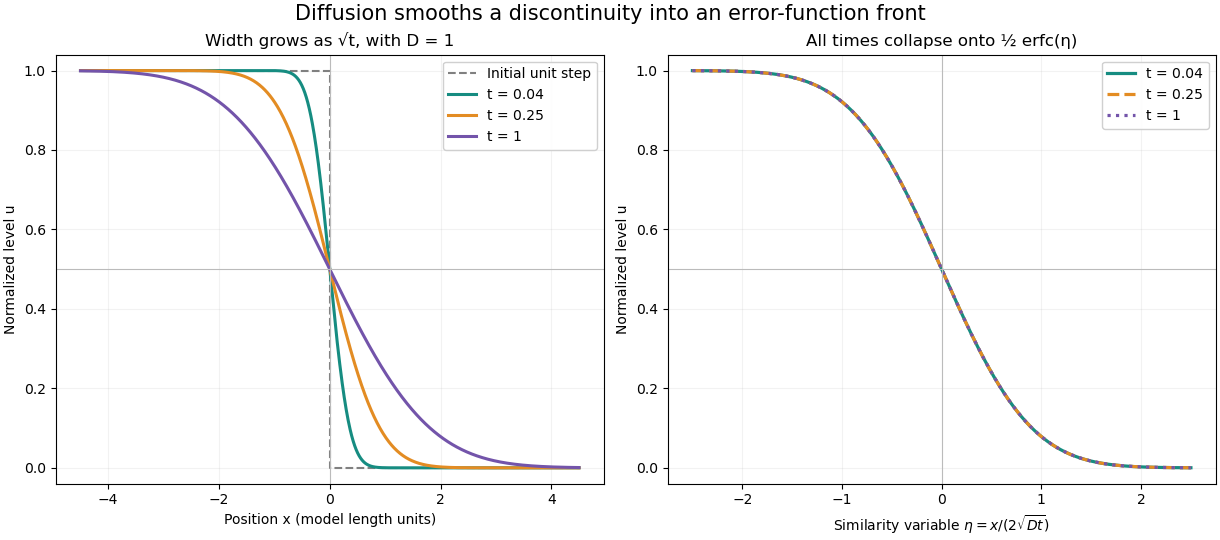

At every positive time, , while as and as . For every fixed , the limit as returns the specified initial value. The value assigned at the single initial discontinuity does not change this convolution. The error function therefore explains smoothing without pretending that a discontinuous initial profile remains sharp.
Direct differentiation checks the partial differential equation. Writing givesThe model assumes constant diffusion coefficient, no advection, and no finite-domain boundary effects. For an interpretation as heat conduction, the heat equation applies to a normalized temperature difference under its own material assumptions.
New to topics? Read the docs here!